


Hopes and Limits of Adipose-Derived Stem Cells (ADSCs) and Mesenchymal Stem Cells (MSCs) in Wound Healing
- PMID: 32075181
- PMCID: PMC7072889
- DOI: 10.3390/ijms21041306
Hopes and Limits of Adipose-Derived Stem Cells (ADSCs) and Mesenchymal Stem Cells (MSCs) in Wound Healing
Abstract
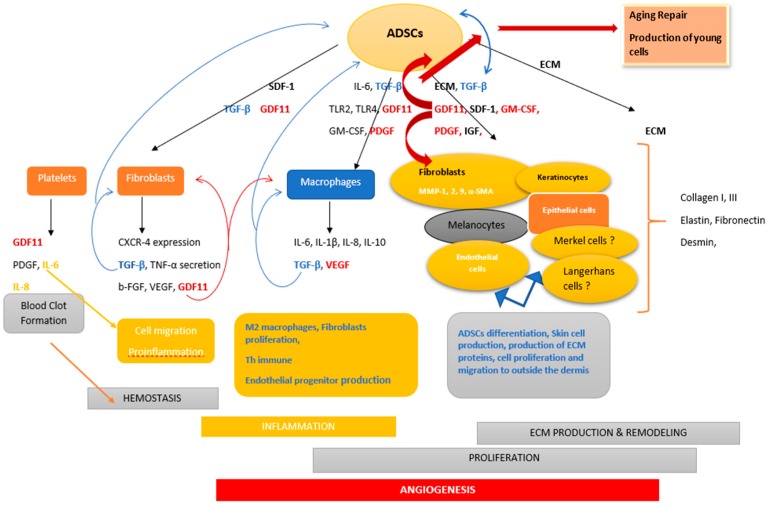
Adipose tissue derived stem cells (ADSCs) are mesenchymal stem cells identified within subcutaneous tissue at the base of the hair follicle (dermal papilla cells), in the dermal sheets (dermal sheet cells), in interfollicular dermis, and in the hypodermis tissue. These cells are expected to play a major role in regulating skin regeneration and aging-associated morphologic disgraces and structural deficits. ADSCs are known to proliferate and differentiate into skin cells to repair damaged or dead cells, but also act by an autocrine and paracrine pathway to activate cell regeneration and the healing process. During wound healing, ADSCs have a great ability in migration to be recruited rapidly into wounded sites added to their differentiation towards dermal fibroblasts (DF), endothelial cells, and keratinocytes. Additionally, ADSCs and DFs are the major sources of the extracellular matrix (ECM) proteins involved in maintaining skin structure and function. Their interactions with skin cells are involved in regulating skin homeostasis and during healing. The evidence suggests that their secretomes ensure: (i) The change in macrophages inflammatory phenotype implicated in the inflammatory phase, (ii) the formation of new blood vessels, thus promoting angiogenesis by increasing endothelial cell differentiation and cell migration, and (iii) the formation of granulation tissues, skin cells, and ECM production, whereby proliferation and remodeling phases occur. These characteristics would be beneficial to therapeutic strategies in wound healing and skin aging and have driven more insights in many clinical investigations. Additionally, it was recently presented as the tool key in the new free-cell therapy in regenerative medicine. Nevertheless, ADSCs fulfill the general accepted criteria for cell-based therapies, but still need further investigations into their efficiency, taking into consideration the host-environment and patient-associated factors.
Keywords: adipose derived stem cells; aging; differentiation; microenvironment; regeneration; rejuvenation; skin; wound healing.
Conflict of interest statement
The authors declare no conflict of interest. The funders had no role in the design of the study; in the collection, analyses, or interpretation of data; in the writing of the manuscript, or in the decision to publish the results.
Figures
References
-
- Jacobs S.A., Pinxteren J., Roobrouck V.D., Luyckx A., van’t Hof W., Deans R., Verfaillie C.M., Waer M., Billiau A.D., Van Gool S.W. Human multipotent adult progenitor cells are nonimmunogenic and exert potent immunomodulatory effects on alloreactive T-cell responses. Cell Transplant. 2013;22:1915–1928. doi: 10.3727/096368912X657369. - DOI - PubMed
-
- Vishnubalaji R., Al-Nbaheen M., Kadalmani B., Aldahmash A., Ramesh T. Comparative investigation of the differentiation capability of bone-marrow- and adipose-derived mesenchymal stem cells by qualitative and quantitative analysis. Cell Tissue Res. 2012;347:419–427. doi: 10.1007/s00441-011-1306-3. - DOI - PubMed
Publication types
MeSH terms
LinkOut - more resources
Full Text Sources
Other Literature Sources
Medical
Miscellaneous
