


Intratumor Heterogeneity and Therapy Resistance: Contributions of Dormancy, Apoptosis Reversal (Anastasis) and Cell Fusion to Disease Recurrence
- PMID: 32075223
- PMCID: PMC7073004
- DOI: 10.3390/ijms21041308
Intratumor Heterogeneity and Therapy Resistance: Contributions of Dormancy, Apoptosis Reversal (Anastasis) and Cell Fusion to Disease Recurrence
Abstract
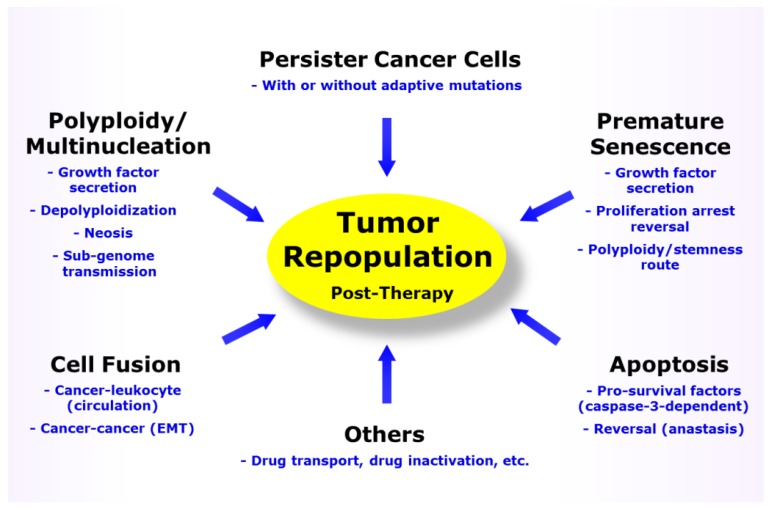
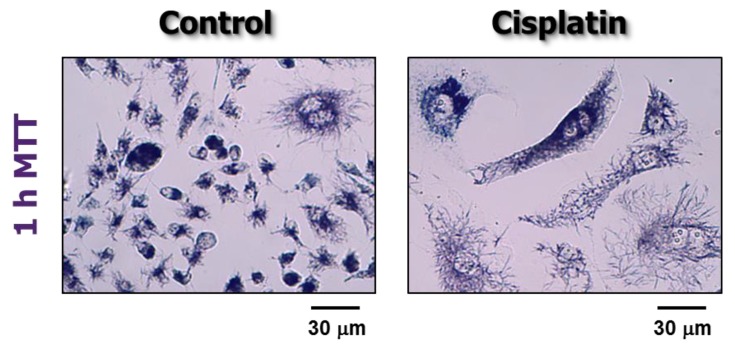
A major challenge in treating cancer is posed by intratumor heterogeneity, with different sub-populations of cancer cells within the same tumor exhibiting therapy resistance through different biological processes. These include therapy-induced dormancy (durable proliferation arrest through, e.g., polyploidy, multinucleation, or senescence), apoptosis reversal (anastasis), and cell fusion. Unfortunately, such responses are often overlooked or misinterpreted as "death" in commonly used preclinical assays, including the in vitro colony-forming assay and multiwell plate "viability" or "cytotoxicity" assays. Although these assays predominantly determine the ability of a test agent to convert dangerous (proliferating) cancer cells to potentially even more dangerous (dormant) cancer cells, the results are often assumed to reflect loss of cancer cell viability (death). In this article we briefly discuss the dark sides of dormancy, apoptosis, and cell fusion in cancer therapy, and underscore the danger of relying on short-term preclinical assays that generate population-based data averaged over a large number of cells. Unveiling the molecular events that underlie intratumor heterogeneity together with more appropriate experimental design and data interpretation will hopefully lead to clinically relevant strategies for treating recurrent/metastatic disease, which remains a major global health issue despite extensive research over the past half century.
Keywords: anastasis; apoptosis; cancer therapy; cell fusion; colony formation assay; dormancy; high-throughput assays; persister; polyploid giant cancer cells; senescence.
Conflict of interest statement
The authors declare no conflict of interest.
Figures
References
-
- Rubinstein L.V., Shoemaker R.H., Paull K.D., Simon R.M., Tosini S., Skehan P., Scudiero D.A., Monks A., Boyd M.R. Comparison of in vitro anticancer-drug-screening data generated with a tetrazolium assay versus a protein assay against a diverse panel of human tumor cell lines. J. Natl. Cancer Inst. 1990;82:1113–1118. doi: 10.1093/jnci/82.13.1113. - DOI - PubMed
Publication types
MeSH terms
Substances
LinkOut - more resources
Full Text Sources
Medical
Miscellaneous
