


Carbapenemase-producing Enterobacteriaceae circulating in the Reunion Island, a French territory in the Southwest Indian Ocean
- PMID: 32075697
- PMCID: PMC7031992
- DOI: 10.1186/s13756-020-0703-3
Carbapenemase-producing Enterobacteriaceae circulating in the Reunion Island, a French territory in the Southwest Indian Ocean
Abstract
Background: The spread of carbapenemase-producing Enterobacteriaceae (CPE) in the Southwest Indian Ocean area (SIOA) is poorly documented. Reunion Island is a French overseas territory located close to Madagascar and connected with Southern Africa, Indian sub-continent and Europe, with several weekly flights. Here we report the results of the CPE surveillance program in Reunion Island over a six-year period.
Methods: All CPE were collected between January 2011 and December 2016. Demographics and clinical data of the carrier patients were collected. We determined their susceptibility to antimicrobials, identified the carbapenemases and ESBL by PCR and sequencing, and explored their genetic relationship using pulsed-field gel electrophoresis and multi-locus sequence typing.
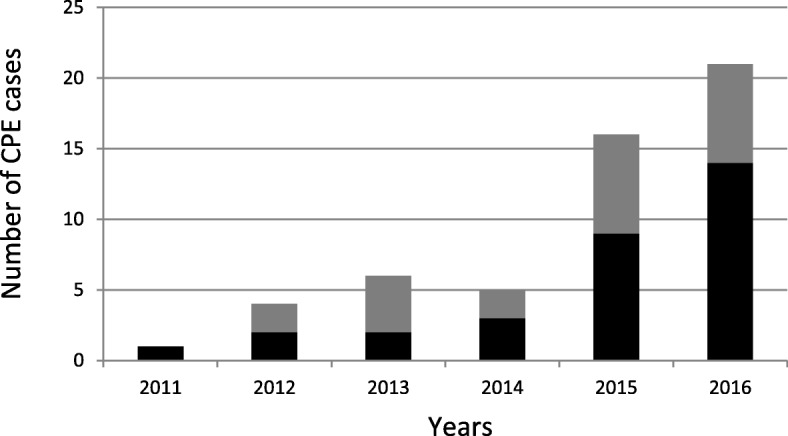
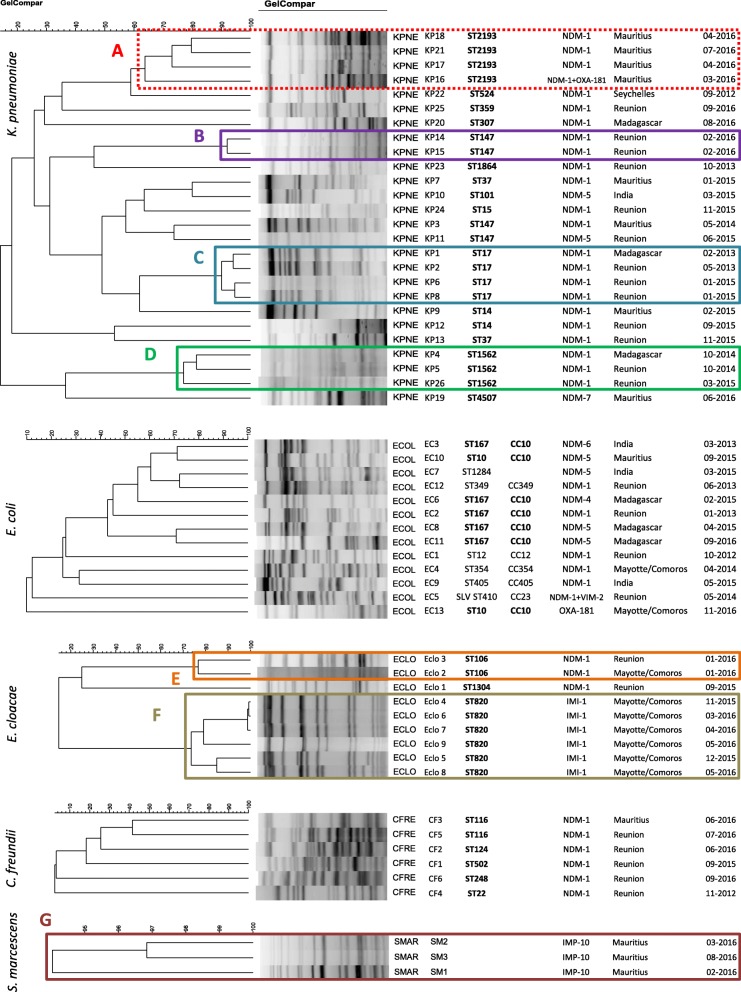
Results: A total of 61 CPEs isolated from 53 patients were retrieved in 6 public or private laboratories of the island. We found that 69.8% of CPE patients were linked to a foreign country of SIOA and that almost half of CPE cases (47.2%) reached the island through a medical evacuation. The annual number of CPE cases strongly increased over the studied period (one case in 2011 vs. 21 cases in 2016). A proportion of 17.5% of CPE isolates were non-susceptible to colistin. blaNDM was the most frequent carbapenemase (79.4%), followed by blaIMI (11.1%), and blaIMP-10 (4.8%). Autochtonous CPE cases (30.2%) harboured CPE isolates belonging to a polyclonal population.
Conclusions: Because the hospital of Reunion Island is the only reference healthcare setting of the SIOA, we can reasonably estimate that its CPE epidemiology reflects that of this area. Mauritius was the main provider of foreign CPE cases (35.5%). We also showed that autochthonous isolates of CPEs are mostly polyclonal, thus unrelated to cross-transmission. This demonstrates the local spread of carbapenemase-encoding genes (i.e. blaNDM) in a polyclonal bacterial population and raises fears that Reunion Island could contribute to the influx of NDM-carbapenemase producers into the French mainland territory.
Keywords: Carbapenemase; Epidemiology; French overseas territory; Indian Ocean; NDM; Reunion Island.
Conflict of interest statement
None declared.
Figures
References
-
- Albiger B, Glasner C, Struelens MJ, Grundmann H, Monnet DL. the European Survey of Carbapenemase-Producing Enterobacteriaceae (EuSCAPE) working group. Carbapenemase-producing Enterobacteriaceae in Europe: assessment by national experts from 38 countries, May 2015. Euro Surveill. 2015;20(45). - PubMed
Publication types
MeSH terms
Substances
LinkOut - more resources
Full Text Sources
Research Materials
Miscellaneous
