. 2020 Mar 11;27(3):376-388.e8.
doi: 10.1016/j.chom.2020.01.010. Epub 2020 Feb 18.

Xenosiderophore Utilization Promotes Bacteroides thetaiotaomicron Resilience during Colitis

Affiliations

Xenosiderophore Utilization Promotes Bacteroides thetaiotaomicron Resilience during Colitis

Wenhan Zhu et al. Cell Host Microbe. .

Abstract

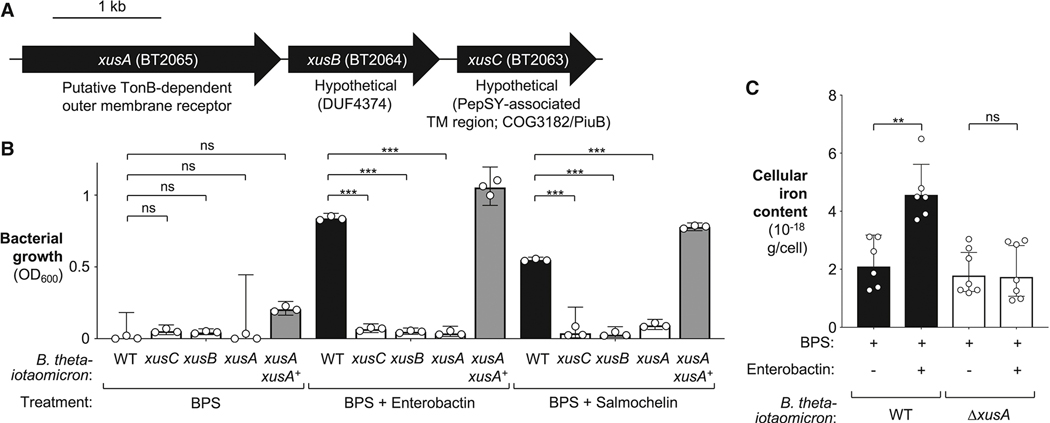
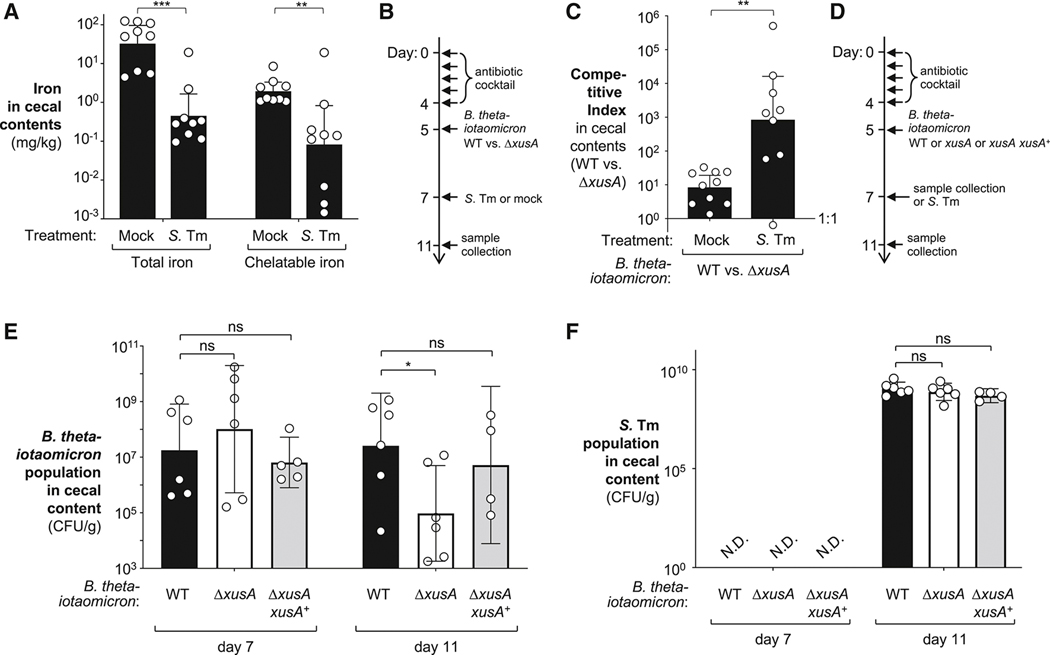
During short-lived perturbations, such as inflammation, the gut microbiota exhibits resilience and reverts to its original configuration. Although microbial access to the micronutrient iron is decreased during colitis, pathogens can scavenge iron by using siderophores. How commensal bacteria acquire iron during gut inflammation is incompletely understood. Curiously, the human commensal Bacteroides thetaiotaomicron does not produce siderophores but grows under iron-limiting conditions using enterobacterial siderophores. Using RNA-seq, we identify B. thetaiotaomicron genes that were upregulated during Salmonella-induced gut inflammation and were predicted to be involved in iron uptake. Mutants in the xusABC locus (BT2063-2065) were defective for xenosiderophore-mediated iron uptake in vitro. In the normal mouse gut, the XusABC system was dispensable, while a xusA mutant colonized poorly during colitis. This work identifies xenosiderophore utilization as a critical mechanism for B. thetaiotaomicron to sustain colonization during inflammation and suggests a mechanism of how interphylum iron metabolism contributes to gut microbiota resilience.

Keywords: bacteroidetes; gut inflammation; gut microbiota resilience; iron metabolism; siderophore.


Conflict of interest statement

Declaration of Interests The corresponding author (S.E.W.) is listed as an inventor on patent application WO2014200929A1, which describes a treatment to prevent the inflammation-associated expansion of Enterobacteriaceae. The other authors declare no competing interests.

Figures

Figure 1:
Figure 1:. Changes in the B. thetaiotaomicron transcriptome in response to Salmonella infection.
(A – C) Groups of gnotobiotic Swiss Webster mice were colonized with C. symbiosum ATCC14940 and B. thetaiotaomicron VPI-5482 Δtdk for 7 days. Mice were either intragastrically inoculated with S. Tm IR715 (N = 5) or remained uninfected (N = 5) for 2 days, and the cecal content was collected and the bacterial transcriptome assessed using RNA-seq. (A) Schematic representation of the experiment. (B) Principle coordinate plot of the B. thetaiotaomicron transcriptomes in mock-treated (black circles) and S. Tm-infected mice (red). (C) Volcano plot of differentially expressed genes in B. thetaiotaomicron in response to S. Tm infection. Genes downregulated by more than a 4-fold and P < 0.05 are shown in blue, genes upregulated by the same criteria are shown in red. Gene with predicted functions in iron metabolism are indicated by their gene locus number. See also Fig. S3.
Figure 2:
Figure 2:. Utilization of enterobacterial siderophores by Bacteroides strains in vitro.
(A) B. thetaiotaomicron VPI-5482 Δtdk or S. Tm SL1344 were anaerobically cultured in haemin-containing tryptone yeast extract glucose (TYG) medium in the presence or absence of 200 μmol/L of iron chelator bathophenanthroline disulfonate (BPS) for 36 hours. Bacterial growth was assessed by measuring optical density of the culture at a wavelength of 600 nm (OD600). (B – C) Bacteroides strains were cultured in haemin-supplemented TYG medium before being subcultured in iron-limited (200 μmol/L of BPS) TYG medium supplemented with either 0.5 μM aerobactin, 0.5 μM 2,3-dihydroxybenzoic acid (2,3-DHBA), 0.5 μM enterobactin, or 2 μM salmochelin. Growth of B. thetaiotaomicron (B) and Bacteroides mouse isolates (C) was determined by measuring the optical density. See also Fig. S1–3. Bars represent the geometric mean ± 95% confidence interval. *, P < 0.05; **, P < 0.01 ***, P < 0.001; ns, not statistically significant.
Figure 3:
Figure 3:. Role of the B. thetaiotaomicron xusABC operon in xenosiderophore uptake in vitro.
(A). Schematic representation of the xusABC operon in B. thetaiotaomicron VPI-5482. (B) The indicated B. thetaiotaomicron strains were cultured in iron-limiting TYG medium supplemented with siderophores for 36 hours. The chelator bathophenanthroline disulfonate (BPS) was added at a concentration of 200 μmol/L. Enterobactin or salmochelin (50% iron saturation) were added at a final concentration of 0.5 μM and 2 μM, respectively. Growth was assessed by measuring optical density (OD600). (C) The B. thetaiotaomicron wild-type strain and an isogenic xusA mutant were cultured in iron-deprived media to exhaust endogenous iron before being subcultured in the presence of iron-laden enterobactin or vehicle. Inductively Coupled Plasma Mass Spectrometry was used to assess cellular iron levels. Bars represent the geometric mean ± 95% confidence interval. **, P < 0.01 ***, P < 0.001; ns, not statistically significant.
Figure 4:
Figure 4:. Role of xusABC locus in B. thetaiotaomicron colonization during murine S. Tm infection.
(A) Groups of streptomycin-treated C57BL/6 mice were either mock-treated (N = 9) or intragastrically inoculated with S. Tm SL1344 (N = 9). Four days after infection, the cecal contents were collected and separated into the chelatable and inaccessible iron fraction. The iron concentration was determined by ICP-MS. (B – C) Groups of C57BL/6 mice were treated with a cocktail of antibiotics, followed by intragastrical inoculation of an equal mixture of B. thetaiotaomicron wild-type strain (genomic signature tag 3; WZ433) and a xusA mutant (genomic signature tag 13; WZ647). Mice were mock-treated (LB, N = 10) or challenged with S. Tm SL1344 (N = 9) for 4 days. The abundance of each B. thetaiotaomicron strain in cecal contents was determined using qPCR targeting strain-specific signature tags. The competitive index was calculated as the ratio of the two strains in the cecal content, corrected by the ratio in the inoculum. A schematic representation of the experiment is shown in (B). Competitive index of B. thetaiotaomicron wild-type over xusA mutant in cecal contents (C). (D – F) Groups of C57BL/6 mice were treated with a cocktail of antibiotics, followed by intragastrical inoculation of either the B. thetaiotaomicron wild-type strain (Δtdk, GenR; N = 12), an isogenic xusA mutant (WZ777, GenR CmR, N = 12), or a complemented xusA mutant (WZ675, xusA xusA+, N = 9). After two days, half of the animals in each group were euthanized to assess the colonization levels of these strains at homeostatic conditions, while the remaining groups were challenged with S. Tm SL1344 for 4 days. A schematic representation of the experiment is shown in (D). Abundance of indicated B. thetaiotaomicron (E) and S. Tm (F) strains in cecal contents as determined by plating on selective agar. See also Fig. S4–6. Bars represent the geometric mean ± 95% confidence interval. *, P < 0.05; **, P < 0.01; ***; P < 0.001; ns, not statistically significant.
Figure 5:
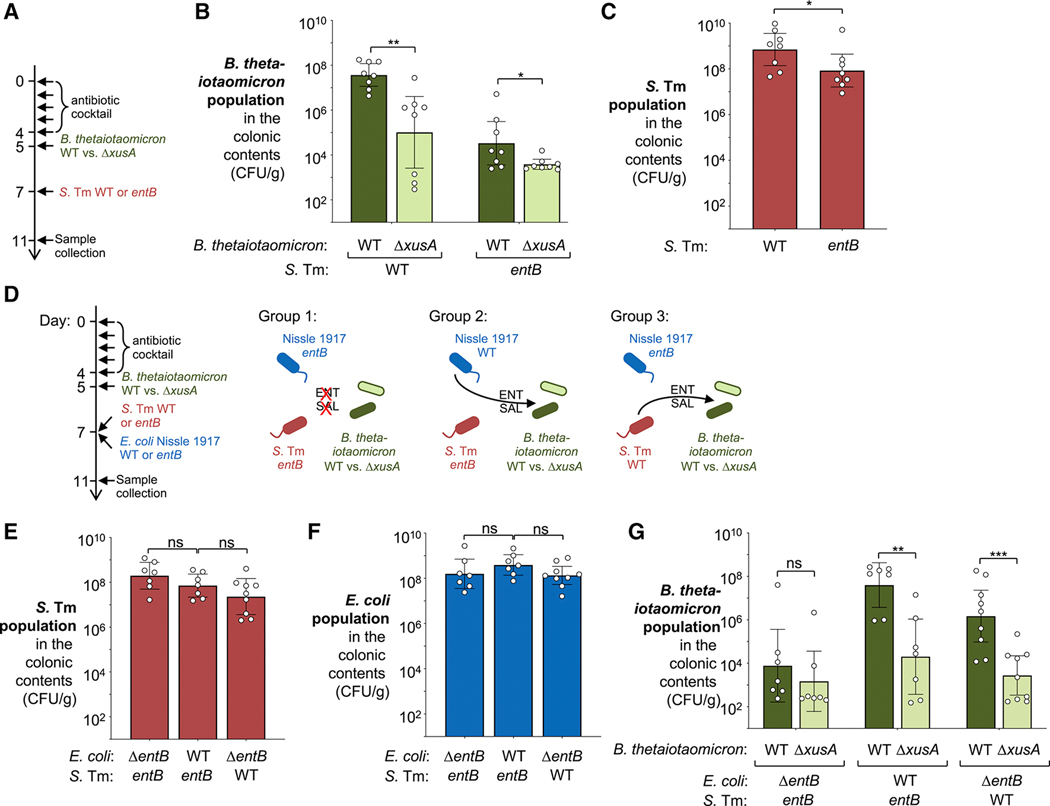
Figure 5:. Contribution of enterobacterial siderophores to B. thetaiotaomicron fitness during infectious colitis.
(AC) Groups of C57BL/6 mice were treated with a cocktail of antibiotics, followed by intragastrical inoculation of an equal mixture of the B. thetaiotaomicron wild-type strain (Δtdk, GenR) and a xusA mutant (WZ777, GenR CmR). Mice were then intragastrically inoculated with either S. Tm wild-type strain (SL1344; N = 8) or an entB mutant (WZ818; N = 8). (A) Schematic representation of the experiment. Four days after the S. Tm challenge, the abundance of B. thetaiotaomicron (B) and S. Tm (C) populations in the colonic contents was determined by plating on selective agar. (D – G) Groups of Lcn2-/mice were treated with a cocktail of antibiotics, followed by intragastrical inoculation of an equal mixture of the B. thetaiotaomicron wild-type strain (Δtdk, GenR) and a xusA mutant (WZ777, GenR CmR). Mice were then intragastrically inoculated with either an equal mixture of an S. Tm entB mutant (AR1258) and an E. coli Nissle 1917 entB mutant (WZ780) (N = 7, group 1), an equal mixture of an S. Tm entB mutant and the Nissle 1917 wild-type strain (WZ36) (N = 7, group 2), or an equal mixture of the S. Tm wild-type strain (IR715) and the Nissle 1917 entB mutant (WZ780) (N = 9, group 3). (D) Schematic representation of the experiment. Four days after the S. Tm challenge, the abundance of S. Tm (E), E. coli (F), and B. thetaiotaomicron (G) populations in the colonic contents was determined by plating on selective agar. See also Fig. S4. Bars represent the geometric mean ± 95% confidence interval. *, P < 0.05; **, P < 0.01; ***; P < 0.001; ns, not statistically significant.
Figure 6:
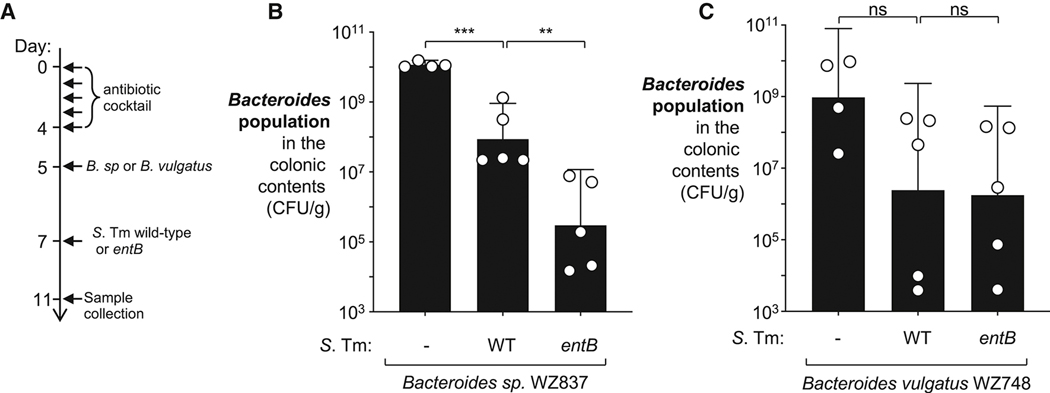
Figure 6:. Contribution of siderophore utilization to fitness of Bacteroides isolates in vivo.
(A – E) Groups of C57BL/6 mice were treated with a cocktail of antibiotics, followed by intragastrical inoculation of B. sp (WZ837, GenR) or B. vulgatus (WZ748, GenR). Groups of mice either remained untreated (N = 4), or were intragastrically inoculated with the S. Tm wild-type strain (N = 5) or a S. Tm entB mutant (WZ818, N = 5). (A) Schematic representation of the experiment. Four days after the S. Tm inoculation, the abundance of B. sp (B) and B. vulgatus (C) populations in the colonic contents was determined by plating on selective agar. Bars represent the geometric mean ± 95% confidence interval. **, P < 0.01; ***, P < 0.001; ns, not statically significant.
Figure 7:
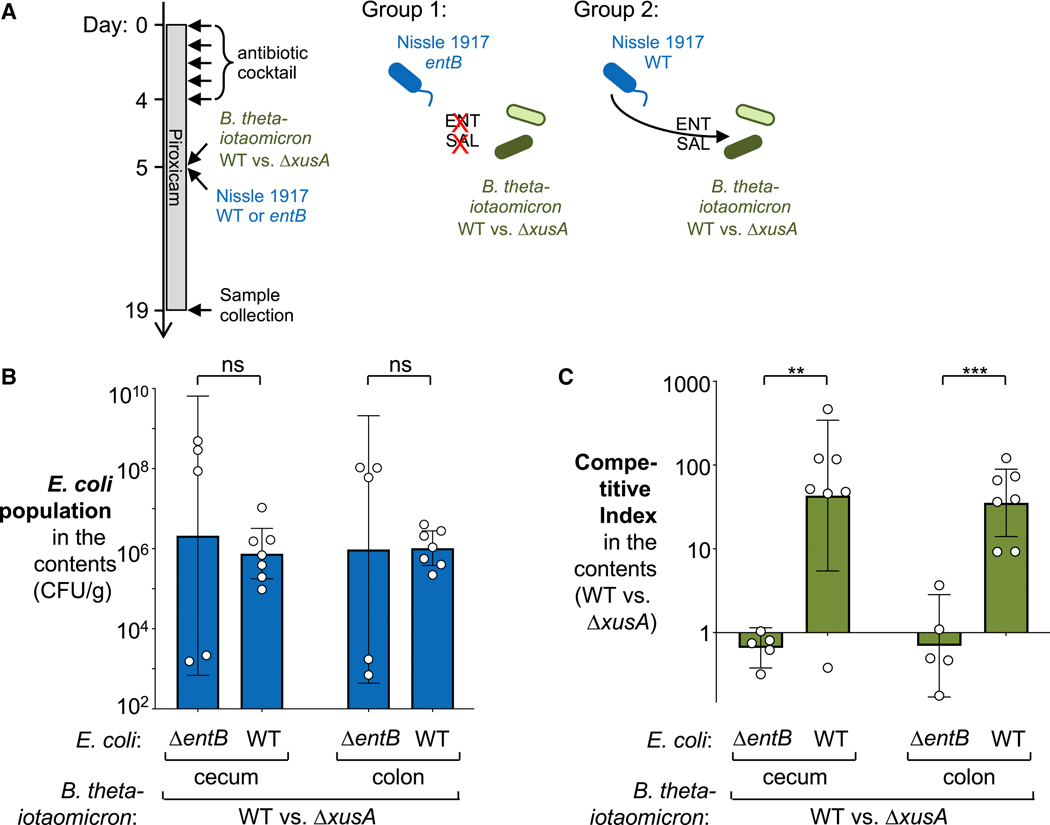
Figure 7:. Contribution of Enterobacterial siderophores to B. thetaiotaomicron fitness during non-infectious colitis.
(A – C) Groups of Il10−/− mice were treated with a cocktail of antibiotics to allow stable engraftment of B. thetaiotaomicron. Piroxicam was administered in the mouse diet throughout the experiment. Mice were intragastrically inoculated with an equal mixture of B. thetaiotaomicron wild-type strain (Δtdk, GenR) and a xusA mutant (WZ777, GenRCmR), plus a Nissle 1917 entB mutant (WZ780) (N = 5, group 1) or the same B. thetaiotaomicron mixture plus the Nissle 1917 wild-type strain (WZ36) (N = 7, group 2). Fourteen days after bacterial inoculation, Nissle 1917 and B. thetaiotaomicron abundance in intestinal contents was determined by plating on selective agar. (A) Schematic representation of the experiment. (B) E. coli population in intestinal content. (C) Competitive index of B. thetaiotaomicron wild-type over xusA mutant in intestinal content. See also Fig. S7. Bars represent the geometric mean ± 95% confidence interval. **, P < 0.01 ***, P < 0.001; ns, not statistically significant.

References

    1. Anderson MT, Mitchell LA, Zhao L, and Mobley HLT (2017). Capsule Production and Glucose Metabolism Dictate Fitness during Serratia marcescens Bacteremia. MBio. 8(3). Published online 2017/05/26 DOI: 10.1128/mBio.00740-17. - DOI - PMC - PubMed
    1. Arpaia N, Campbell C, Fan X, Dikiy S, van der Veeken J, deRoos P, Liu H, Cross JR, Pfeffer K, Coffer PJ, et al. (2013). Metabolites produced by commensal bacteria promote peripheral regulatory T-cell generation. Nature. 504(7480), 451–455. Published online 2013/11/15 DOI: 10.1038/nature12726. - DOI - PMC - PubMed
    1. Arthur JC, Perez-Chanona E, Muhlbauer M, Tomkovich S, Uronis JM, Fan TJ, Campbell BJ, Abujamel T, Dogan B, Rogers AB, et al. (2012). Intestinal inflammation targets cancer-inducing activity of the microbiota. Science. 338(6103), 120–123. Published online 2012/08/21 DOI: 10.1126/science.1224820. - DOI - PMC - PubMed
    1. Bacchetti De Gregoris T, Aldred N, Clare AS, and Burgess JG (2011). Improvement of phylum- and class-specific primers for real-time PCR quantification of bacterial taxa. J Microbiol Methods. 86(3), 351–356. Published online 2011/06/28 DOI: 10.1016/j.mimet.2011.06.010. - DOI - PubMed
    1. Baumler AJ, Norris TL, Lasco T, Voight W, Reissbrodt R, Rabsch W, and Heffron F. (1998). IroN, a novel outer membrane siderophore receptor characteristic of Salmonella enterica. J Bacteriol. 180(6), 1446–1453. Published online 1998/03/27. - PMC - PubMed

Publication types