


Objectively measured near work, outdoor exposure and myopia in children
- PMID: 32075819
- PMCID: PMC7587221
- DOI: 10.1136/bjophthalmol-2019-315258
Objectively measured near work, outdoor exposure and myopia in children
Abstract
Aim: To reassess the association between near work, outdoor exposure and myopia in children through an objective approach.
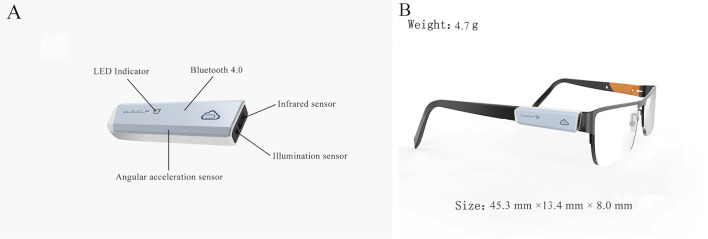
Methods: Eighty-six children (10.13±0.48 years) were asked to wear Clouclip, a newly developed wearable device that is able to measure working distance and eye-level illuminance, for a complete week to obtain information on near work and outdoor exposure. The mean daily Clouclip wearing time was 11.72±1.14 hour. The spherical equivalent refraction was determined by cycloplegic autorefraction.
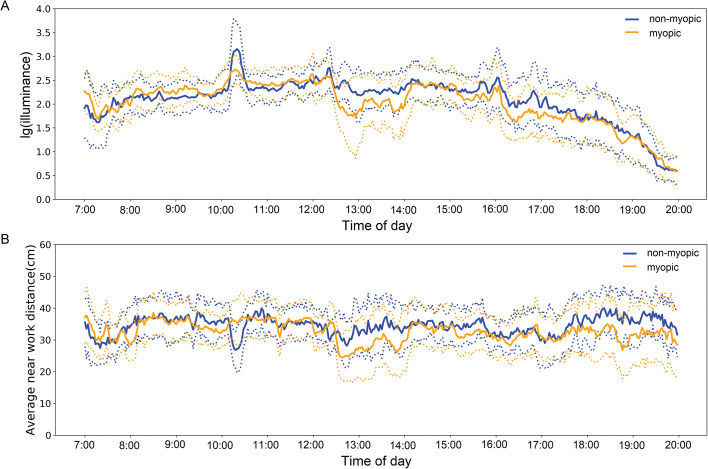
Results: The myopic children were found to be exposed to light intensities >3000 lux (0.68±0.50 hour vs 1.02±0.53 hour, p=0.012) and >5000 lux (0.42±0.35 hour vs 0.63±0.31 hour, p=0.004) for shorter durations on average each day than the non-myopic children. Additionally, the myopic children spent more time on average each day on activities at a distance of <20 cm than non-myopic children (1.89±0.61 hour vs 1.52±0.77 hour, p=0.019). In the multivariate logistic analysis, the time spent with a higher light intensity (>3000 lux (OR=0.27, 95% CI: 0.10 to 0.72, p=0.009); >5000 lux (OR=0.11, 95% CI: 0.02 to 0.56, p=0.008)) and a working distance of <20 cm (in a circumstance of >3000 lux (OR=1.17, 95% CI: 1.09 to 1.86, p=0.038) or in that of >5000 lux (OR=1.12, 95% CI: 1.03 to 1.77, p=0.046)) were the independent protective factors and risk factors, respectively.
Conclusion: The current study provides novel evidence, based on objective data, to support the association between the intensity of near work, light intensity and myopia. However, the causality and the dose-effect relationship need to be investigated further.
Keywords: epidemiology; optics and refraction.
© Author(s) (or their employer(s)) 2020. Re-use permitted under CC BY-NC. No commercial re-use. See rights and permissions. Published by BMJ.
Conflict of interest statement
Competing interests: None declared.
Figures
References
Publication types
MeSH terms
LinkOut - more resources
Full Text Sources
