Review
. 2019 Dec 2;10(3):1703-1721.
doi: 10.1002/ece3.5754. eCollection 2020 Feb.

Metacommunity theory for transmission of heritable symbionts within insect communities

Affiliations
Review

Metacommunity theory for transmission of heritable symbionts within insect communities

Joel J Brown et al. Ecol Evol. .

Abstract

Microbial organisms are ubiquitous in nature and often form communities closely associated with their host, referred to as the microbiome. The microbiome has strong influence on species interactions, but microbiome studies rarely take interactions between hosts into account, and network interaction studies rarely consider microbiomes. Here, we propose to use metacommunity theory as a framework to unify research on microbiomes and host communities by considering host insects and their microbes as discretely defined "communities of communities" linked by dispersal (transmission) through biotic interactions. We provide an overview of the effects of heritable symbiotic bacteria on their insect hosts and how those effects subsequently influence host interactions, thereby altering the host community. We suggest multiple scenarios for integrating the microbiome into metacommunity ecology and demonstrate ways in which to employ and parameterize models of symbiont transmission to quantitatively assess metacommunity processes in host-associated microbial systems. Successfully incorporating microbiota into community-level studies is a crucial step for understanding the importance of the microbiome to host species and their interactions.

Keywords: bacteria; dispersal; heritable; insect; metacommunity; microbiome; species interactions; symbiont; transmission.


Conflict of interest statement

The authors declare no known conflict of interest regarding the publication of this manuscript.

Figures
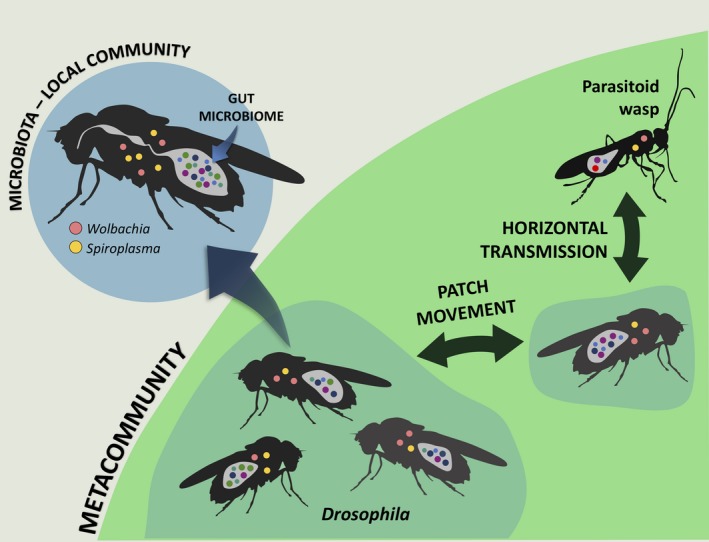
Figure 1
Figure 1
Applying the metacommunity concept to microbial communities of insects, in this case a community of hosts (Drosophila) and parasitoids. Each individual insect is a “patch” that harbors a local community of endosymbiotic bacteria. The green area represents the regional metacommunity of hosts. Bacteria can be present both within the gut and inside host cells and hemolymph (with Wolbachia and Spiroplasma as specific examples of the latter category). Differently colored circles within an insect each represent a different bacterial genus. Arrows indicate horizontal transmission (dispersal) of bacteria among local communities (host microbiomes). This diagram represents one of multiple ways to apply metacommunity theory to host–symbiont systems; see Table 1 scenarios B‐E for alternative approaches
Figure 2
Figure 2
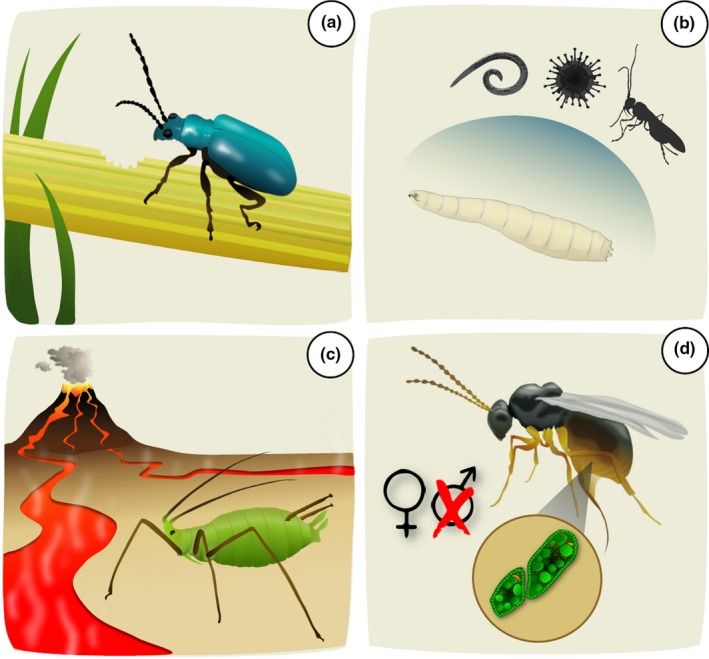
Representative examples of how microbial symbionts influence insect host ecology, physiology, and health. (a) novel symbioses can facilitate host insect feeding on a new food source; (b) the presence of specific microbes can protect a host against natural enemies such as parasitoids, fungi, and nematodes; (c) symbionts can modify host thermal tolerance in both positive and negative ways; and (d) some symbionts, like Wolbachia and Spiroplasma, manipulate host sex ratios by male‐killing, genetic feminization, and by inducing cytoplasmic incompatibility
Figure 3
Figure 3
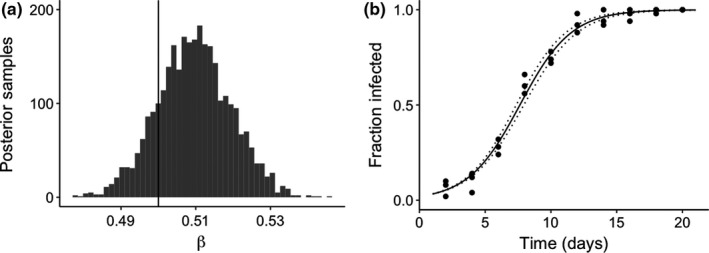
Graphs represent fitting a simple susceptible‐infected (SI) model to hypothetical experimental data. In this experiment, a single‐infected host was released in a population of 49 susceptible hosts, and this was replicated across three host populations. Symbiont transmission occurs horizontally, from infected individuals to susceptible individuals. We simulated the data based on the SI model, adding observation error, and setting the transmission rate to 0.50 day−1 host−1. The model was then fit to the synthetic data with Stan using 3 Hamiltonian Monte Carlo chains, with a 2,000 iteration warm‐up period, and 5,000 total iterations, thinning by 3. A vague prior (N(0, 5)) was used for the transmission rate. (a) Marginal posterior estimate of transmission rate, with vertical line delineating the true parameter value (0.50). (b) Fit of the model (median and 95% credible interval) to time‐series data of the fraction of the population infected, where the three populations were sampled every 2 days of the experiment
Figure 4
Figure 4
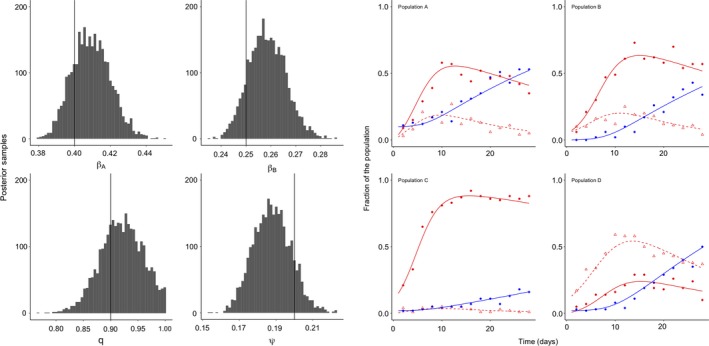
Fitting the two symbionts—one host species SI model to synthetic data, from Box 2 “Multisymbiont model and experiment” section. Four populations of 100 hosts were exposed to variable initial numbers of hosts infected with symbiont A (closed red circles, red line), symbiont B (open red triangles, dashed red line), or coinfected with both symbionts (closed blue circles, blue line). Experimentally manipulating the initial conditions enables us to estimate the parameters with more power, because we observe more variable dynamics in the system. Specifically, the initial conditions for each simulated population (S0,IA0,IB0,X0) are as follows: (a) 90, 0, 0, 10; (b) 90, 5, 5, 0; (c) 88, 10, 0, 2; (d) 88, 0, 10, 2. We chose these values to demonstrate that the transient dynamics of the model are influenced by subtle changes to initial conditions, and we should see these dynamics reflected in the experimental data. Again, the model was fit to the synthetic data with Stan using vague priors for each of the four parameters, and 5,000 total sampling iterations. Graphs in the left‐hand panel show the marginal posterior samples for each parameter, with the vertical line delineating the true parameter value. To reiterate, the parameters are as follows: βA and βB are the transmission rates of the two symbionts, respectively; q modulates the likelihood that susceptible hosts become infected through contact with coinfected hosts (i.e., q=1 would mean that there was an equal likelihood of susceptible hosts being infected by single‐ or coinfected hosts); and ψ modulates the likelihood that single‐infected hosts will become coinfected by a secondary symbiont. Graphs in the right‐hand panel depict the simulated, synthetic data, where the fraction of hosts infected with one or both pathogens changes over time. The lines represent the median model predictions. Only median posterior model predictions are shown, for clarity

References

    1. Adair, K. L. , & Douglas, A. E. (2017). Making a microbiome: The many determinants of host‐associated microbial community composition. Current Opinion in Microbiology, 35, 23–29. 10.1016/j.mib.2016.11.002 - DOI - PubMed
    1. Adair, K. L. , Wilson, M. , Bost, A. , & Douglas, A. E. (2018). Microbial community assembly in wild populations of the fruit fly Drosophila melanogaster . ISME Journal, 12(4), 959–972. 10.1038/s41396-017-0020-x - DOI - PMC - PubMed
    1. Agrawal, A. A. , Ackerly, D. D. , Adler, F. , Arnold, A. E. , Cáceres, C. , Doak, D. F. , … Werner, E. (2007). Filling key gaps in population and community ecology. Frontiers in Ecology and the Environment, 5, 145–152. 10.1890/1540-9295(2007)5[145:FKGIPA]2.0.CO;2 - DOI
    1. Ahmed, M. Z. , Li, S.‐J. , Xue, X. , Yin, X.‐J. , Ren, S.‐X. , Jiggins, F. M. , … Qiu, B.‐L. (2015). The intracellular bacterium Wolbachia uses parasitoid wasps as phoretic vectors for efficient horizontal transmission. PLoS Path, 11, e1004672 10.1371/journal.ppat.1004672 - DOI - PMC - PubMed
    1. Anderson, R. M. , & May, R. M. (1979). Population biology of infectious diseases: Part I. Nature, 280, 361–367. 10.1038/280361a0 - DOI - PubMed

LinkOut - more resources