The origin of life as a planetary phenomenon
- PMID: 32076638
- PMCID: PMC7002131
- DOI: 10.1126/sciadv.aax3419
The origin of life as a planetary phenomenon
Abstract
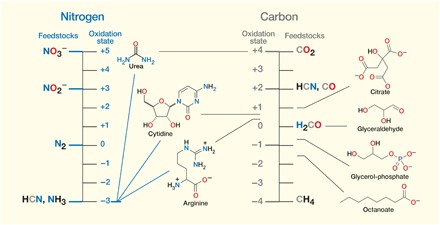
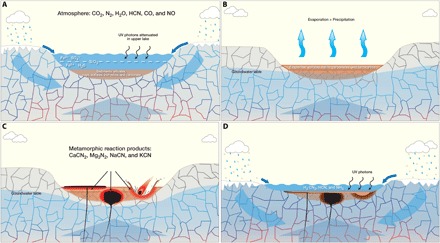
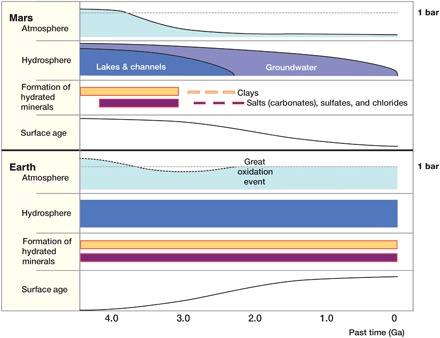
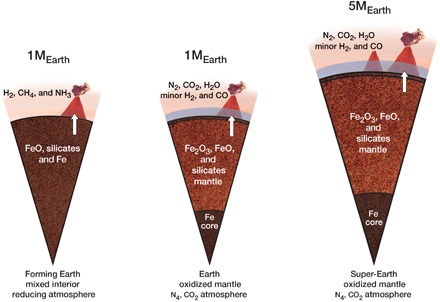
We advocate an integrative approach between laboratory experiments in prebiotic chemistry and geologic, geochemical, and astrophysical observations to help assemble a robust chemical pathway to life that can be reproduced in the laboratory. The cyanosulfidic chemistry scenario described here was developed by such an integrative iterative process. We discuss how it maps onto evolving planetary surface environments on early Earth and Mars and the value of comparative planetary evolution. The results indicate that Mars can offer direct evidence for geochemical conditions similar to prebiotic Earth, whose early record has been erased. The Jezero crater is now the chosen landing site for NASA's Mars 2020 rover, making this an extraordinary opportunity for a breakthrough in understanding life's origins.
Copyright © 2020 The Authors, some rights reserved; exclusive licensee American Association for the Advancement of Science. No claim to original U.S. Government Works. Distributed under a Creative Commons Attribution NonCommercial License 4.0 (CC BY-NC).
Figures
References
-
- Szostak J., The narrow road to the deep past: In search of the chemistry of the origin of life. Angew. Chem. Int. Ed. 56, 11037–11043 (2017). - PubMed
-
- Wilson S. A., Howard A. D., Moore J. M., Grant J. A., A cold-wet middle-latitude environment on Mars during the Hesperian-Amazonian transition. J. Geophys. Res. 121, 1667–1694 (2016).
-
- Ranjan S., Sasselov D. D., Constraints on the early terrestrial UV environment relevant to prebiotic chemistry. Astrobiology 17, 169–204 (2017). - PubMed
Publication types
Grants and funding
LinkOut - more resources
Full Text Sources
Miscellaneous