An official website of the United States government
The .gov means it’s official.
Federal government websites often end in .gov or .mil. Before
sharing sensitive information, make sure you’re on a federal
government site.
The site is secure.
The https:// ensures that you are connecting to the
official website and that any information you provide is encrypted
and transmitted securely.
1 Department of Radiology, NYU School of Medicine, 650 First Ave, New York, NY 10016 (F.K., M.J.M., M.B., M.P., K.J.G., J.K., H.C., D.W., N.Y., M.P.R., D.K.S., Y.W.L.); Department of Artificial Intelligence Research, Facebook, Menlo Park, Calif (J.Z., A.S., J.P., E.O., C.L.Z.); Department of Artificial Intelligence Research, Facebook, New York, NY (A.D.); Center for Data Science, New York University, New York, NY (K.J.G.); Department of Artificial Intelligence Research, Facebook, Montreal, Canada (M.D., A.R., M.R., P.V.); and Department of Computer Science, University of Florida, Gainesville, Fla (Z.Z.).
1 Department of Radiology, NYU School of Medicine, 650 First Ave, New York, NY 10016 (F.K., M.J.M., M.B., M.P., K.J.G., J.K., H.C., D.W., N.Y., M.P.R., D.K.S., Y.W.L.); Department of Artificial Intelligence Research, Facebook, Menlo Park, Calif (J.Z., A.S., J.P., E.O., C.L.Z.); Department of Artificial Intelligence Research, Facebook, New York, NY (A.D.); Center for Data Science, New York University, New York, NY (K.J.G.); Department of Artificial Intelligence Research, Facebook, Montreal, Canada (M.D., A.R., M.R., P.V.); and Department of Computer Science, University of Florida, Gainesville, Fla (Z.Z.).
A publicly available dataset containing k-space data as well as Digital Imaging and Communications in Medicine image data of knee images for accelerated MR image reconstruction using machine learning is presented.
2020 by the Radiological Society of North America, Inc.
Disclosures of Conflicts of Interest: F.K. Activities related to the present article: has collaborative research agreements with Facebook Artificial Intelligence Research; collaboration with Amazon Web Services Public Dataset Program to cover the cost of storage of the publicly available dataset; receives funding from NIH. Activities not related to the present article: disclosed no relevant relationships. Other relationships: disclosed no relevant relationships. J.Z. disclosed no relevant relationships. A.S. disclosed no relevant relationships. M.J.M. Activities related to the present article: has collaborative research agreements with Facebook Artificial Intelligence Research; collaboration with Amazon Web Services Public Dataset Program to cover the cost of storage of the publicly available dataset; Activities not related to the present article: receives grant and travel funding from the NIH. Other relationships: disclosed no relevant relationships. M.B. disclosed no relevant relationships. A.D. disclosed no relevant relationships. M.P. disclosed no relevant relationships. K.J.G. disclosed no relevant relationships. J.K. disclosed no relevant relationships. H.C. Activities related to the present article: has collaborative research agreements with Facebook Artificial Intelligence Research; collaboration with Amazon Web Services Public Dataset Program to cover the cost of storage of the publicly available dataset. Activities not related to the present article: supported by Bayer to speak at the International Liver Forum; holds patent on MRI technique called GRASP and a provisional patent on a technique for automated assessment of image quality; receives hardware and software support from Siemens Healthineers. Other relationships: disclosed no relevant relationships. Z.Z. disclosed no relevant relationships. M.D. disclosed no relevant relationships. A.R. disclosed no relevant relationships. M.R. disclosed no relevant relationships. P.V. disclosed no relevant relationships. J.P. disclosed no relevant relationships. D.W. disclosed no relevant relationships. N.Y. disclosed no relevant relationships. E.O. disclosed no relevant relationships. C.L.Z. disclosed no relevant relationships. M.P.R. Activities related to the present article: has collaborative research agreements with Facebook Artificial Intelligence Research; collaboration with Amazon Web Services Public Dataset Program to cover the cost of storage of the publicly available dataset. Activities not related to the present article: disclosed no relevant relationships. Other relationships: disclosed no relevant relationships. D.K.S. Activities related to the present article: disclosed no relevant relationships. Activities not related to the present article: Scientific advisor for QBio; receives royalties from Siemens and Bruker for patents and license fees for intellectual property related to parallel magnetic resonance imaging; owns stock in QBio; has collaborative research agreements with Facebook Artificial Intelligence Research and Siemens Healthineers; has various advisory roles for Siemens Healthineers; collaboration with Amazon Web Services Public Dataset Program to cover the cost of storage of the publicly available dataset. Other relationships: disclosed no relevant relationships. Y.W.L. Activities related to the present article: has collaborative research agreements with Facebook Artificial Intelligence Research; collaboration with Amazon Web Services Public Dataset Program to cover the cost of storage of the publicly available dataset. Activities not related to the present article: receives funding from the NIH. Other relationships: disclosed no relevant relationships.
Figures
Figure 1:
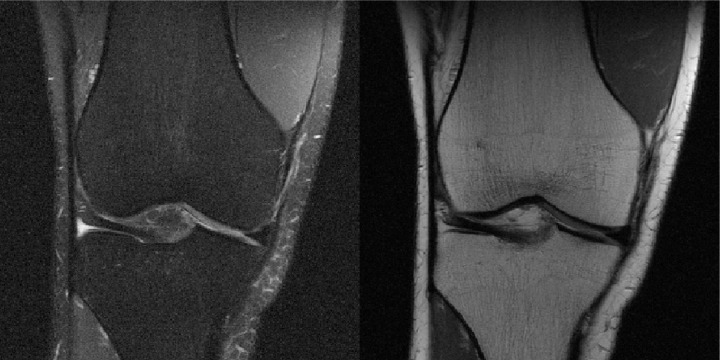
Coronal proton density−weighted images with…
Figure 1:
Coronal proton density−weighted images with fat suppression (left) and without fat suppression (right).…
Figure 1:
Coronal proton density−weighted images with fat suppression (left) and without fat suppression (right). Both images were reconstructed from fully sampled k-space data using a sum-of-squares combination of component coil images.
Figure 2:
Examples of binary sampling masks…
Figure 2:
Examples of binary sampling masks (white = included, black = omitted) for pseudorandomly…
Figure 2:
Examples of binary sampling masks (white = included, black = omitted) for pseudorandomly undersampled k-space data with fourfold acceleration (left) and eightfold acceleration (right). The overall acceleration factor is set randomly either to four or to eight (representing a fourfold or an eightfold acceleration, respectively), with equal probability for each example. The undersampling mask is then generated by first including some number of adjacent low-frequency k-space lines to provide a fully sampled central region of k-space. When the acceleration factor equals four, the fully sampled central region includes 8% of all k-space lines; when the acceleration factor equals eight, 4% of all k-space lines are included. The remaining k-space lines are included at random, by drawing samples from a uniform random distribution with the probability set such that the correct number of total k-space lines is achieved.
Hammernik K, Klatzer T, Kobler E, et al. Learning a variational network for reconstruction of accelerated MRI data. Magn Reson Med 2018;79(6):3055–3071.
-
PMC
-
PubMed
Wang S, Su Z, Ying L, et al. Accelerating Magnetic Resonance Imaging Via Deep Learning. In: IEEE International Symposium on Biomedical Imaging (ISBI), 2016; 514–517.
-
PMC
-
PubMed
Chen F, Taviani V, Malkiel I, et al. Variable-density single-shot fast spin-echo MRI with deep learning reconstruction by using variational networks. Radiology 2018;289(2):366–373.
-
PMC
-
PubMed
Mardani M, Gong E, Cheng JY, et al. Deep generative adversarial neural networks for compressive sensing MRI. IEEE Trans Med Imaging 2019;38(1):167–179.
-
PMC
-
PubMed