


Perception of quality of life in people experiencing or having experienced a Clostridioides difficile infection: a US population survey
- PMID: 32076853
- PMCID: PMC7031450
- DOI: 10.1186/s41687-020-0179-1
Perception of quality of life in people experiencing or having experienced a Clostridioides difficile infection: a US population survey
Abstract
Background: Although the incidence, severity and mortality of Clostridioides (Clostridium) difficile infection (CDI) have been increasing, patients' quality of life changes resulting from CDI have not been studied thoroughly. This study aimed at exploring the consequences of CDI on quality of life through patients' perspective.
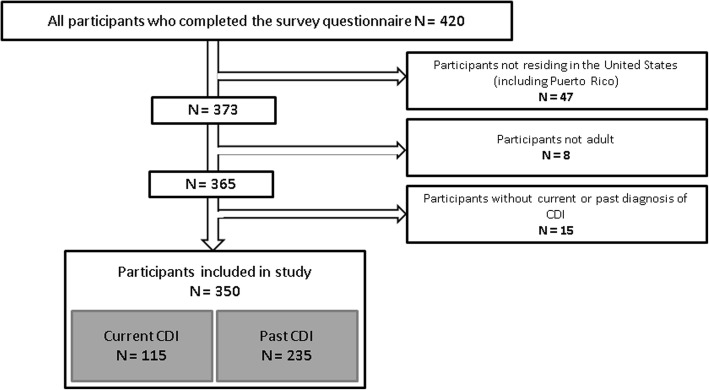
Methods: An observational, cross-sectional study involving 350 participants with a self-reported CDI diagnosis was conducted through an online self-administered survey. Participants were grouped into those who had active disease ("Current CDI") and those who had a history of CDI ("Past CDI").
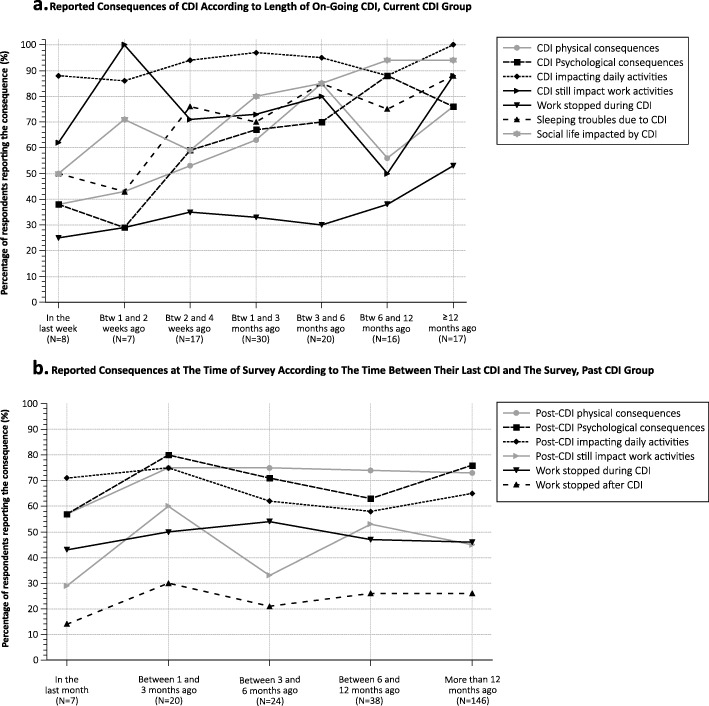
Results: One hundred fifteen participants (33%) reported Current CDI and 235 (67%) reported Past CDI. A large majority of participants admitted that their daily activities were impacted by the infection (93.9% and 64.7% of Current and Past CDI respondents respectively, p < 0.05). Physical and psychological consequences of CDI were experienced by 63.5% and 66.1% of participants with active CDI. Despite the infection being cleared, these consequences were still frequently experienced in Past CDI cohort with similar rates (reported by 73.2% of respondents for both, physical consequences p = 0.08; psychological consequences p = 0.21). After the infection, 56.6% of respondents noted that post-CDI symptoms remained; 40.9% believed they would never get rid of them.
Conclusions: While the societal burden of CDI is well described in the literature, our study is one of the first aimed at understanding the major burden of CDI on quality of life. Our results highlight the long-lasting nature of CDI and further reinforce the need for enhanced therapeutics in the prevention and treatment of this devastating infection.
Keywords: C. difficile infection (CDI); Psychological consequences; Quality of life; Questionnaire; Recurrence; Survey.
Conflict of interest statement
Pierre-Alain Bandinelli, Lise Lurienne, Thibaut Galvain and Charles-Alexis Coursel are employees of Da Volterra and may own/hold stock in the company.
Caterina Oneto and Paul Feuerstadt declare that they have no conflict of interest.
Figures
References
-
- Cohen SH, Gerding DN, Johnson S, et al. Clinical practice guidelines for Clostridium difficile infection in adults: 2010 update by the Society for Healthcare Epidemiology of America (SHEA) and the Infectious Diseases Society of America (IDSA) Infection Control and Hospital Epidemiology. 2010;31(05):431–455. doi: 10.1086/651706. - DOI - PubMed
-
- Miller BA, Chen LF, Sexton DJ, Anderson DJ. Comparison of the burdens of hospital-onset, healthcare facility-associated Clostridium difficile infection and of healthcare-associated infection due to methicillin-resistant Staphylococcus aureus in community hospitals. Infection Control and Hospital Epidemiology. 2011;32:387–390. doi: 10.1086/659156. - DOI - PubMed
LinkOut - more resources
Full Text Sources
Miscellaneous
