


Emotion-related socialization in the classroom: Considering the roles of teachers, peers, and the classroom context
- PMID: 32077726
- PMCID: PMC7041856
- DOI: 10.1037/dev0000863
Emotion-related socialization in the classroom: Considering the roles of teachers, peers, and the classroom context
Abstract
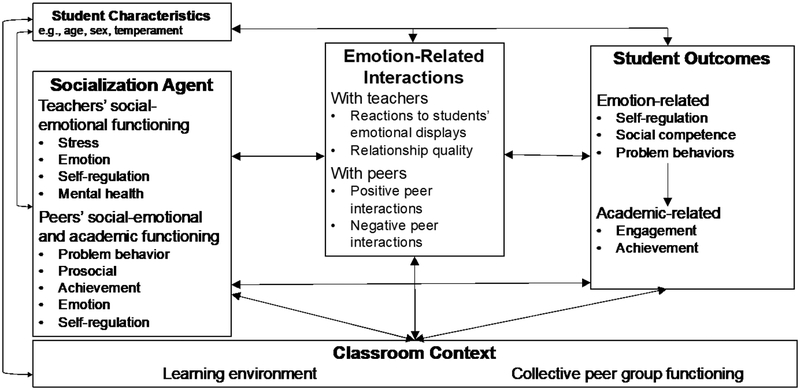
The goal of this study was to apply aspects of the heuristic model advanced by Eisenberg, Cumberland, and Spinrad (1998) to the study of socialization that takes place in preschool and elementary school classrooms. Investigating socialization in this context is important given the number of hours students spend in school, the emotional nature of social interactions that take place involving teachers and students, and the emotions students often experience in the context of academic work. Guided by Eisenberg, Cumberland, et al.'s (1998) call to consider complex socialization pathways, we focus our discussion on ways teachers, peers, and the classroom context can shape students' emotion-related outcomes (e.g., self-regulation, adjustment) and academic-related outcomes (e.g., school engagement, achievement) indirectly and differentially (e.g., as a function of student or classroom characteristics). Our illustrative review of the intervention literature demonstrates that the proposed classroom-based socialization processes have clear applied implications, and efforts to improve socialization in the classroom can promote students' emotional and academic competence. We conclude our discussion by outlining areas that require additional study. (PsycINFO Database Record (c) 2020 APA, all rights reserved).
Figures
References
-
- Abry T, Granger KL, Bryce CI, Taylor M, Swanson J, & Bradley RH (2018). First-grade classroom-level adversity: Associations with teaching practices, academic skills, and executive functioning. School Psychology Quarterly, 33(4), 547–560. - PubMed
-
- Acar IH, Kutaka TS, Rudasill KM, Torquati JC, Coplan RJ, & Yıldız S (2018). Examining the roles of child temperament and teacher-child relationships as predictors of Turkish children’s social competence and antisocial behavior. Current Psychology. doi: 10.1007/s12144-018-9901-z - DOI
-
- Allport GW (1954). The nature of prejudice. Reading, MA: Addison-Wesley.
Publication types
MeSH terms
Grants and funding
LinkOut - more resources
Full Text Sources
Miscellaneous
