Long-term Effect of Intraocular Lens vs Contact Lens Correction on Visual Acuity After Cataract Surgery During Infancy: A Randomized Clinical Trial
- PMID: 32077909
- PMCID: PMC7042945
- DOI: 10.1001/jamaophthalmol.2020.0006
Long-term Effect of Intraocular Lens vs Contact Lens Correction on Visual Acuity After Cataract Surgery During Infancy: A Randomized Clinical Trial
Abstract
Importance: Although intraocular lenses (IOLs) are often implanted in children, little is known whether primary IOL implantation or aphakia and contact lens correction results in better long-term visual outcomes after unilateral cataract surgery during infancy.
Objective: To compare long-term visual outcomes with contact lens vs IOL correction following unilateral cataract surgery during infancy.
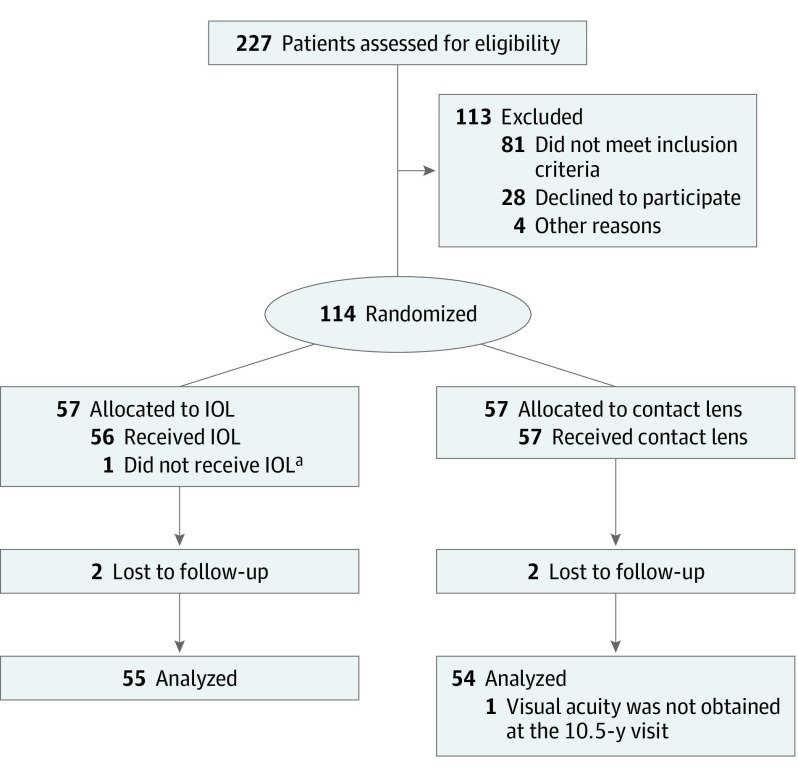
Design, setting, and participants: This multicenter randomized clinical trial enrolled 114 infants with a unilateral congenital cataract who underwent cataract surgery with or without primary IOL implantation between 1 and 6 months of age. Data on long-term visual outcomes were collected when the children were age 10.5 years (July 14, 2015, to July 12, 2019) and analyzed from March 30 through August 6, 2019.
Interventions: Intraocular lens implantation at the time of cataract surgery.
Main outcomes and measures: Best-corrected visual acuity using the electronic Early Treatment Diabetic Retinopathy Study (E-ETDRS) testing protocol. Analysis was performed on an intention-to-treat basis.
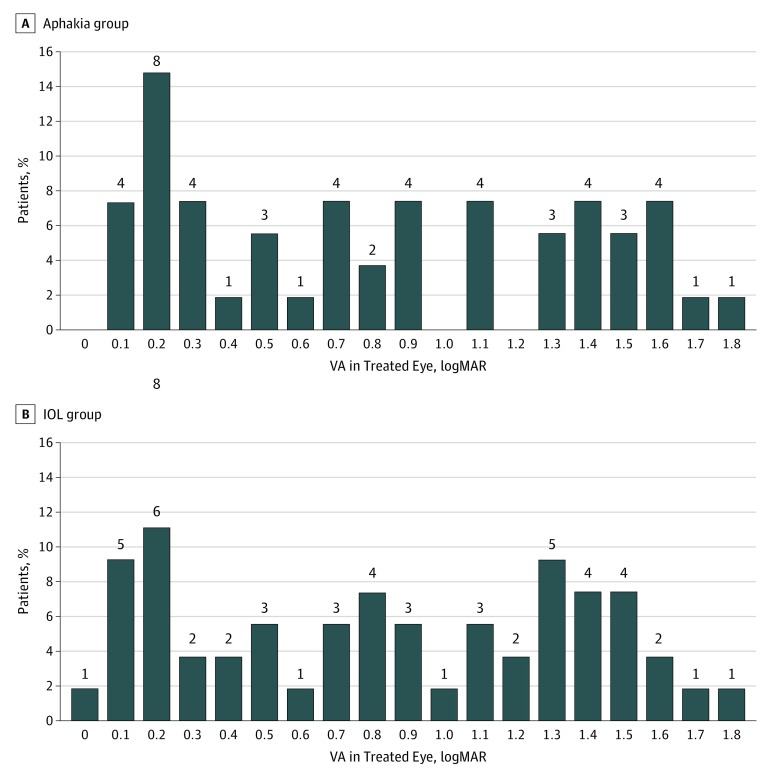
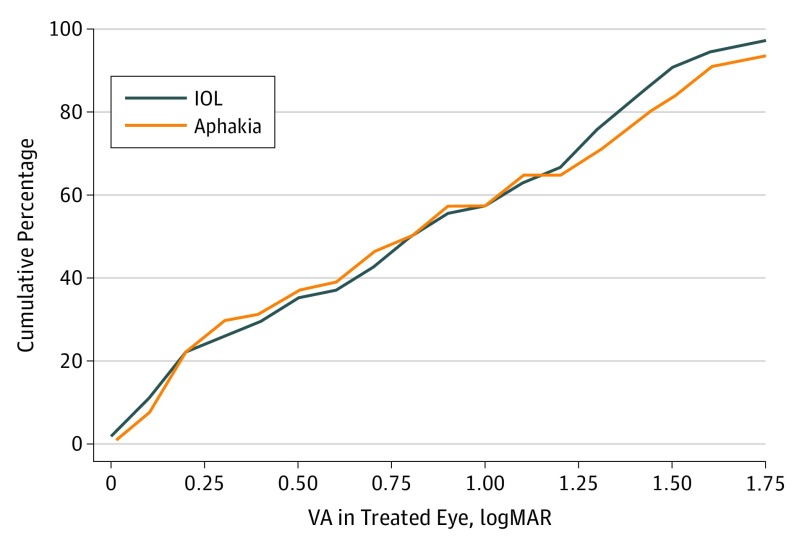
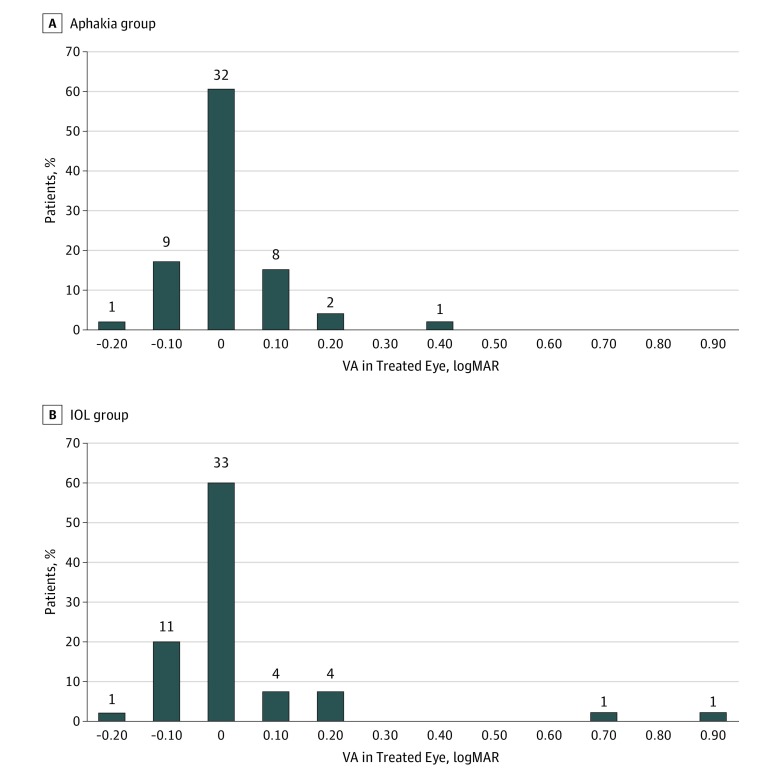
Results: Best-corrected visual acuity was measured at age 10.5 years for 110 of the 114 patients (96%) enrolled as infants. The participants included 58 girls (53%) and 52 boys (47%). Overall, 27 of the children (25%) had good (logMAR 0.30 [Snellen equivalent, 20/40] or better) visual acuity in the treated eye (12 [22%] in the IOL group and 15 [27%] in the aphakia group), but 50 children (44%) had a visual acuity of logMAR 1.00 (Snellen equivalent, 20/200) or worse (25 [44%] in the IOL group and 25 [44%] in the aphakia group). The median logMAR acuity in the treated eye was similar in children randomized to receive an IOL at the time of cataract extraction (0.89; interquartile range [IQR], 0.33-1.43 [Snellen equivalent, 20/159]) and those who remained aphakic (0.86; IQR, 0.30-1.46 [Snellen equivalent, 20/145]) (IQR, 0.30-1.46; P = .82). Although the overall difference in median visual acuity between the 2 groups was small, the estimate was imprecise (99% CI for the difference in medians was -0.54 to 0.47).
Conclusions and relevance: As in previous phases of the study, visual acuity outcomes were highly variable with only 27 children (25%) achieving excellent visual acuity in their treated eye and 50 children (44%) having poor vision in the treated eye. Implanting an IOL at the time of cataract extraction was neither beneficial nor detrimental to the visual outcome.
Trial registration: ClinicalTrials.gov Identifier: NCT00212134.
Conflict of interest statement
Figures
Comment in
-
Visual Acuity Outcome at Age 10.5 Years for Treatment of Monocular Infantile Cataract-It Is Worth the Effort.JAMA Ophthalmol. 2020 Apr 1;138(4):372-373. doi: 10.1001/jamaophthalmol.2020.0018. JAMA Ophthalmol. 2020. PMID: 32077905 No abstract available.
References
-
- Solebo AL, Russell-Eggitt I, Cumberland PM, Rahi JS; British Isles Congenital Cataract Interest Group . Risks and outcomes associated with primary intraocular lens implantation in children under 2 years of age: the IoLunder2 cohort study. Br J Ophthalmol. 2015;99(11):1471-1476. doi: 10.1136/bjophthalmol-2014-306394 - DOI - PubMed
-
- Solebo AL, Cumberland P, Rahi JS; British Isles Congenital Cataract Interest Group . 5-Year outcomes after primary intraocular lens implantation in children aged 2 years or younger with congenital or infantile cataract: findings from the IoLunder2 prospective inception cohort study. Lancet Child Adolesc Health. 2018;2(12):863-871. doi: 10.1016/S2352-4642(18)30317-1 - DOI - PubMed
-
- Bothun ED, Wilson ME, Traboulsi EI, et al. ; Toddler Aphakia and Pseudophakia Study Group (TAPS) . Outcomes of unilateral cataracts in infants and toddlers 7 to 24 months of age: Toddler Aphakia and Pseudophakia Study (TAPS). Ophthalmology. 2019;126(8):1189-1195. doi: 10.1016/j.ophtha.2019.03.011 - DOI - PubMed
Publication types
MeSH terms
Associated data
Grants and funding
LinkOut - more resources
Full Text Sources
Medical
Research Materials