


Cost-effectiveness analysis of voice rehabilitation for patients with laryngeal cancer: a randomized controlled study
- PMID: 32078058
- PMCID: PMC7547033
- DOI: 10.1007/s00520-020-05362-8
Cost-effectiveness analysis of voice rehabilitation for patients with laryngeal cancer: a randomized controlled study
Abstract
Introduction: Voice problems are common following radiotherapy for laryngeal cancer. Few studies exist covering the effect of voice rehabilitation, and no previous studies exist regarding the cost of said rehabilitation. This randomized controlled study aimed to analyze the cost-effectiveness of voice rehabilitation after radiotherapy for patients with laryngeal cancer.
Material and methods: A total of 66 patients with laryngeal cancer with follow-up data 12 months post-radiotherapy were included. Patients were randomized into receiving either voice rehabilitation (n = 32) or no voice rehabilitation (n = 34). The patient outcome was measured as quality-adjusted life years (QALYs). The index range between 0 and 1, where 0 equals death and 1 represents perfect health. The QALYs were assessed with the European Organization for Research and Treatment of Cancer questionnaire QLQ-C30 mapped to EuroQoL 5 Dimension values. The cost of rehabilitation and other healthcare visits was derived from hospital systems. The patients reported the total amount of sick leave days during the first 12 months following radiotherapy. The cost-effectiveness of the voice rehabilitation was compared with no rehabilitation intervention based on the incremental cost-effectiveness ratio.
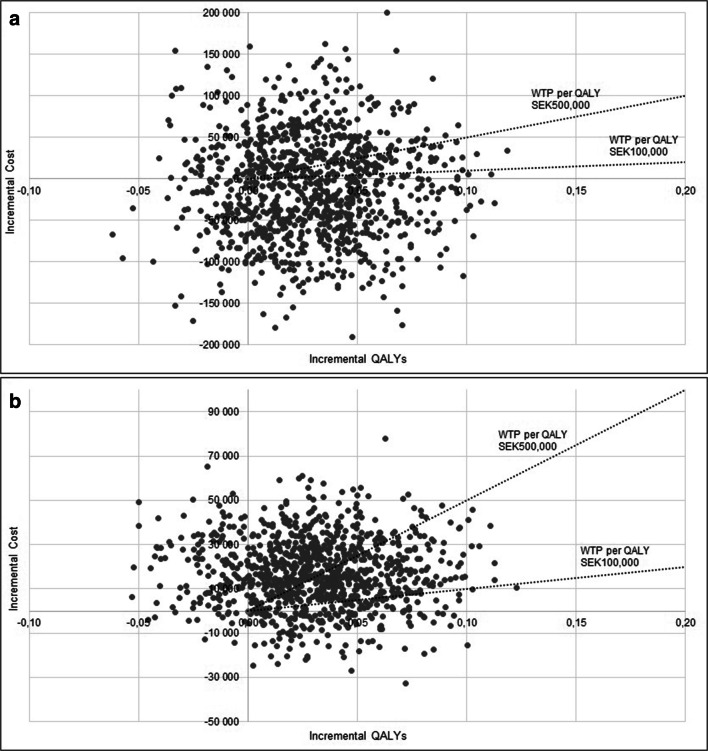
Results: The cost per gained QALY with voice rehabilitation compared to no rehabilitation from a societal perspective was - 27,594 € (SEK - 250,852) which indicates that the voice rehabilitation is a cost-saving alternative compared to no rehabilitation due to lower costs and a slightly better health outcome. From a healthcare perspective, the voice rehabilitation indicates a cost 60,800 € (SEK 552,725) per gained QALY.
Conclusion: From a societal perspective, i.e., including the costs of production loss, voice rehabilitation compared to no voice rehabilitation following radiotherapy for laryngeal cancer seems to be cost-saving. When analyzing only the healthcare costs in relation to health outcomes, voice rehabilitation indicates an incremental cost of 60,800 € per gained QALY, which is just above the threshold of the maximum willingness to pay level.
Keywords: Cost-effectiveness; Costs; Laryngeal neoplasms; Quality of life; Radiotherapy; Voice therapy.
Conflict of interest statement
The authors declare that they have no conflict of interest.
Figures
References
-
- Agarwal JP, Baccher GK, Waghmare CM, Mallick I, Ghosh-Laskar S, Budrukkar A, Pai P, Chaturvedi P, D'Cruz A, Shrivastava SK, Dinshaw KA. Factors affecting the quality of voice in the early glottic cancer treated with radiotherapy. Radiother Oncol. 2009;90(2):177–182. doi: 10.1016/j.radonc.2008.09.016. - DOI - PubMed
-
- van Gogh CD, Verdonck-de Leeuw IM, Boon-Kamma BA, Rinkel RN, de Bruin MD, Langendijk JA, Kuik DJ, Mahieu HF. The efficacy of voice therapy in patients after treatment for early glottic carcinoma [randomized controlled trial research support, non-U.S. Gov’t] Cancer. 2006;106(1):95–105. doi: 10.1002/cncr.21578. - DOI - PubMed
Publication types
MeSH terms
LinkOut - more resources
Full Text Sources
Medical
Miscellaneous
