Review
. 2020 Feb 14;126(4):533-551.
doi: 10.1161/CIRCRESAHA.119.315889. Epub 2020 Feb 13.

Targeting Age-Related Pathways in Heart Failure

Affiliations
Review

Targeting Age-Related Pathways in Heart Failure

Haobo Li et al. Circ Res. .

Abstract

During aging, deterioration in cardiac structure and function leads to increased susceptibility to heart failure. The need for interventions to combat this age-related cardiac decline is becoming increasingly urgent as the elderly population continues to grow. Our understanding of cardiac aging, and aging in general, is limited. However, recent studies of age-related decline and its prevention through interventions like exercise have revealed novel pathological and cardioprotective pathways. In this review, we summarize recent findings concerning the molecular mechanisms of age-related heart failure and highlight exercise as a valuable experimental platform for the discovery of much-needed novel therapeutic targets in this chronic disease.

Keywords: aging; epigenetics; exercise; heart failure; senescence.


Figures
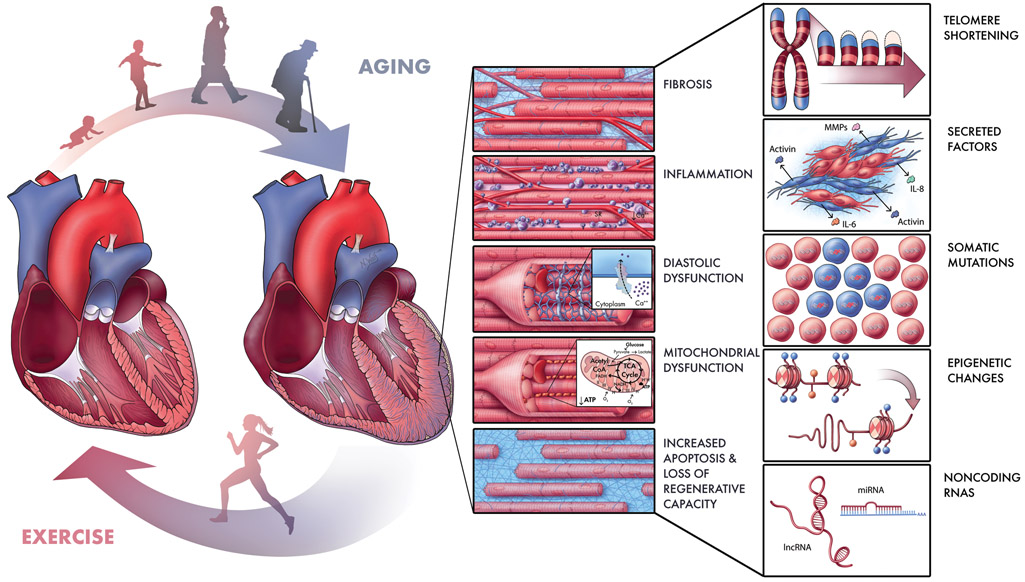
Figure 1.
Figure 1.. Schematic of Processes and Pathways Contributing to Age-Related Cardiac Disease.
As we age, multiple processes likely contribute to cardiac dysfunction, including fibrosis, inflammation, mechanical stiffening and diastolic dysfunction, mitochondrial dysfunction, and a growing imbalance between loss and birth of cardiomyocytes (Center). These processes are driven by molecular mechanisms (some of which are depicted at right) such as telomere shortening, senescence-associated secreted factors, accumulation of somatic mutations, epigenetic changes, and alterations in noncoding RNAs regulating gene expression. Some of these may represent targets for new therapeutic strategies to mitigate both age-related and other forms of heart failure. Since exercise mitigates many effects of aging (Left, bottom), it may provide a useful tool by enabling us to prioritize candidate cardiac pathways exacerbated by aging and mitigated by exercise. Illustration by Nicole Wolf, MS, ©2019. Printed with permission.
Figure 2.
Figure 2.. Schematic of Secreted Factors Contributing to Age-related Cardiac Disease.
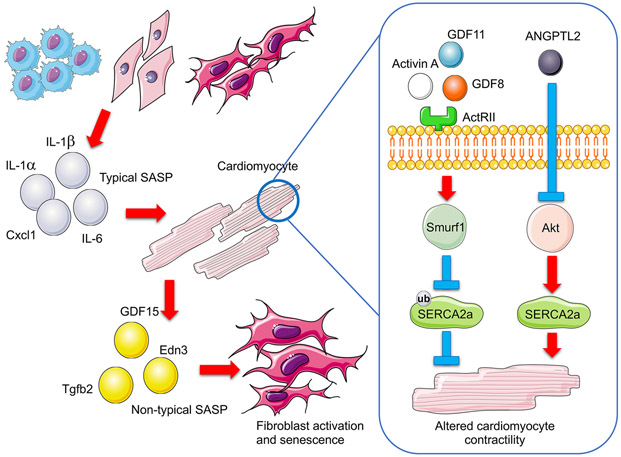
Accumulating senescent cells adversely affect other cells (e.g. cardiomyocytes and fibroblasts) through a senescence-associated secretory phenotype (SASP) which promotes inflammation, cell death and senescence. While systemic increases in senescent cells lead to increasing secretion of typical SASP proteins with age (e.g., IL-1α, IL-1β, IL-6, Cxcl1), senescent cardiomyocytes secrete non-typical SASP (e.g., GDF15, Tgfb2, and Edn3). Circulating activin and ANGPTL2 are also increased with age. Elevated activin, through binding to its receptor ActRIIb, triggers Smurf1-mediated ubiquitination and subsequent degradation of SERCA2a, while increased ANGPTL2 inactives Akt and thereby degrades SERCA2a. All of these processes contribute to cardiac aging and cardiac dysfunction.
Figure 3.
Figure 3.. Schematic of Telomere Shortening Contributing to Age-related Cardiac Disease.
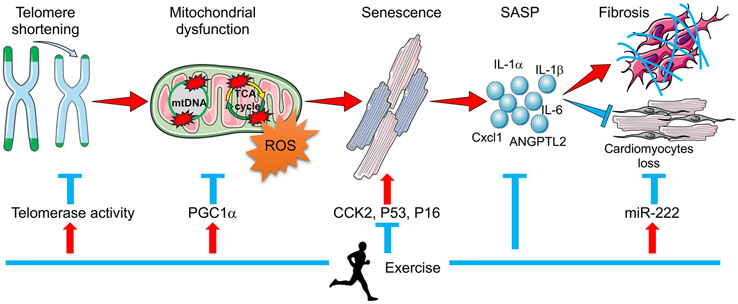
Telomeres shorten with cell division and aging is associated with reduced telomere length. Mitochondria are particularly vulnerable. Critically short telomeres lead to mitochondrial DNA damage, ultimately disrupting mitochondrial function and inducing senescence. Through secretion of senescence-associated secretory phenotype (SASP) factors, senescent cells induce fibrosis and promote cardiomyocyte loss, eventually leading to cardiac dysfunction. Exercise has been shown to protect the heart against cardiac aging and cardiac dysfunction by modulating each step in this sequence.

References

    1. Mosterd A, Hoes AW. Clinical epidemiology of heart failure. Heart. 2007;93:1137–1146 - PMC - PubMed
    1. Benjamin EJ, Muntner P, Alonso A, Bittencourt MS, Callaway CW, Carson AP, Chamberlain AM, Chang AR, Cheng S, Das SR, Delling FN, Djousse L, Elkind MSV, Ferguson JF, Fornage M, Jordan LC, Khan SS, Kissela BM, Knutson KL, Kwan TW, Lackland DT, Lewis TT, Lichtman JH, Longenecker CT, Loop MS, Lutsey PL, Martin SS, Matsushita K, Moran AE, Mussolino ME, O’Flaherty M, Pandey A, Perak AM, Rosamond WD, Roth GA, Sampson UKA, Satou GM, Schroeder EB, Shah SH, Spartano NL, Stokes A, Tirschwell DL, Tsao CW, Turakhia MP, VanWagner LB, Wilkins JT, Wong SS, Virani SS, American Heart Association Council on E, Prevention Statistics C, Stroke Statistics S. Heart disease and stroke statistics-2019 update: A report from the american heart association. Circulation. 2019;139:e56–e528 - PubMed
    1. Fleg JL, Cooper LS, Borlaug BA, Haykowsky MJ, Kraus WE, Levine BD, Pfeffer MA, Pina IL, Poole DC, Reeves GR, Whellan DJ, Kitzman DW, National Heart L, Blood Institute Working G. Exercise training as therapy for heart failure: Current status and future directions. Circ Heart Fail. 2015;8:209–220 - PMC - PubMed
    1. Lakatta EG. So! What’s aging? Is cardiovascular aging a disease? J Mol Cell Cardiol. 2015;83:1–13 - PMC - PubMed
    1. Lakatta EG, Levy D. Arterial and cardiac aging: Major shareholders in cardiovascular disease enterprises: Part i: Aging arteries: A “set up” for vascular disease. Circulation. 2003;107:139–146 - PubMed

Publication types