


Temporal Trends in Stroke Incidence Over Time by Sex and Age in the GCNKSS
- PMID: 32078459
- PMCID: PMC7286565
- DOI: 10.1161/STROKEAHA.120.028910
Temporal Trends in Stroke Incidence Over Time by Sex and Age in the GCNKSS
Erratum in
-
Correction to: Temporal Trends in Stroke Incidence Over Time by Sex and Age in the GCNKSS.Stroke. 2020 Jul;51(7):e141. doi: 10.1161/STR.0000000000000329. Epub 2020 Jun 22. Stroke. 2020. PMID: 32568656 No abstract available.
Abstract
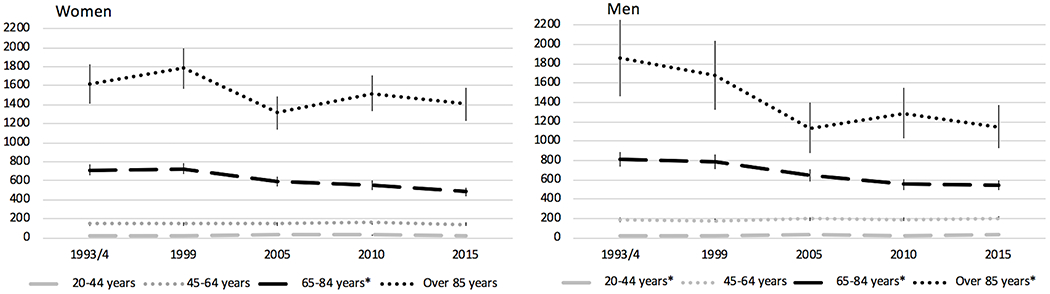
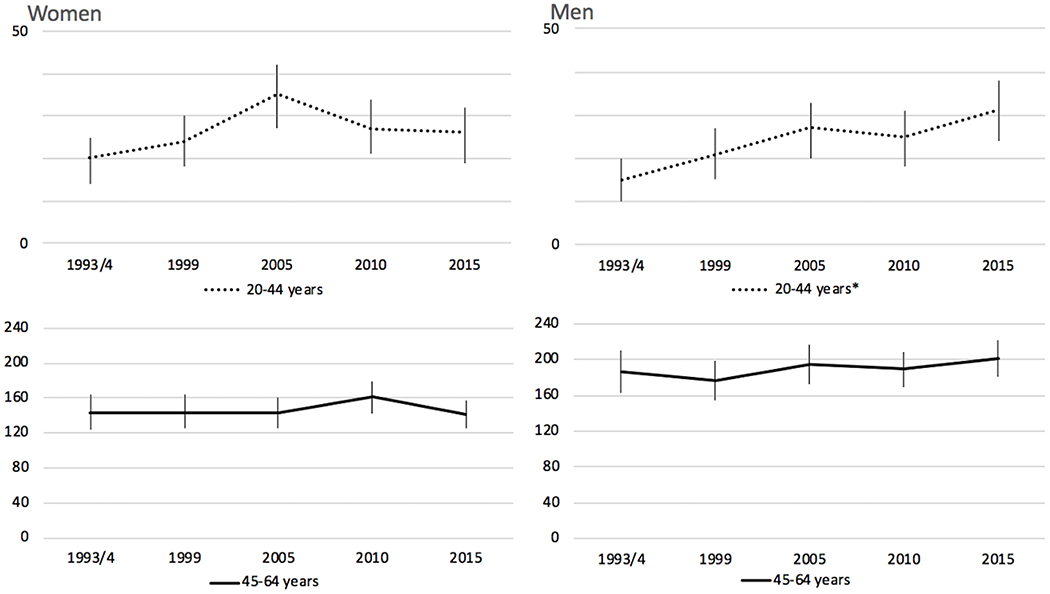
Background and Purpose- Sex differences in stroke incidence over time were previously reported from the GCNKSS (Greater Cincinnati/Northern Kentucky Stroke Study). We aimed to determine whether these differences continued through 2015 and whether they were driven by particular age groups. Methods- Within the GCNKSS population of 1.3 million, incident (first ever) strokes among residents ≥20 years of age were ascertained at all local hospitals during 5 periods: July 1993 to June 1994 and calendar years 1999, 2005, 2010, and 2015. Out-of-hospital cases were sampled. Sex-specific incidence rates per 100 000 were adjusted for age and race and standardized to the 2010 US Census. Trends over time by sex were compared (overall and age stratified). Sex-specific case fatality rates were also reported. Bonferroni corrections were applied for multiple comparisons. Results- Over the 5 study periods, there were 9733 incident strokes (56.3% women). For women, there were 229 (95% CI, 215-242) per 100 000 incident strokes in 1993/1994 and 174 (95% CI, 163-185) in 2015 (P<0.05), compared with 282 (95% CI, 263-301) in 1993/1994 to 211 (95% CI, 198-225) in 2015 (P<0.05) in men. Incidence rates decreased between the first and last study periods in both sexes for IS but not for intracerebral hemorrhage or subarachnoid hemorrhage. Significant decreases in stroke incidence occurred between the first and last study periods for both sexes in the 65- to 84-year age group and men only in the ≥85-year age group; stroke incidence increased for men only in the 20- to 44-year age group. Conclusions- Overall stroke incidence decreased from the early 1990s to 2015 for both sexes. Future studies should continue close surveillance of sex differences in the 20- to 44-year and ≥85-year age groups, and future stroke prevention strategies should target strokes in the young- and middle-age groups, as well as intracerebral hemorrhage.
Keywords: adult; humans; incidence; sex; stroke.
Figures
References
-
- Benjamin EJ, Virani SS, Callaway CW, Chamberlain AM, Chang AR, Cheng S, et al. Heart disease and stroke statistics - 2018 update: A report from the American Heart Association. Circulation. 2018;137:e67–e492. - PubMed
-
- Leading Causes of Death in Males, CDC [Internet]. [cited 2017 Feb 4]; Available from: https://www.cdc.gov/men/lcod/2014/index.htm
-
- Leading Causes of Death in Females, CDC. [Internet]. [cited 2017 Feb 4]; Available from: https://www.cdc.gov/women/lcod/
Publication types
MeSH terms
Grants and funding
LinkOut - more resources
Full Text Sources
Medical
