. 2020 Apr 1;128(4):715-728.
doi: 10.1152/japplphysiol.00787.2019. Epub 2020 Feb 20.

Both hyperthermia and dehydration during physical work in the heat contribute to the risk of acute kidney injury

Affiliations

Both hyperthermia and dehydration during physical work in the heat contribute to the risk of acute kidney injury

Christopher L Chapman et al. J Appl Physiol (1985). .

Abstract

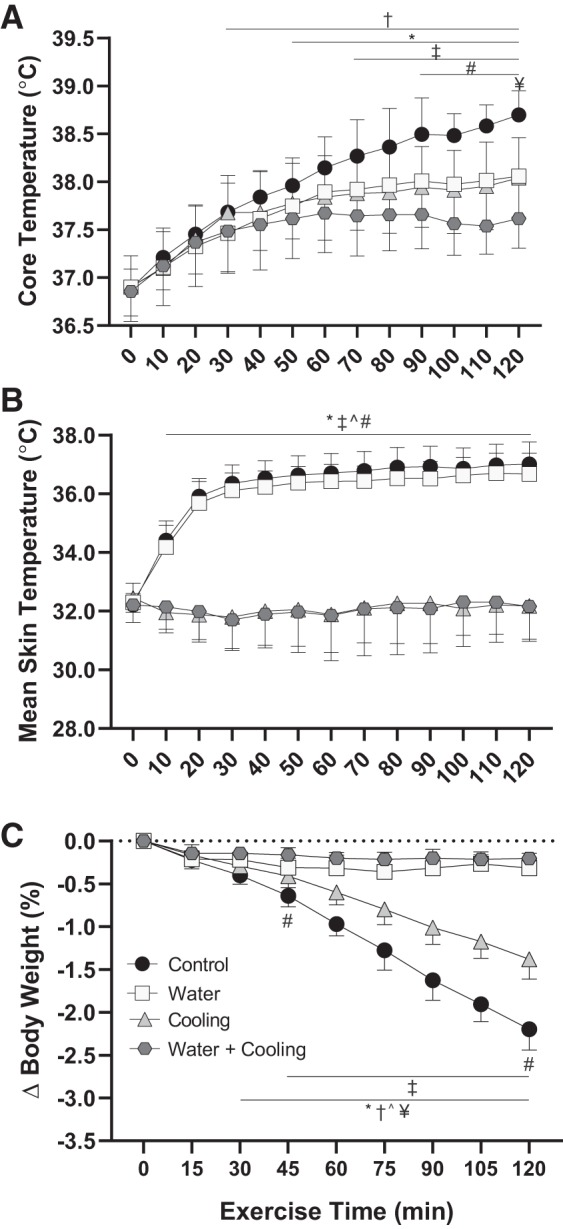
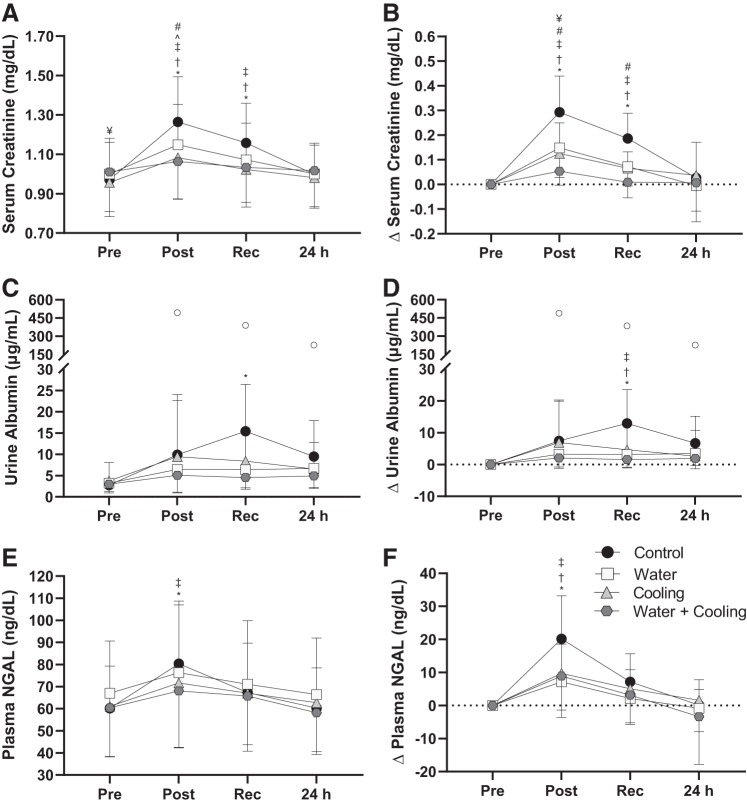
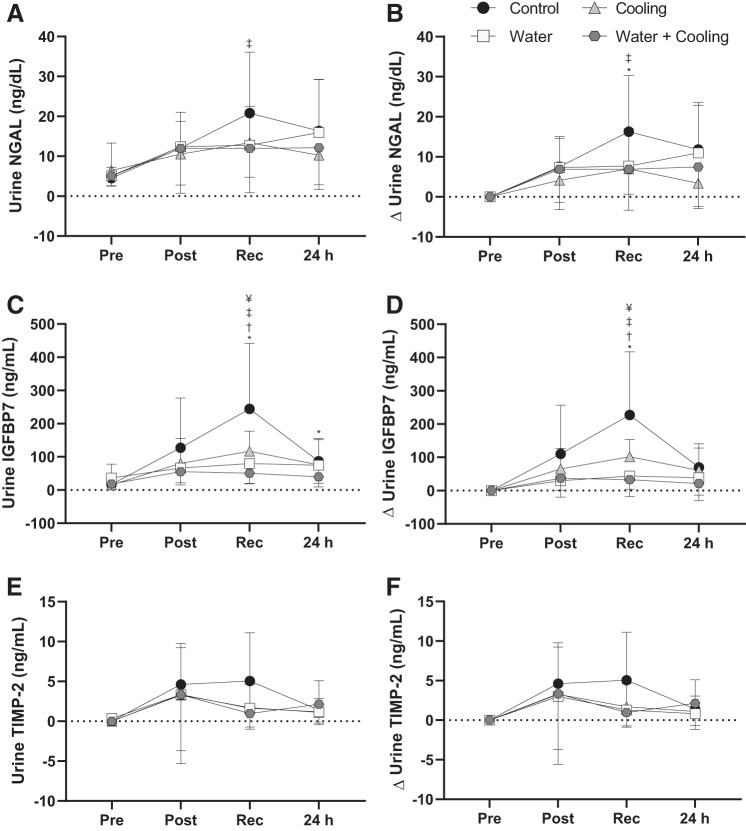
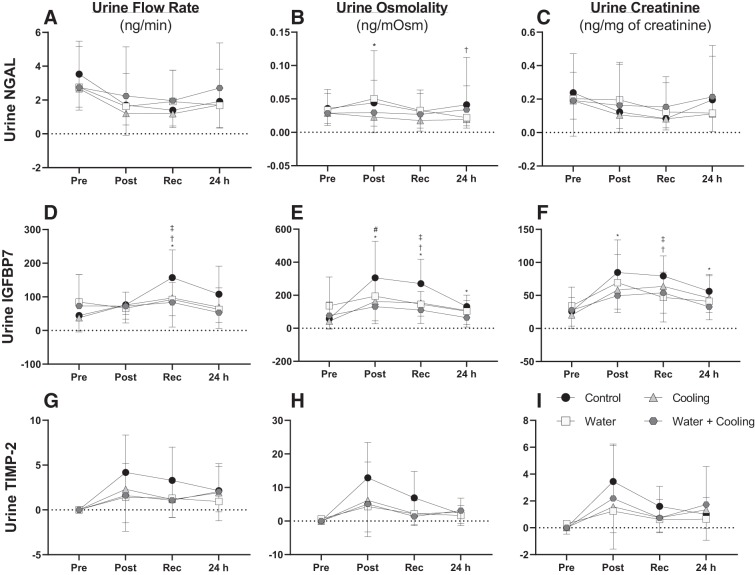
Occupational heat stress increases the risk of acute kidney injury (AKI) and kidney disease. This study tested the hypothesis that attenuating the magnitude of hyperthermia (i.e., increase in core temperature) and/or dehydration during prolonged physical work in the heat attenuates increases in AKI biomarkers. Thirteen healthy adults (3 women, 23 ± 2 yr) exercised for 2 h in a 39.7 ± 0.6°C, 32 ± 3% relative-humidity environmental chamber. In four trials, subjects received water to remain euhydrated (Water), continuous upper-body cooling (Cooling), a combination of both (Water + Cooling), or no intervention (Control). The magnitude of hyperthermia (increased core temperature of 1.9 ± 0.3°C; P < 0.01) and dehydration (percent loss of body mass of -2.4 ± 0.5%; P < 0.01) were greatest in the Control group. There were greater increases in the urinary biomarkers of AKI in the Control trial: albumin (increase of 13 ± 11 μg/mL; P ≤ 0.05 compared with other trials), neutrophil gelatinase-associated lipocalin (NGAL) (increase of 16 ± 14 ng/dL, P ≤ 0.05 compared with Cooling and Water + Cooling groups), and insulin-like growth factor-binding protein 7 (IGFBP7) (increase of 227 ± 190 ng/mL; P ≤ 0.05 compared with other trials). Increases in IGFBP7 in the Control trial persisted after correcting for urine production/concentration. There were no differences in the AKI biomarker tissue inhibitor of metalloproteinase 2 (TIMP-2) between trials (P ≥ 0.11). Our findings indicate that the risk of AKI is highest with greater magnitudes of hyperthermia and dehydration during physical work in the heat. Additionally, the differential findings between IGFBP7 (preferentially secreted in proximal tubules) and TIMP-2 (distal tubules) suggest the proximal tubules as the location of potential renal injury.NEW & NOTEWORTHY We demonstrate that the risk for acute kidney injury (AKI) is higher in humans with greater magnitudes of hyperthermia and dehydration during physical work in the heat and that alleviating the hyperthermia and/or limiting dehydration equally reduce the risk of AKI. The biomarker panel employed in this study suggests the proximal tubules as the location of potential renal injury.

Keywords: AKI; exercise; heat stress, hydration; kidney function.


Conflict of interest statement

No conflicts of interest, financial or otherwise, are declared by the authors.

Figures
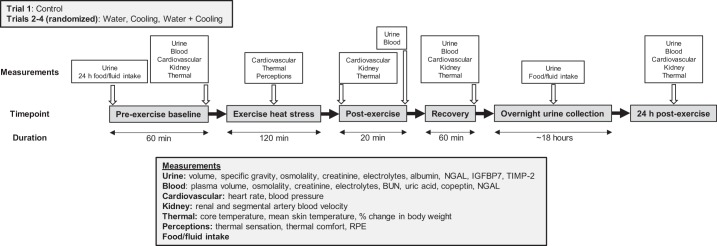
Fig. 1.
Fig. 1.
Schematic of study protocol. In a quasi-randomized crossover design, subjects undertook 2 h of treadmill walking in a 39.7 ± 0.6°C, 32 ± 3% relative humidity environment. During exercise heat stress, subjects received water to remain euhydrated (Water; n = 13), continuous upper body cooling (Cooling; n = 12), a combination of both (Water + Cooling; n = 13), or no intervention (Control; n = 13). BUN, blood urea nitrogen; IGFBP7, insulin-like growth factor-binding protein 7; NGAL, neutrophil gelatinase-associated lipocalin; RPE, rating of perceived exertion; TIMP-2, tissue inhibitor of metalloproteinase 2.
Fig. 2.
Fig. 2.
Core temperature (A), mean skin temperature (B), and percent loss of body weight (C) during 2 h of physical work in the heat. During physical work, subjects received either no intervention (Control), water only to maintain hydration throughout (Water), continuous upper-body cooling only (Cooling), or both interventions (Water + Cooling). Data are presented as means (SD). Statistical analyses are from post hoc two-tailed Tukey's test pairwise comparisons following a mixed-effects model ANOVA: †Control is different from Water (P < 0.05), ‡Control is different from Cooling (P < 0.03), *Control is different from Water + Cooling (P < 0.04), ^Water is different from Cooling (P < 0.05), #Water is different from Water + Cooling (P < 0.03), and ¥Cooling is different from Water + Cooling (P < 0.05).
Fig. 3.
Fig. 3.
Absolute values and changes (Δ) in serum creatinine (A and B), urine albumin (C and D), and plasma neutrophil gelatinase-associated lipocalin (NGAL) (E and F) before (Pre), immediately after (Post), at 1 h of recovery after Post (Rec), and at 24 h after Pre-physical work (24 h) in the heat. During, subjects received either no intervention (Control), water only to maintain hydration throughout (Water), continuous upper-body cooling only (Cooling), or both interventions (Water + Cooling). For urine albumin, data from the Control trial (Post and Rec) and Cooling trial (24 h) in 1 subject are plotted as singular data points (open circles). These values are in physiological ranges but were excluded from the mean data and statistical analyses given that they are outliers (>3 standard deviations from the mean) to clarify data interpretation. Statistical analyses are from post hoc two-tailed Tukey's test pairwise comparisons following a mixed-effects model ANOVA: †Control is different from Water (P < 0.05), ‡Control is different from Cooling (P ≤ 0.04), *Control is different from Water + Cooling (P < 0.05), ^Water is different from Cooling (P = 0.05), #Water is different from Water + Cooling (P < 0.03), and ¥Cooling is different from Water + Cooling (P ≤ 0.05).
Fig. 4.
Fig. 4.
Absolute values and changes (Δ) in urine neutrophil gelatinase-associated lipocalin (NGAL) (A and B), urine insulin-like growth factor-binding protein 7 (IGFBP7) (C and D), and urine tissue inhibitor of metalloproteinase 2 (TIMP-2) (E and F) before (Pre), immediately after (Post), at 1 h of recovery after Post (Rec), and 24 h after Pre-exercise (24 h) in the heat. During exercise, subjects received either no intervention (Control), water only to maintain hydration throughout (Water), continuous upper-body cooling only (Cooling), or both interventions (Water + Cooling). Statistical analyses are from post hoc two-tailed Tukey's test pairwise comparisons following a mixed-effects model ANOVA: †Control is different from Water (P ≤ 0.05), ‡Control is different from Cooling (P ≤ 0.05), *Control is different from Water + Cooling (P ≤ 0.05), and ¥Cooling different from Water + Cooling (P < 0.01).
Fig. 5.
Fig. 5.
Normalization of urine biomarkers of acute kidney injury. Neutrophil gelatinase-associated lipocalin (NGAL) (A–C), insulin-like growth factor-binding protein 7 (IGFBP7) (D–F), and tissue inhibitor of metalloproteinase 2 (TIMP-2) (G–I) are normalized to urine flow rate, urine osmolality, and urine creatinine before (Pre), immediately after (Post), at 1 h of recovery after Post (Rec), and at 24 h after Pre-exercise (24 h) in the heat. During exercise, subjects received either no intervention (Control), water only to maintain hydration throughout (Water), continuous upper-body cooling only (Cooling), or both interventions (Water + Cooling). Statistical analyses are from post hoc two-tailed Tukey's test pairwise comparisons following a mixed-effects model ANOVA: †Control is different from Water (P ≤ 0.05), ‡Control is different from Cooling (P < 0.03), *Control is different from Water + Cooling (P ≤ 0.05), and #Water is different from Water + Cooling (P < 0.04).

Comment in

  • Reply to Beunders et al.
    Chapman CL, Johnson BD, Vargas NT, Hostler D, Parker MD, Schlader ZJ. Chapman CL, et al. J Appl Physiol (1985). 2020 May 1;128(5):1461. doi: 10.1152/japplphysiol.00216.2020. J Appl Physiol (1985). 2020. PMID: 32412395 No abstract available.
  • The effects of physical exercise on the assessment of kidney function.
    Beunders R, Bongers CCWG, Pickkers P. Beunders R, et al. J Appl Physiol (1985). 2020 May 1;128(5):1459-1460. doi: 10.1152/japplphysiol.00189.2020. J Appl Physiol (1985). 2020. PMID: 32412396 No abstract available.
  • Reply to Chapman et al.
    Beunders R, Bongers CCWG, Pickkers P. Beunders R, et al. J Appl Physiol (1985). 2020 Jul 1;129(1):162. doi: 10.1152/japplphysiol.00464.2020. J Appl Physiol (1985). 2020. PMID: 32646320 No abstract available.

References

    1. Balanescu S, Kopp P, Gaskill MB, Morgenthaler NG, Schindler C, Rutishauser J. Correlation of plasma copeptin and vasopressin concentrations in hypo-, iso-, and hyperosmolar states. J Clin Endocrinol Metab 96: 1046–1052, 2011. doi: 10.1210/jc.2010-2499. - DOI - PubMed
    1. Birn H, Christensen EI. Renal albumin absorption in physiology and pathology. Kidney Int 69: 440–449, 2006. doi: 10.1038/sj.ki.5000141. - DOI - PubMed
    1. Bongers CCWG, Alsady M, Nijenhuis T, Hartman YAW, Eijsvogels TMH, Deen PMT, Hopman MTE. Impact of acute versus repetitive moderate intensity endurance exercise on kidney injury markers. Physiol Rep 5: e13544, 2017. doi: 10.14814/phy2.13544. - DOI - PMC - PubMed
    1. Borg G. Perceived exertion as an indicator of somatic stress. Scand J Rehabil Med 2: 92–98, 1970. - PubMed
    1. Bossard G, Bourgoin P, Corbeau JJ, Huntzinger J, Beydon L. Early detection of postoperative acute kidney injury by Doppler renal resistive index in cardiac surgery with cardiopulmonary bypass. Br J Anaesth 107: 891–898, 2011. doi: 10.1093/bja/aer289. - DOI - PubMed

Publication types

Substances