


Effect of acetazolamide on susceptibility to central sleep apnea in chronic spinal cord injury
- PMID: 32078469
- PMCID: PMC7191512
- DOI: 10.1152/japplphysiol.00532.2019
Effect of acetazolamide on susceptibility to central sleep apnea in chronic spinal cord injury
Abstract
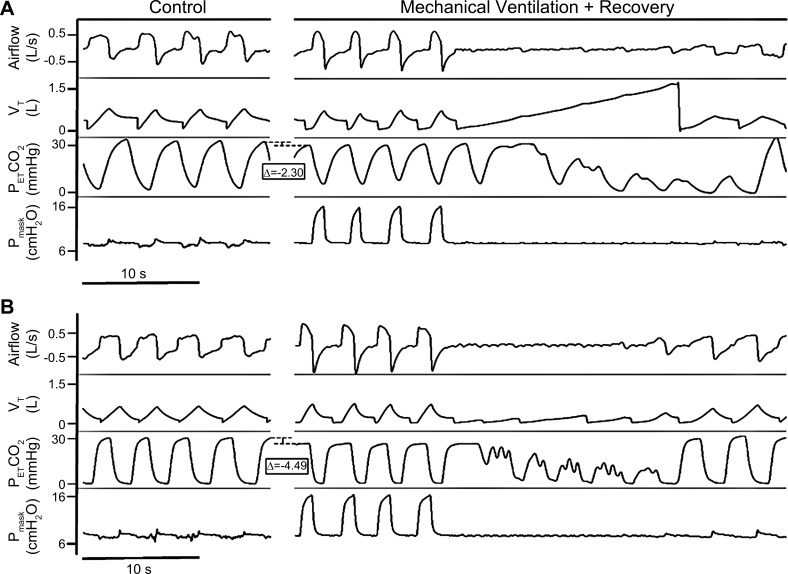
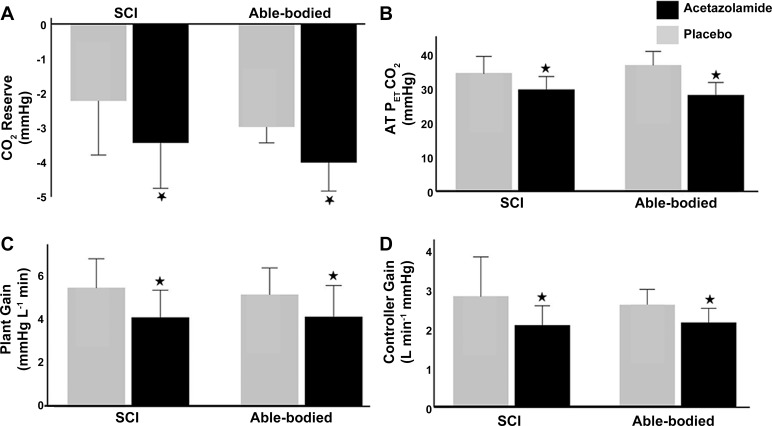
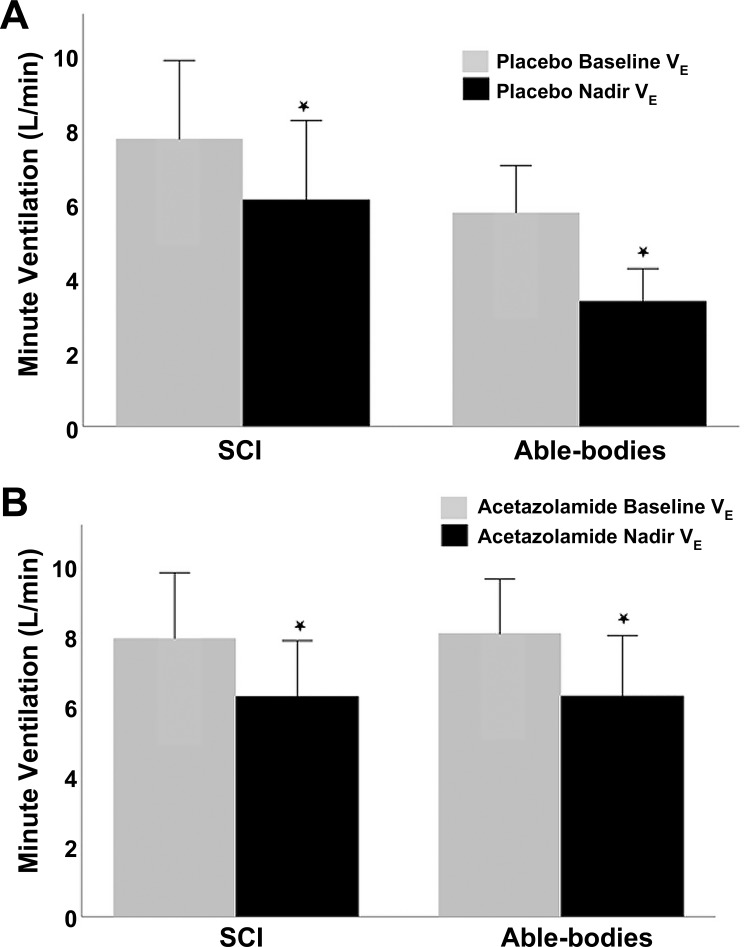
Spinal cord injury (SCI) is an established risk factor for central sleep apnea. Acetazolamide (ACZ), a carbonic anhydrase inhibitor, has been shown to decrease the frequency of central apnea by inducing mild metabolic acidosis. We hypothesized that ACZ would decrease the propensity to develop hypocapnic central apnea and decrease the apneic threshold. We randomized 16 participants with sleep-disordered breathing (8 SCI and 8 able-bodied controls) to receive ACZ (500 mg twice a day for 3 days) or placebo with a 1-wk washout before crossing over to the other drug arm. Study nights included polysomnography and determination of the hypocapnic apneic threshold and CO2 reserve using noninvasive ventilation. For participants with spontaneous central apnea, CO2 was administered until central apnea was abolished, and CO2 reserve was measured as the difference in end-tidal Pco2 () before and after. Steady-state plant gain, the response of end-tidal Pco2 to changes in ventilation, was calculated from and V̇e ratio during stable sleep. Controller gain, the response of ventilatory drive to changes in end-tidal Pco2, was defined as the ratio of change in V̇e between control and hypopnea to the ΔCO2 during stable non-rapid eye movement sleep. Treatment with ACZ for three days resulted in widening of the CO2 reserve (-4.0 ± 1.2 vs. -3.0 ± 0.7 mmHg for able-bodied, -3.4 ± 1.9 vs. -2.2 ± 2.2 mmHg for SCI, P < 0.0001), and a corresponding decrease in the hypocapnic apnea threshold (28.3 ± 5.2 vs. 37.1 ± 5.6 mmHg for able-bodied, 29.9 ± 5.4 vs. 34.8 ± 6.9 mmHg for SCI, P < 0.0001), respectively. ACZ significantly reduced plant gain when compared with placebo (4.1 ± 1.7 vs. 5.4 ± 1.8 mmHg/L min for able-bodied, 4.1 ± 2.0 vs. 5.1 ± 1.7 mmHg·L-1·min for SCI, P < 0.01). Acetazolamide decreased apnea-hypopnea index (28.8 ± 22.9 vs. 39.3 ± 24.1 events/h; P = 0.05), central apnea index (0.6 ± 1.5 vs. 6.3 ± 13.1 events/h; P = 0.05), and oxyhemoglobin desaturation index (7.5 ± 8.3 vs. 19.2 ± 15.2 events/h; P = 0.01) compared with placebo. Our results suggest that treatment with ACZ decreases susceptibility to hypocapnic central apnea due to decreased plant gain. Acetazolamide may attenuate central sleep apnea and improve nocturnal oxygen saturation, but its clinical utility requires further investigation in a larger sample of patients.NEW & NOTEWORTHY Tetraplegia is a risk factor for central sleep-disordered breathing (SDB) and is associated with narrow CO2 reserve (a marker of susceptibility to central apnea). Treatment with high-dose acetazolamide for 3 days decreased susceptibility to hypocapnic central apnea and reduced the frequency of central respiratory events during sleep. Acetazolamide may play a therapeutic role in alleviating central SDB in patients with cervical spinal cord injury, but larger clinical trials are needed.
Keywords: acetazolamide; central sleep apnea; loop gain; spinal cord injury.
Conflict of interest statement
This was not an industry-supported study. The authors have indicated no financial conflicts of interest.
Figures
References
-
- National Spinal Cord Injury Statistical Center Spinal Cord Injury: Facts and Figures at a Glance (2019 SCI Data Sheet) Birmingham, AL: University of Alabama at Birmingham, 2019; https://www.nscisc.uab.edu/Public/Facts%20and%20Figures%202019%20-%20Fin....
-
- Aurora RN, Chowdhuri S, Ramar K, Bista SR, Casey KR, Lamm CI, Kristo DA, Mallea JM, Rowley JA, Zak RS, Tracy SL. The treatment of central sleep apnea syndromes in adults: practice parameters with an evidence-based literature review and meta-analyses. Sleep (Basel) 35: 17–40, 2012. doi: 10.5665/sleep.1580. - DOI - PMC - PubMed
-
- Basnyat B, Gertsch JH, Holck PS, Johnson EW, Luks AM, Donham BP, Fleischman RJ, Gowder DW, Hawksworth JS, Jensen BT, Kleiman RJ, Loveridge AH, Lundeen EB, Newman SL, Noboa JA, Miegs DP, O’Beirne KA, Philpot KB, Schultz MN, Valente MC, Wiebers MR, Swenson ER. Acetazolamide 125 mg BD is not significantly different from 375 mg BD in the prevention of acute mountain sickness: the prophylactic acetazolamide dosage comparison for efficacy (PACE) trial. High Alt Med Biol 7: 17–27, 2006. doi: 10.1089/ham.2006.7.17. - DOI - PubMed
-
- Berry R, Brooks R, Gamaldo C, Harding S, Marcus C, Vaughn B. The AASM Manual for the Scoring of Sleep and Associated Events: Rules, Terminology and Technical Specifications, version 2.0 Darien, Illinois: American Academy of Sleep Medicine, 2012.
Publication types
MeSH terms
Substances
Grants and funding
LinkOut - more resources
Full Text Sources
Other Literature Sources
Medical
