


State and Territorial Laws Prohibiting Sales of Tobacco Products to Persons Aged <21 Years - United States, December 20, 2019
- PMID: 32078593
- PMCID: PMC7043390
- DOI: 10.15585/mmwr.mm6907a3
State and Territorial Laws Prohibiting Sales of Tobacco Products to Persons Aged <21 Years - United States, December 20, 2019
Abstract
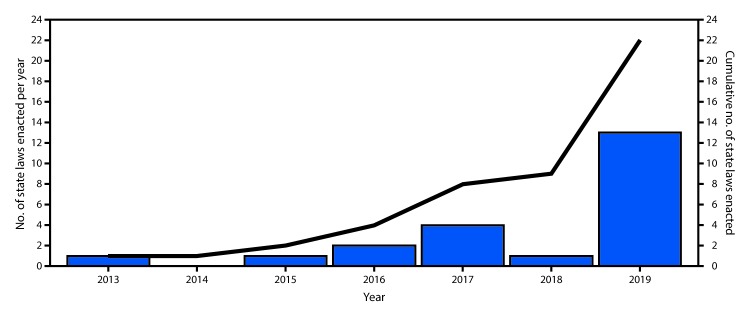
Raising the minimum legal sales age (MLSA) for tobacco products to 21 years (T21) is a strategy to help prevent and delay the initiation of tobacco product use (1). On December 20, 2019, Congress raised the federal MLSA for tobacco products from 18 to 21 years. Before enactment of the federal T21 law, localities, states, and territories were increasingly adopting their own T21 laws as part of a comprehensive approach to prevent youth initiation of tobacco products, particularly in response to recent increases in use of e-cigarettes among youths (2). Nearly all tobacco product use begins during adolescence, and minors have cited social sources such as older peers and siblings as a common source of access to tobacco products (1,3). State and territorial T21 laws vary widely and can include provisions that might not benefit the public's health, including penalties to youths for purchase, use, or possession of tobacco products; exemptions for military populations; phase-in periods; and preemption of local laws. To understand the landscape of U.S. state and territorial T21 laws before enactment of the federal law, CDC assessed state and territorial laws prohibiting sales of all tobacco products to persons aged <21 years. As of December 20, 2019, 19 states, the District of Columbia (DC), Guam, and Palau had enacted T21 laws, including 13 enacted in 2019. Compared with T21 laws enacted during 2013-2018, more laws enacted in 2019 have purchase, use, or possession penalties; military exemptions; phase-in periods of 1 year or more; and preemption of local laws related to tobacco product sales. T21 laws could help prevent and reduce youth tobacco product use when implemented as part of a comprehensive approach that includes evidence-based, population-based tobacco control strategies such as smoke-free laws and pricing strategies (1,4).
Conflict of interest statement
All authors have completed and submitted the International Committee of Medical Journal Editors form for disclosure of potential conflicts of interest. No potential conflicts of interest were disclosed.
Figures
References
-
- Institute of Medicine. Public health implications of raising the minimum age of legal access to tobacco products. Washington, DC: National Academies Press, 2015. http://www.nationalacademies.org/hmd/~/media/Files/Report%20Files/2015/T... - PubMed
-
- US Department of Health and Human Services. The health consequences of smoking—50 years of progress: a report of the Surgeon General. Atlanta, GA: US Department of Health and Human Services, CDC; 2014. https://www.cdc.gov/tobacco/data_statistics/sgr/50th-anniversary/index.htm
MeSH terms
LinkOut - more resources
Full Text Sources
Research Materials
