


Current Perspectives on the Auxin-Mediated Genetic Network that Controls the Induction of Somatic Embryogenesis in Plants
- PMID: 32079138
- PMCID: PMC7072907
- DOI: 10.3390/ijms21041333
Current Perspectives on the Auxin-Mediated Genetic Network that Controls the Induction of Somatic Embryogenesis in Plants
Abstract
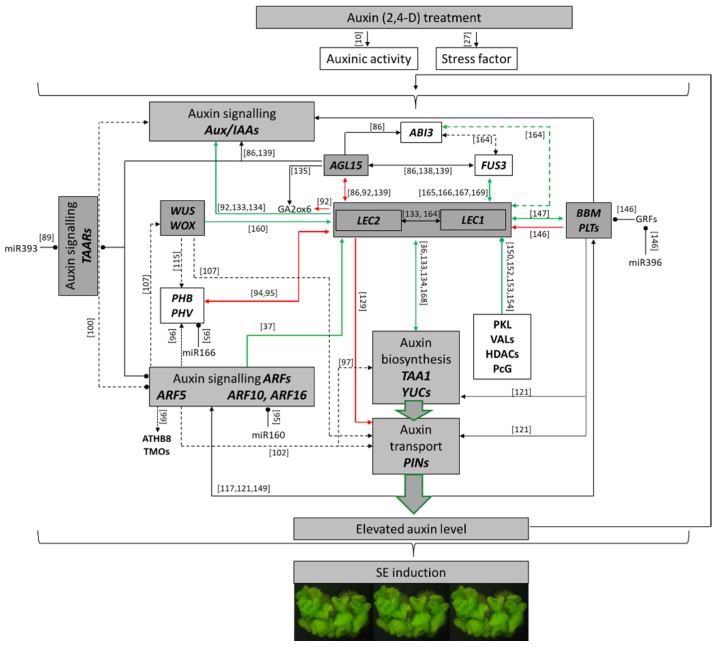
Auxin contributes to almost every aspect of plant development and metabolism as well as the transport and signalling of auxin-shaped plant growth and morphogenesis in response to endo- and exogenous signals including stress conditions. Consistently with the common belief that auxin is a central trigger of developmental changes in plants, the auxin treatment of explants was reported to be an indispensable inducer of somatic embryogenesis (SE) in a large number of plant species. Treating in vitro-cultured tissue with auxins (primarily 2,4-dichlorophenoxyacetic acid, which is a synthetic auxin-like plant growth regulator) results in the extensive reprogramming of the somatic cell transcriptome, which involves the modulation of numerous SE-associated transcription factor genes (TFs). A number of SE-modulated TFs that control auxin metabolism and signalling have been identified, and conversely, the regulators of the auxin-signalling pathway seem to control the SE-involved TFs. In turn, the different expression of the genes encoding the core components of the auxin-signalling pathway, the AUXIN/INDOLE-3-ACETIC ACIDs (Aux/IAAs) and AUXIN RESPONSE FACTORs (ARFs), was demonstrated to accompany SE induction. Thus, the extensive crosstalk between the hormones, in particular, auxin and the TFs, was revealed to play a central role in the SE-regulatory network. Accordingly, LEAFY COTYLEDON (LEC1 and LEC2), BABY BOOM (BBM), AGAMOUS-LIKE15 (AGL15) and WUSCHEL (WUS) were found to constitute the central part of the complex regulatory network that directs the somatic plant cell towards embryogenic development in response to auxin. The revealing picture shows a high degree of complexity of the regulatory relationships between the TFs of the SE-regulatory network, which involve direct and indirect interactions and regulatory feedback loops. This review examines the recent advances in studies on the auxin-controlled genetic network, which is involved in the mechanism of SE induction and focuses on the complex regulatory relationships between the down- and up-stream targets of the SE-regulatory TFs. In particular, the outcomes from investigations on Arabidopsis, which became a model plant in research on genetic control of SE, are presented.
Keywords: ARFs; Aux/IAA; LAFL group genes; auxin; auxin signalling; somatic embryogenesis; transcription factors.
Conflict of interest statement
The authors declare no conflict of interest.
Figures
References
-
- Monja-Mio K.M., Herrera-Alamillo M.Á., Robert M.L. Somatic embryogenesis in temporary immersion bioreactors. In: Loyola-Vargas V., Ochoa-Alejo N., editors. Somatic Embryogenesis: Fundamental Aspects and Applications. 1st ed. Springer International Publishing; Cham, Switzerland: 2016. pp. 435–454.
-
- Ochoa-Alejo N. The uses of somatic embryogenesis for genetic transformation. In: Loyola-Vargas V., Ochoa-Alejo N., editors. Somatic Embryogenesis: Fundamental Aspects and Applications. 1st ed. Springer International Publishing; Cham, Switzerland: 2016. pp. 415–434.
-
- Ikeda M., Kamada H. Comparison of molecular mechanisms of somatic and zygotic embryogenesis. In: Mujib A., Samaj J., editors. Somatic Embryogenesis. 1st ed. Springer; Berlin, Heidelberg: 2006. pp. 51–68.
-
- Wójcikowska B., Gaj M.D. Somatic embryogenesis in Arabidopsis. In: Loyola-Vargas V., Ochoa-Alejo N., editors. Somatic Embryogenesis: Fundamental Aspects and Applications. 1st ed. Springer International Publishing; Cham, Switzerland: 2016. pp. 185–199.
-
- Gaj M.D. Factors influencing somatic embryogenesis induction and plant regeneration with particular reference to Arabidopsis thaliana (L.) Heynh. Plant Growth Regul. 2004;43:27–47. doi: 10.1023/B:GROW.0000038275.29262.fb. - DOI
Publication types
MeSH terms
Substances
Grants and funding
LinkOut - more resources
Full Text Sources
Molecular Biology Databases
