


The effect of patent ductus arteriosus on coronary artery blood flow in premature infants: a prospective observational pilot study
- PMID: 32080335
- PMCID: PMC7222133
- DOI: 10.1038/s41372-020-0622-4
The effect of patent ductus arteriosus on coronary artery blood flow in premature infants: a prospective observational pilot study
Abstract
Objective: To compare coronary flows between premature infants with and without hemodynamically significant patent ductus arteriosus (hsPDA) and to determine if coronary flow is influenced by medical PDA treatment.
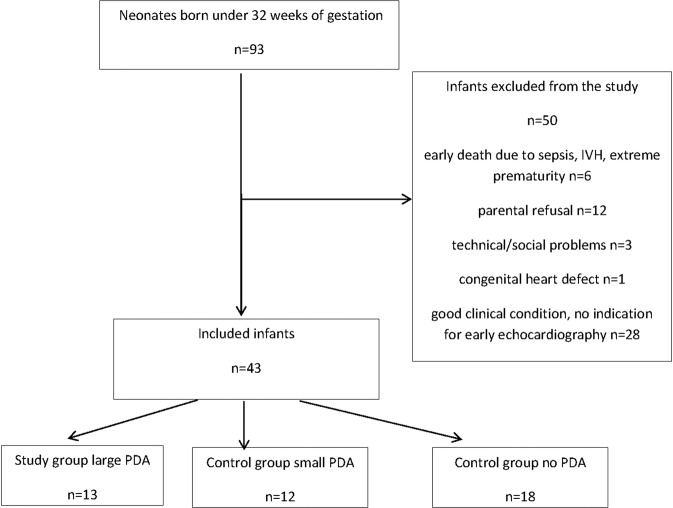
Design: Prospective, observational pilot study. Forty-three infants <32 weeks gestation underwent echocardiography when routinely indicated. Study group included infants with hsPDA requiring treatment. Comparison groups included infants with nonsignificant PDA and infants without PDA.
Results: The study group (n = 13), compared with the comparison groups with nonsignificant PDA (n = 12) and without PDA (n = 18) had higher troponin levels (p = 0.003 and 0.004, respectively). In infants with hsPDA compared with infants with no PDA there was a significant increase in myocardial oxygen demand and decrease in left main coronary artery flow, with nonsignificant increase in cardiac output.
Conclusions: Decrease in coronary artery flows and higher troponin values may suggest a "steal effect," not allowing to meet the elevated myocardial oxygen demand in infants with hsPDA.
Conflict of interest statement
The authors declare that they have no conflict of interest.
Figures
Comment in
-
Ductal steal: does it affect pre-ductal arteries.J Perinatol. 2021 Jan;41(1):179. doi: 10.1038/s41372-020-00851-4. Epub 2020 Oct 6. J Perinatol. 2021. PMID: 33024256 No abstract available.
-
Ductal steal: does it affect pre-ductal arteries.J Perinatol. 2021 Jan;41(1):4-5. doi: 10.1038/s41372-020-00844-3. Epub 2020 Oct 6. J Perinatol. 2021. PMID: 33024257 No abstract available.
References
Publication types
MeSH terms
LinkOut - more resources
Full Text Sources
