Review
. 2020 May 15;87(10):875-884.
doi: 10.1016/j.biopsych.2019.12.018. Epub 2019 Dec 24.

Plasticity of the Reward Circuitry After Early-Life Adversity: Mechanisms and Significance

Affiliations
Review

Plasticity of the Reward Circuitry After Early-Life Adversity: Mechanisms and Significance

Matthew T Birnie et al. Biol Psychiatry. .

Abstract

Disrupted operation of the reward circuitry underlies many aspects of affective disorders. Such disruption may manifest as aberrant behavior including risk taking, depression, anhedonia, and addiction. Early-life adversity is a common antecedent of adolescent and adult affective disorders involving the reward circuitry. However, whether early-life adversity influences the maturation and operations of the reward circuitry, and the potential underlying mechanisms, remain unclear. Here, we present novel information using cutting-edge technologies in animal models to dissect out the mechanisms by which early-life adversity provokes dysregulation of the complex interactions of stress and reward circuitries. We propose that certain molecularly defined pathways within the reward circuitry are particularly susceptible to early-life adversity. We examine regions and pathways expressing the stress-sensitive peptide corticotropin-releasing factor (CRF), which has been identified in critical components of the reward circuitry and interacting stress circuits. Notably, CRF is strongly modulated by early-life adversity in several of these brain regions. Focusing on amygdala nuclei and their projections, we provide evidence suggesting that aberrant CRF expression and function may underlie augmented connectivity of the nucleus accumbens with fear/anxiety regions, disrupting the function of this critical locus of pleasure and reward.

Keywords: Addiction; Amygdala; Anhedonia; CRH; Nucleus accumbens; Stress.


Conflict of interest statement

Financial disclosure statement: Drs. Birnie, Kooiker, Short, Bolton and Chen report no biomedical financial interests or potential conflicts of interest. Dr. Baram has received royalties for a book, reimbursements for her travel expenses from the Gordon Research Conferences and consultant fees from Amzell.

Figures

Figure 1.
Figure 1.. The reward circuitry in the human and rodent brain.
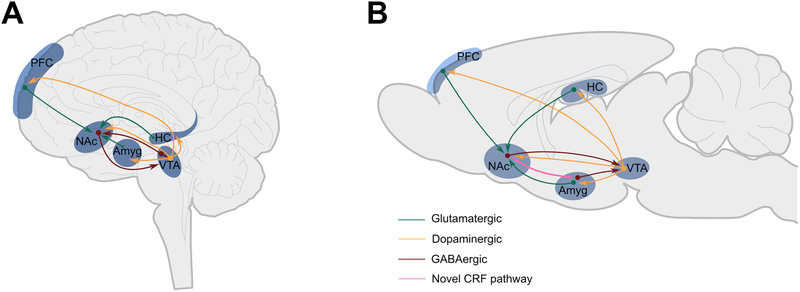
A schematic of the known major dopaminergic, glutamatergic and GABAergic connections between the ventral tegmental area (VTA), amygdala (Amyg) nucleus accumbens (NAc), hippocampus (HC) and prefrontal cortex (PFC) in human (A) and rodent (B) brain. The sine qua non of pleasure/reward in this system is a release of dopamine in the NAc from terminals of VTA-origin neurons. The NAc is further innervated by glutamatergic projections from the PFC, Amyg and HC. A CRH+ projection from the BLA to the NAc has recently been identified.
Figure 2.
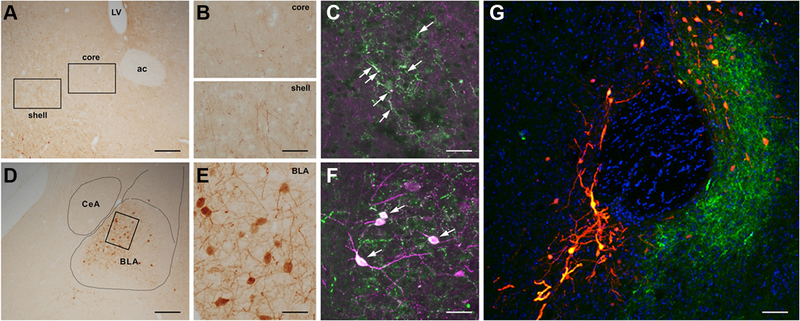
Figure 2.. A CRH expressing pathway between the basolateral amygdala (BLA) and the nucleus accumbens (NAc).
A Cre-driven retrograde adeno-associated virus (AAV2-retro-CAG-FLEX-tdTomato-WPRE) was injected into the NAc of CRH-IRES-Cre mice. (A) Low and (B) high magnification images of CRH+ fiber terminals in the NAc core and shell. (C) High magnification image of antibody-immunolabeled CRH+ fiber terminals colocalized with virus-labeled CRH+ fiber terminals in the NAc. (D-F) The virus retrogradely labels CRH+ cells in the BLA. (G) A low magnification image of the NAc. The tdTomato reporter is shown in orange, immunostaining to confirm CRH localization is shown in green. The section was counter stained with DAPI (blue). Bar = 200um in (A, D), 80um in (B), 35um in (C, F), 40um in (E) and 60um in (G).
Figure 3.
Figure 3.. Early life adversity induces anhedonia.
Rearing mice and rats in a model of simulated poverty results in adolescent and adult anhedonia. This is apparent as measured by reduced sucrose and M&M consumption, as well as diminished social play and hedonic set point for cocaine.
Figure 4.
Figure 4.. Proposed changes to CRH+ connectivity of the reward circuitry following early life adversity.
(A) Connectivity between nodes of the reward circuitry following normal early life experiences. (B) Early life adversity results in aberrant connectivity of key nodes of the reward circuitry. Black arrows = known connectivity, pink arrows = known CRH+ connectivity. NAc -Nucleus accumbens, Hippo = Hippocampus, VTA = Ventral tegmental area, Amyg = Amygdala, PVT = Paraventricular thalamus, PFC = Prefrontal cortex.

References

    1. Di Segni M, Andolina D, Luchetti A, Babicola L, D’Apolito LI, Pascucci T, et al. Unstable Maternal Environment Affects Stress Response in Adult Mice in a Genotype-Dependent Manner. Cereb Cortex. 2016;26:4370–4380. - PubMed
    1. Klengel T, Binder EB. Gene—Environment Interactions in Major Depressive Disorder. Can J Psychiatry. 2013;58:76–83. - PubMed

    1. Hanson JL, Hariri AR, Williamson DE. Blunted Ventral Striatum Development in Adolescence Reflects Emotional Neglect and Predicts Depressive Symptoms. Biol Psychiatry. 2015;78:598–605. - PMC - PubMed
    1. Gaffrey MS, Barch DM, Bogdan R, Farris K, Petersen SE, Luby JL. Amygdala Reward Reactivity Mediates the Association Between Preschool Stress Response and Depression Severity. Biol Psychiatry. 2018;83:128–136. - PMC - PubMed
    1. Short A, Baram TZ. Adverse early-life experiences and neurological disease: Age-old questions and novel answers. Nat Rev Neurol. 2019. 2019. - PMC - PubMed

Publication types

Substances