


Variability and Misclassification of Sleep Apnea Severity Based on Multi-Night Testing
- PMID: 32081650
- PMCID: PMC7339240
- DOI: 10.1016/j.chest.2020.01.039
Variability and Misclassification of Sleep Apnea Severity Based on Multi-Night Testing
Abstract
Background: Portable monitoring is a convenient means for diagnosing sleep apnea. However, data on whether one night of monitoring is sufficiently precise for the diagnosis of sleep apnea are limited.
Research question: The current study sought to determine the variability and misclassification in disease severity over three consecutive nights in a large sample of patients referred for sleep apnea.
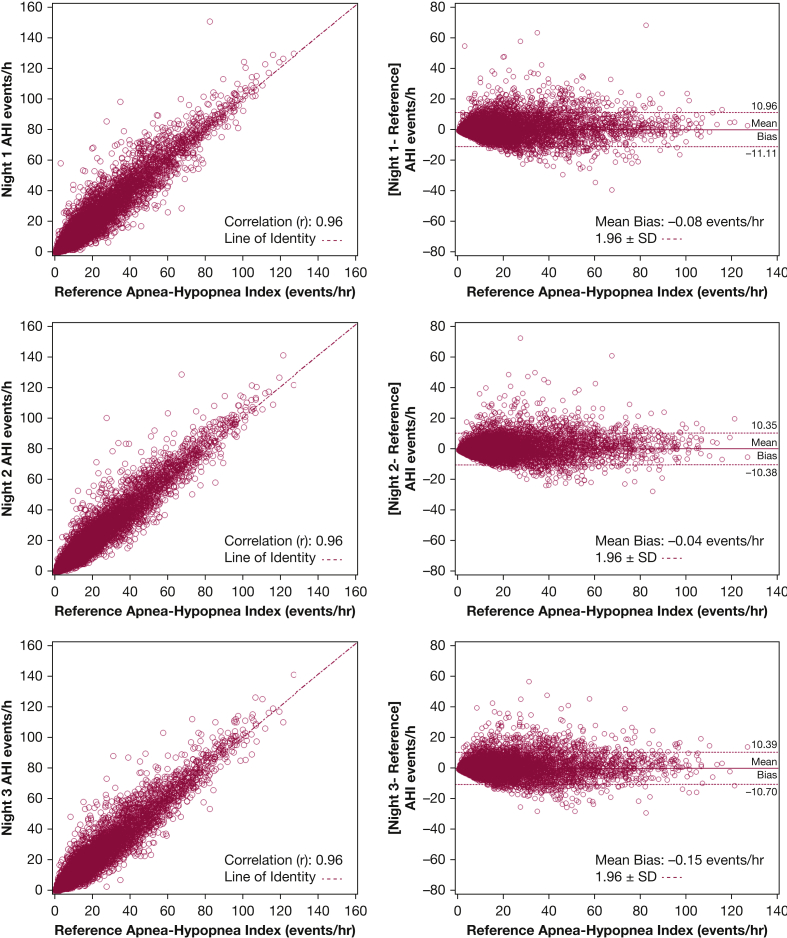
Methods: A sample of 10,340 adults referred for sleep apnea testing was assessed. A self-applied type III monitor was used for three consecutive nights. The apnea-hypopnea index (AHI) was determined for each night, and a reference AHI was computed by using data from all 3 nights. Pairwise correlations and the proportion misclassified regarding disease severity were computed for each of the three AHI values against the reference AHI.
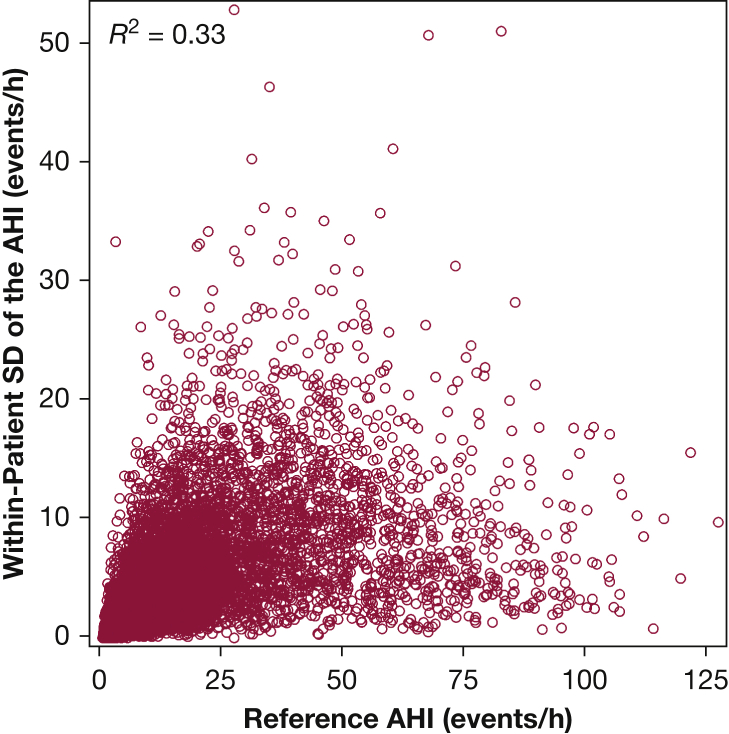
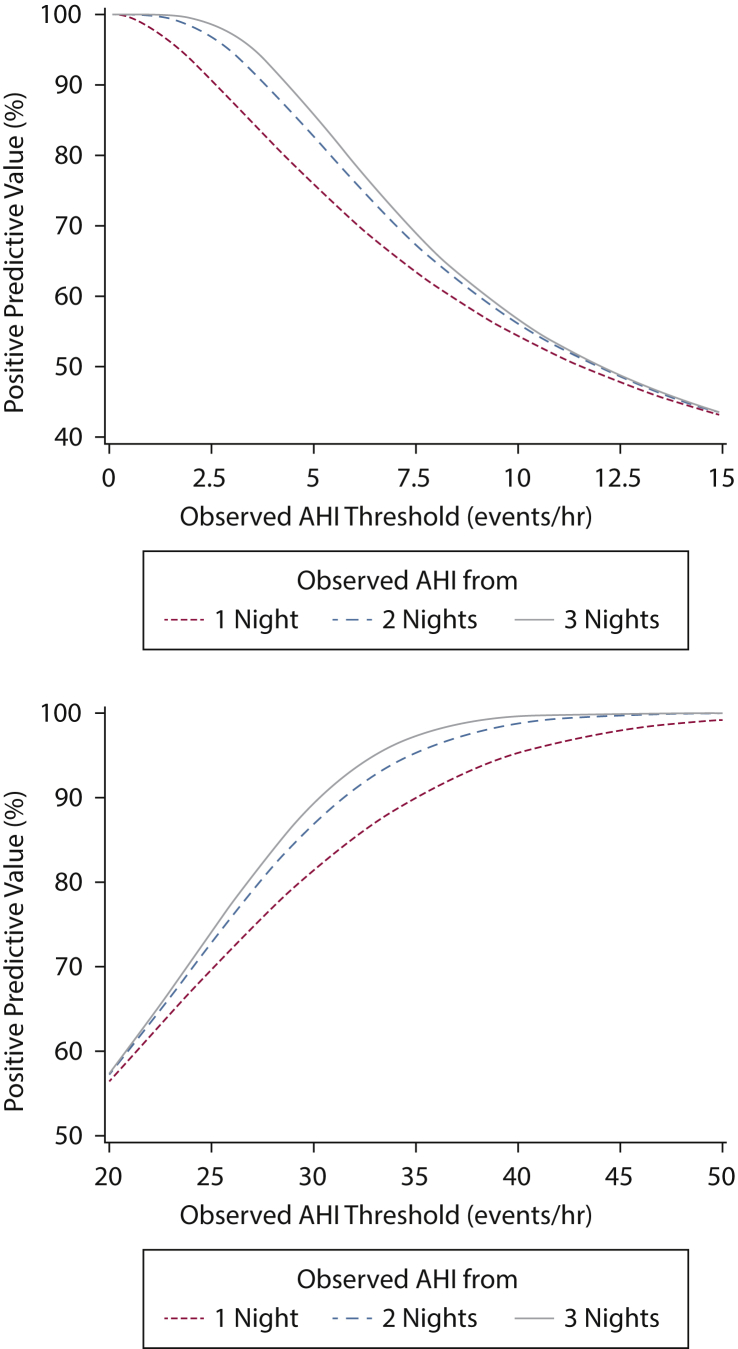
Results: Strong correlations were observed between the AHI from each of the 3 nights (r = 0.87-0.89). However, substantial within-patient variability in the AHI and significant misclassification in sleep apnea severity were observed based on any 1 night of monitoring. Approximately 93% of the patients with a normal study on the first night and 87% of those with severe sleep apnea on the first night were correctly classified compared with the reference derived from all three nights. However, approximately 20% of the patients with mild and moderate sleep apnea on the first night were misdiagnosed either as not having sleep apnea or as having mild disease, respectively.
Conclusions: In patients with mild to moderate sleep apnea, one night of portable testing can lead to misclassification of disease severity given the substantial night-to-night variability in the AHI.
Keywords: home sleep apnea test; portable monitoring; sleep apnea.
Copyright © 2020 American College of Chest Physicians. Published by Elsevier Inc. All rights reserved.
Figures
Comment in
-
It's Time for Multiple Sleep Night Testing in OSA.Chest. 2020 Jul;158(1):33-34. doi: 10.1016/j.chest.2020.02.024. Epub 2020 Jul 2. Chest. 2020. PMID: 32654710 No abstract available.
-
Variability and Misclassification of Sleep Apnea Severity Based on Multi-Night Testing.Chest. 2021 Jan;159(1):453-454. doi: 10.1016/j.chest.2020.07.098. Chest. 2021. PMID: 33422226 No abstract available.
References
-
- Senaratna C.V., Perret J.L., Lodge C.J. Prevalence of obstructive sleep apnea in the general population: a systematic review. Sleep Med Rev. 2017;34:70–81. - PubMed
-
- Floras J.S. Sleep apnea and cardiovascular disease: an enigmatic risk factor. Circ Res. 2018;122(12):1741–1764. - PubMed
-
- Li M., Hou W.S., Zhang X.W., Tang Z.Y. Obstructive sleep apnea and risk of stroke: a meta-analysis of prospective studies. Int J Cardiol. 2014;172(2):466–469. - PubMed
Publication types
MeSH terms
Grants and funding
LinkOut - more resources
Full Text Sources
Medical
