


Exploring the Therapeutic Composition and Mechanism of Jiang-Suan-Chu-Bi Recipe on Gouty Arthritis Using an Integrated Approach Based on Chemical Profile, Network Pharmacology and Experimental Support Using Molecular Cell Biology
- PMID: 32082152
- PMCID: PMC7005212
- DOI: 10.3389/fphar.2019.01626
Exploring the Therapeutic Composition and Mechanism of Jiang-Suan-Chu-Bi Recipe on Gouty Arthritis Using an Integrated Approach Based on Chemical Profile, Network Pharmacology and Experimental Support Using Molecular Cell Biology
Abstract
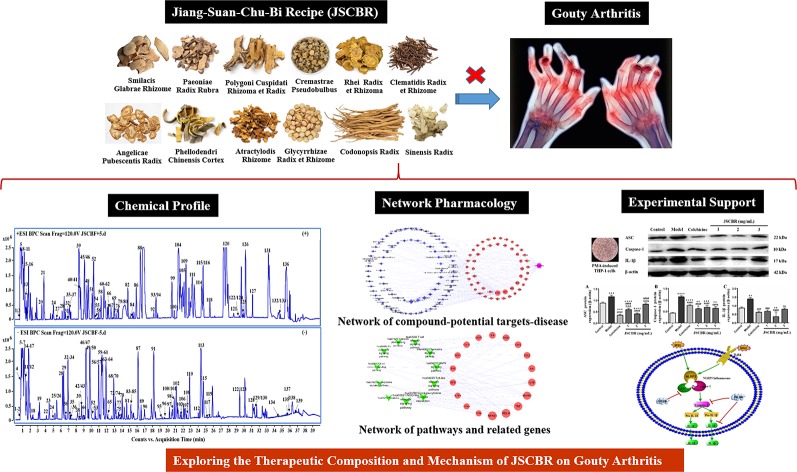
Background: Gouty arthritis is a common metabolic disease caused by long-term purine metabolic disorder and elevated serum uric acid. Jiang-Suan-Chu-Bi recipe (JSCBR), a traditional Chinese herbal formula prescribed according to utilization frequency and cluster analysis, has been clinically validated remedy for gouty arthritis. However, its therapeutic composition and mechanism remains unclear.
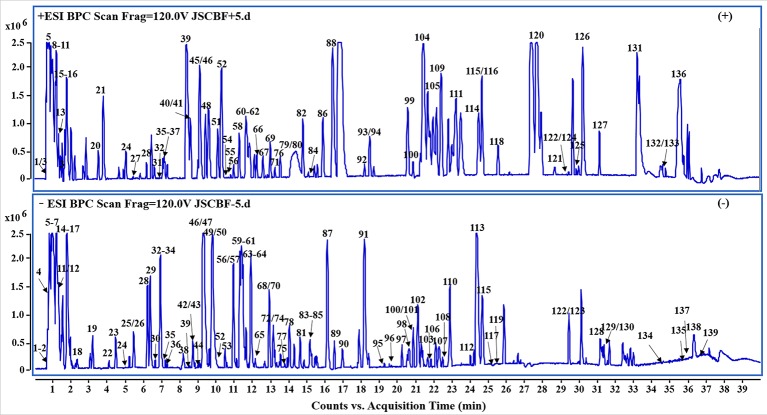
Methods: In the present study, a simple, rapid, and sensitive ultraperformance liquid chromatography coupled with quadrupole time-of-flight mass spectrometry (UHPLC-QTOF-MS)-based chemical profiling was firstly established for comprehensively identifying the major constituents in JSCBR. A phytochemistry-based network pharmacology analysis was further performed to explore the potential therapeutic targets and pathways involved in JSCBR bioactivity. Finally, THP-1 cell model was used to verify the prediction results of network pharmacology by western blot analysis.
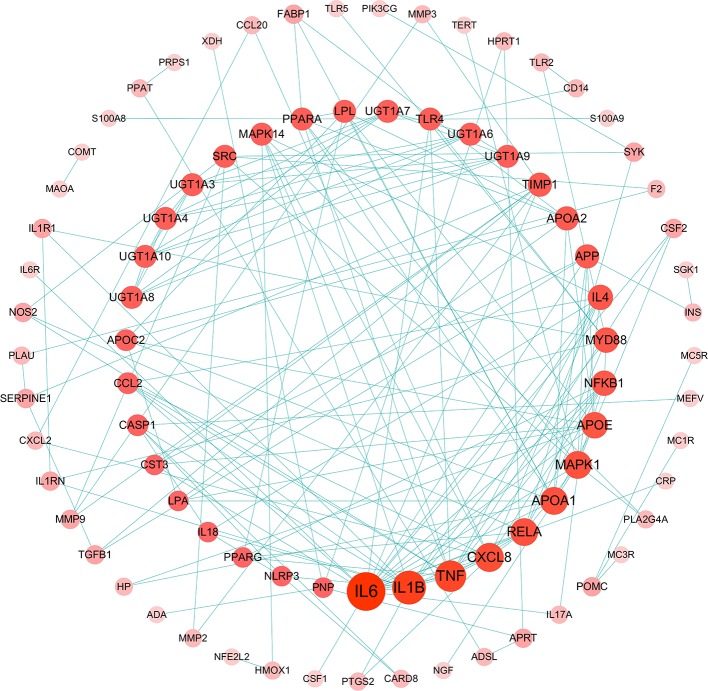
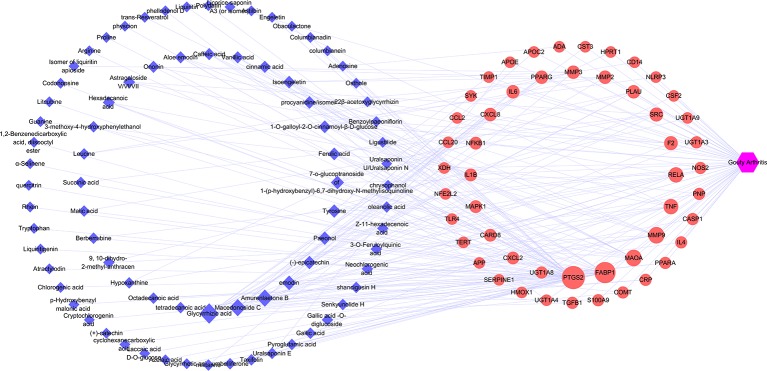
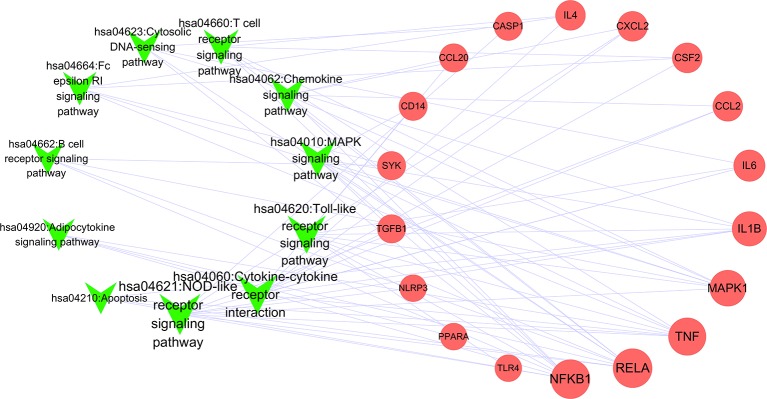
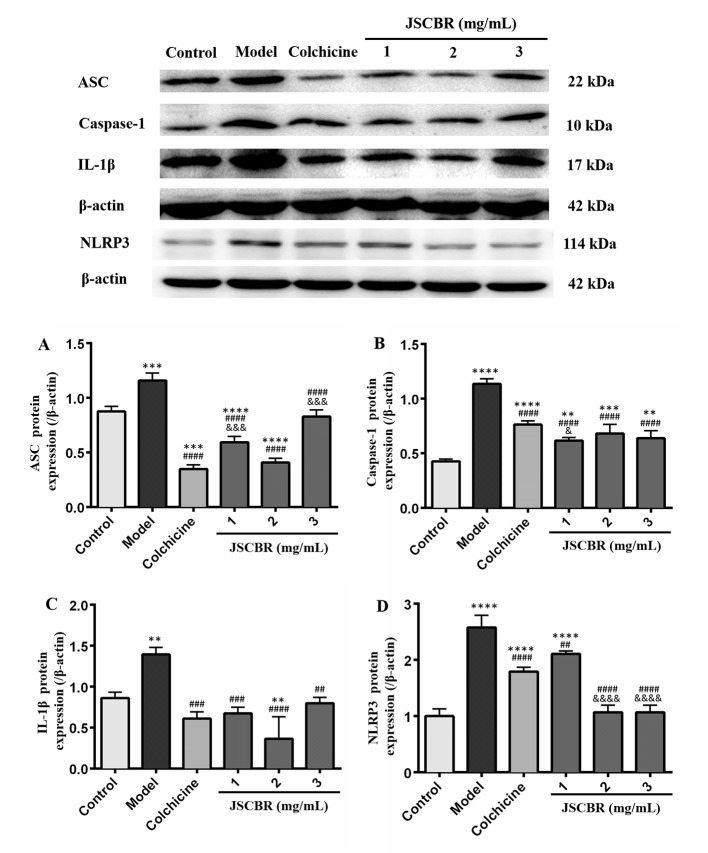
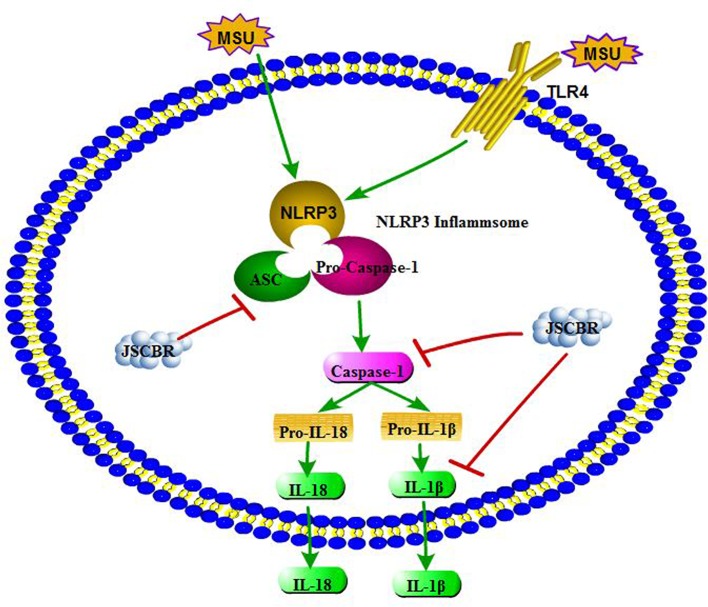
Results: A total of 139 compounds containing phenolic acids, flavonoids, triterpenoid saponins, alkaloids, amino acids, fatty acids, anthraquinones, terpenes, coumarins, and other miscellaneous compounds were identified, respectively. 175 disease genes, 51 potential target nodes, 80 compounds, and 11 related pathways based on network pharmacology analysis were achieved. Among these pathways and genes, NOD-like receptor signaling pathway may play an important role in the curative effect of JSCBR on gouty arthritis by regulation of NRLP3/ASC/CASP1/IL1B. The results of cellular and molecular experiments showed that JSCBR can effectively reduce the protein expression of ASC, caspase-1, IL-1β, and NRLP3 in monosodium urate-induced THP-1 cells, which indicated that JSCBR mediated inflammation in gouty arthritis by inhibiting the activation of NOD-like receptor signaling pathway.
Conclusion: Thus, the integrated approaches adopted in the present study could contribute to simplifying the complex system and providing directions for further research of JSCBR.
Keywords: Jiang-Suan-Chu-Bi recipe (JSCBR); NOD-like receptor signaling pathway; chemical profile; gouty arthritis; network pharmacology.
Copyright © 2020 Xiao, Qu, He, Huang, Qiao, Li, Pan, Sui and Zhang.
Figures
References
-
- Bai Y. J., Xu J. D., Kong M., Gao Q., Liu L. F., Li S. L. (2015). Discovery of characteristic chemical markers for inspecting sulfur-fumigated Radix Angelicae Sinensis by ultra-high performance liquid chromatography-quadrupole/time-of-flight mass spectrometry based metabolomics and chemical profiling approach. Food Res. Int. 76 (3), 387–394. 10.1016/j.foodres.2015.05.055 - DOI - PubMed
-
- Dong Y., Qiu P., Zhu R., Zhao L. S., Zhang P. H., Wang Y. Q., et al. (2019). A combined phytochemistry and network pharmacology approach to reveal the potential antitumor effective substances and mechanism of Phellinus igniarius. Front. Pharmacol. 10, 266. 10.3389/fphar.2019.00266 - DOI - PMC - PubMed
-
- Ge A. H., Ma W. F., Wang C. P., Li J., He J., Liu E. W., et al. (2014). Ultra high performance liquid chromatography with photodiode array detector and quadrupole time-of-flight tandem mass spectrometry coupled with discriminant analysis to evaluate Angelicae pubescentis radix from different regions. J. Sep. Sci. 37 (18), 2523–2534. 10.1002/jssc.201400289 - DOI - PubMed
-
- Guo L. X., Li R., Liu K., Yang J., Li H. J., Li S. L., et al. (2015). Structural characterization and discrimination of Chinese medicinal materials with multiple botanical origins based on metabolite profiling and chemometrics analysis: Clematidis Radix et Rhizoma as a case study. J. Chromatogr. A. 1425, 129–140. 10.1016/j.chroma.2015.11.013 - DOI - PubMed
LinkOut - more resources
Full Text Sources
Miscellaneous
