


The Key Job Demands and Resources of Nursing Staff: An Integrative Review of Reviews
- PMID: 32082226
- PMCID: PMC7005600
- DOI: 10.3389/fpsyg.2020.00084
The Key Job Demands and Resources of Nursing Staff: An Integrative Review of Reviews
Abstract
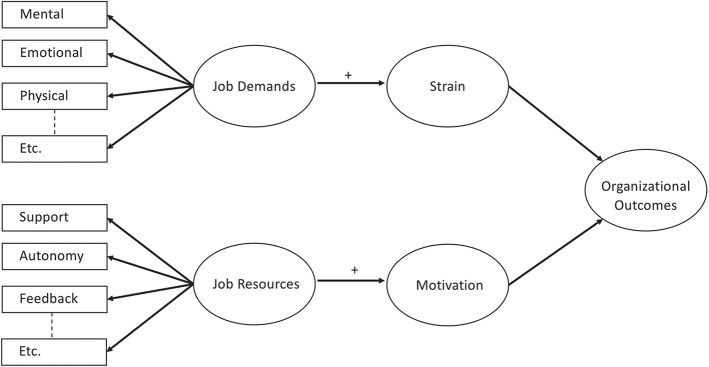
The aim of our review is to identify the key job resources and demands of nursing staff by integrating findings from previously published reviews along the lines of the JD-R model. Understanding these is highly relevant given the ever-increasing pressure in nursing work and the challenges of healthcare organizations in recruiting qualified staff. It is also an important step toward developing targeted workplace interventions. A comprehensive search of the literature identified 14 quantitative and qualitative reviews that were included in our integrative review of reviews. Thematic analysis identified three key job demands and six key job resources of nursing staff, namely work overload, lack of formal rewards, work-life interference, supervisor support, fair and authentic management, transformational leadership, interpersonal relations, autonomy and professional resources. Our results corroborate findings from previous reviews, expand the relevance and generalizability by considering a broader range of relevant health-related and motivational outcomes, and highlight the importance of leadership practices in nursing.
Keywords: JD-R model; healthcare; integrative review; job demands-resources model; nurses; occupational health.
Copyright © 2020 Broetje, Jenny and Bauer.
Figures
References
-
- Aiken L. H., Sermeus W., Van den Heede K., Sloane D. M., Busse R., McKee M., et al. (2012). Patient safety, satisfaction, and quality of hospital care: Cross sectional surveys of nurses and patients in 12 countries in Europe and the United States. BMJ 344:e1717. 10.1136/bmj.e1717 - DOI - PMC - PubMed
-
- Avolio B. J., Gardner W. L., Walumbwa F. O., Luthans F., May D. R. (2004). Unlocking the mask: a look at the process by which authentic leaders impact follower attitudes and behaviors. Leadersh. Q. 15, 801–823. 10.1016/j.leaqua.2004.09.003 - DOI
-
- Bakker A. B., Demerouti E. (2007). The job demands-resources model: State of the art. J. Manage. Psychol. 22, 309–328. 10.1108/02683940710733115 - DOI
Publication types
LinkOut - more resources
Full Text Sources
