


Proteomics and antivenom immunoprofiling of Russell's viper (Daboia siamensis) venoms from Thailand and Indonesia
- PMID: 32082369
- PMCID: PMC7004479
- DOI: 10.1590/1678-9199-JVATITD-2019-0048
Proteomics and antivenom immunoprofiling of Russell's viper (Daboia siamensis) venoms from Thailand and Indonesia
Abstract
The Eastern Russell's viper, Daboia siamensis, is a WHO Category 1 medically important venomous snake. It has a wide but disjunct distribution in Southeast Asia. The specific antivenom, D. siamensis Monovalent Antivenom (DsMAV-Thailand) is produced in Thailand but not available in Indonesia, where a heterologous trivalent antivenom, Serum Anti Bisa Ular (SABU), is used instead. This study aimed to investigate the geographical venom variation of D. siamensis from Thailand (Ds-Thailand) and Indonesia (Ds-Indonesia), and the immunorecognition of the venom proteins by antivenoms.
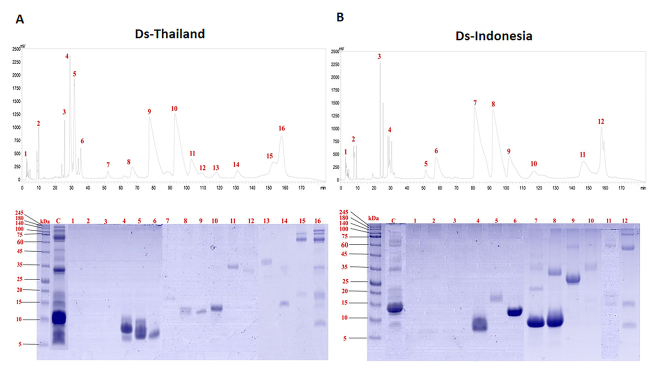
Methods: The venom proteins were decomplexed with reverse-phase high-performance liquid chromatography and sodium dodecyl sulfate-polyacrylamide gel electrophoresis, followed by in-solution tryptic digestion, nano-liquid chromatography-tandem mass spectrometry and protein identification. The efficacies of DsMAV-Thailand and SABU in binding the various venom fractions were assessed using an enzyme-linked immunosorbent assay optimized for immunorecognition profiling.
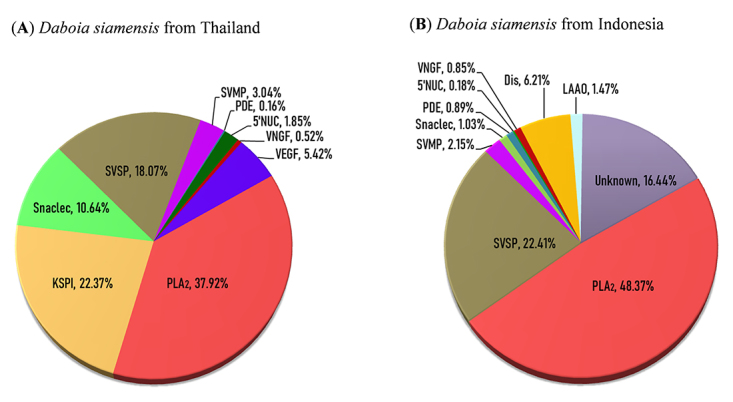
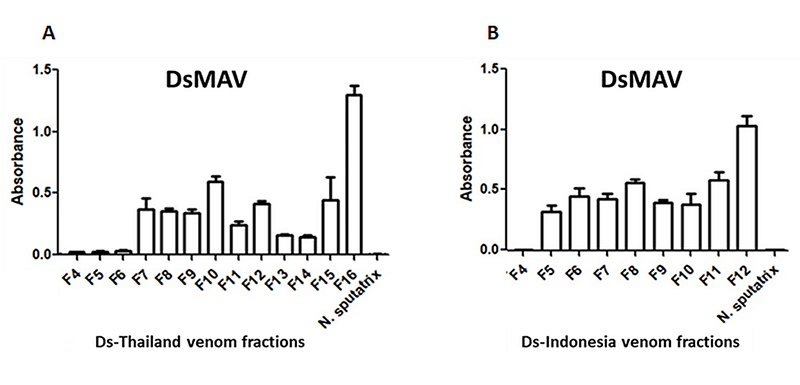
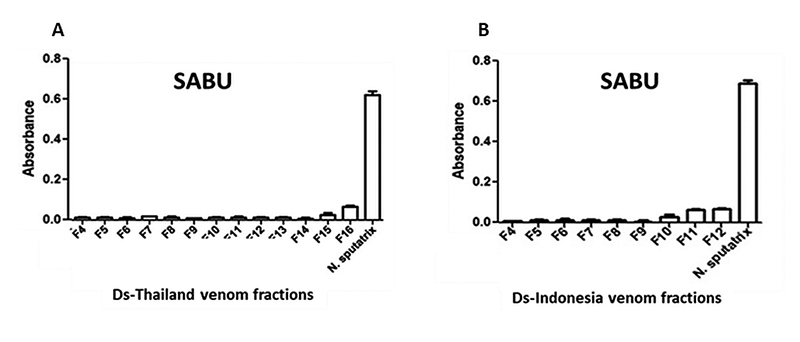
Results: The two most abundant protein families in Ds-Thailand venom are phospholipase A2 (PLA2) and Kunitz-type serine protease inhibitor (KSPI). Those abundant in Ds-Indonesia venom are PLA2 and serine protease. KSPI and vascular endothelial growth factor were detected in Ds-Thailand venom, whereas L-amino acid oxidase and disintegrin were present in Ds-Indonesia venom. Common proteins shared between the two included snaclecs, serine proteases, metalloproteinases, phosphodiesterases, 5'nucleotidases and nerve growth factors at varying abundances. DsMAV-Thailand exhibited strong immunorecognition of the major protein fractions in both venoms, but low immunoreactivity toward the low molecular weight proteins e.g. KSPI and disintegrins. On the other hand, SABU was virtually ineffective in binding all fractionated venom proteins.
Conclusion: D. siamensis venoms from Thailand and Indonesia varied geographically in the protein subtypes and abundances. The venoms, nevertheless, shared conserved antigenicity that allowed effective immunorecognition by DsMAV-Thailand but not by SABU, consistent with the neutralization efficacy of the antivenoms. A specific, appropriate antivenom is needed in Indonesia to treat Russell's viper envenomation.
Keywords: Antivenomics; Eastern Russell's viper; Neutralization; Venomics.
Conflict of interest statement
Competing interests: The authors declare no conflict of interest.
Figures
References
-
- Wüster W. The genus Daboia (Serpentes: Viperidae): Russell's viper. Hamadryad. 1998;23(1):33–40.
-
- Thorpe RS, Pook CE, Malhotra A. Phylogeography of the Russell's viper (Daboia russelii) complex in relation to variation in the colour pattern and symptoms of envenoming. Herpetol J. 2007;17(4):209–218.
-
- Mackessy SP. Evolutionary trends in venom composition in the Western Rattlesnakes (Crotalus viridis sensu lato): Toxicity vs. tenderizers. Toxicon. 2010;55(8):1463–1474. - PubMed
-
- Casewell NR, Wüster W, Vonk FJ, Harrison RA, Fry BG. Complex cocktails: the evolutionary novelty of venoms. Trends Ecol Evol. 2013;28(4):219–229. - PubMed
-
- Faisal T, Tan KY, Sim SM, Quraishi N, Tan NH, Tan CH. Proteomics, functional characterization and antivenom neutralization of the venom of Pakistani Russell's viper (Daboia russelii) from the wild. J Proteomics. 2018;183:1–13. - PubMed
LinkOut - more resources
Full Text Sources