


Tricuspid valve surgery in implantable cardiac electronic device-related endocarditis: Repair or replace?
- PMID: 32082733
- PMCID: PMC7024123
- DOI: 10.5606/tgkdc.dergisi.2018.14790
Tricuspid valve surgery in implantable cardiac electronic device-related endocarditis: Repair or replace?
Abstract
Background: The aim of this study was to investigate lead endocarditis-related tricuspid valve regurgitation, to identify underlying causes, and to report our surgical approaches to tricuspid valve endocarditis.
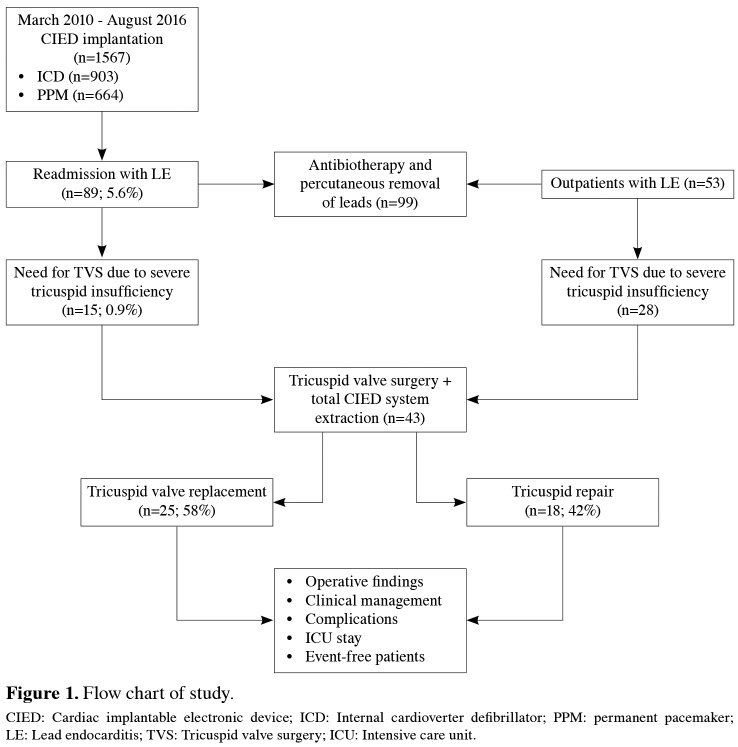
Methods: Between March 2010 and August 2016, medical records of a total of 43 patients (23 males, 20 females; mean age: 63.2±13.6 years; range 48 to 72 years) who underwent tricuspid valve surgery for severe tricuspid regurgitation caused by lead endocarditis, which was previously placed as an implantable cardiac electronic device were reviewed. We removed all systems including infected leads and generators, revised infected wounds and tissues, performed tricuspid valve surgery for lead endocarditis, and applied long-term intravenous antibiotic regimen for the culprit agent, as confirmed by the culture.
Results: Of 43 patients, 18 underwent tricuspid valve repair and 25 underwent tricuspid valve replacement for lead endocarditisrelated severe tricuspid valve regurgitation. During followup (range, 2 to 62 months), two patients required temporary mechanical support due to postoperative acute right heart failure, while eight patients died due to sepsis (n=6; 14%) and stroke (n=2; 4.6%) in the early postoperative period. The remaining patients showed significant improvement in signs and symptoms of heart failure.
Conclusion: Our study results suggest that incompetent experience and inaccurate decision for valve repair may result in delayed valve replacement and prolonged operation time.
Keywords: Implantable cardioverter defibrillator; lead endocarditis; permanent pacemaker; tricuspid valve surgery.
Copyright © 2018, Turkish Society of Cardiovascular Surgery.
Conflict of interest statement
Conflict of Interest: The authors declared no conflicts of interest with respect to the authorship and/or publication of this article.
Figures
References
-
- Habib G, Hoen B, Tornos P, Thuny F, Prendergast B, Vilacosta I, et al. Guidelines on the prevention, diagnosis, and treatment of infective endocarditis (new version 2009): the Task Force on the Prevention, Diagnosis, and Treatment of Infective Endocarditis of the European Society of Cardiology (ESC). Endorsed by the European Society of Clinical Microbiology and Infectious Diseases (ESCMID) and the International Society of Chemotherapy (ISC) for Infection and Cancer. Eur Heart J. 2009;30:2369–2413. - PubMed
-
- Heydari AA, Safari H, Sarvghad MR. Isolated tricuspid valve endocarditis. e109-11Int J Infect Dis. 2009;13 - PubMed
-
- Cabell CH, Heidenreich PA, Chu VH, Moore CM, Stryjewski ME, Corey GR, et al. Increasing rates of cardiac device infections among Medicare beneficiaries: 1990-1999. Am Heart J. 2004;147:582–586. - PubMed
-
- Byrne JG, Rezai K, Sanchez JA, Bernstein RA, Okum E, Leacche M, et al. Surgical management of endocarditis: the society of thoracic surgeons clinical practice guideline. Ann Thorac Surg. 2011;91:2012–2019. - PubMed
LinkOut - more resources
Full Text Sources