


Correlation between serum lactate levels and outcome in pediatric patients undergoing congenital heart surgery
- PMID: 32082767
- PMCID: PMC7018278
- DOI: 10.5606/tgkdc.dergisi.2018.15791
Correlation between serum lactate levels and outcome in pediatric patients undergoing congenital heart surgery
Abstract
Background: This study aimed to investigate the correlation between perioperative arterial lactate levels and morbidity and mortality in children undergoing cardiac surgery.
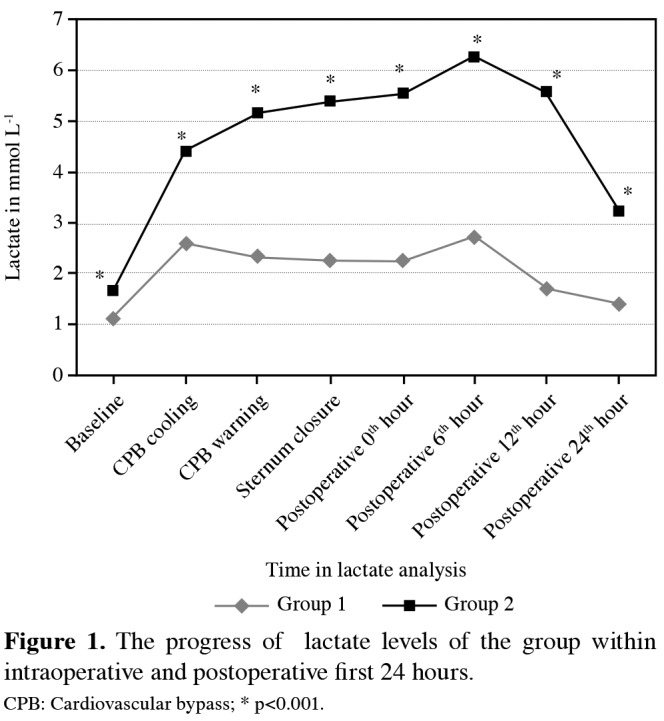
Methods: A total of 236 patients who underwent open heart surgery due to congenital heart disease (121 males, 115 females; mean age 56.4 month (median: 42 month): range, 1 day to 204 month) between June 2014 and May 2016 were retrospectively analyzed. The arterial blood gas analysis results at baseline (after insertion of arterial cannula), during the cooling and warming-up phases in cardiopulmonary bypass, during the sternal closure, and at 0, 6, 12, and 24 hours in the postoperative intensive care unit stay were recorded. The patients were divided into two groups according to their lactate levels: Group 1 (lactate level <4.5 mmol/L, n=183) and Group 2 (lactate level ≥4.5 mmol/L, n=53). Correlation between the lactate groups and demographic data, intraoperative and postoperative variables, postoperative complications, and mortality were investigated.
Results: Sixty-nine patients (29.2%) had cyanotic heart disease. A total of 53 patients (22.5%) had lactate levels of ≥4.5 mmol/L. At least one complication occurred in 41% of the patients. Development of at least one complication (p=0.027) and mortality rate (p<0.001) were significantly higher in the patients with lactate levels of ≥4.5 mmol/L. Seventeen patients (7.2%) died in the postoperative period, and 15 of them had lactate levels of ≥4.5 mmol/L at least once within the first 24 hours. In terms of mortality, lactate levels of ≥4.5 mmol/L at any time, prolonged mechanical ventilation (>48 hours), and undergoing complex surgery (high the Risk-adjusted Classification for Congenital Heart Surgery-1 score, category 4-6) were the independent risk factors for mortality.
Conclusion: Blood arterial lactate level of ≥4.5 mmol/L was found to be a risk factor for postoperative morbidity and mortality in pediatric patients undergoing congenital heart surgery.
Keywords: Cardiac surgery; congenital; heart defects; lactate; mortality; postoperative complications.
Copyright © 2018, Turkish Society of Cardiovascular Surgery.
Conflict of interest statement
Conflict of Interest: The authors declared no conflicts of interest with respect to the authorship and/or publication of this article.
Figures
References
-
- Mizock BA, Falk JL. Lactic acidosis in critical illness. Crit Care Med. 1992;20:80–93. - PubMed
-
- Manikis P, Jankowski S, Zhang H, Kahn RJ, Vincent JL. Correlation of serial blood lactate levels to organ failure and mortality after trauma. Am J Emerg Med. 1995;13:619–622. - PubMed
-
- Cheifetz IM, Kern FH, Schulman SR, Greeley WJ, Ungerleider RM, Meliones JN. Serum lactates correlate with mortality after operations for complex congenital heart disease. Ann Thorac Surg. 1997;64:735–738. - PubMed
-
- Schumacher KR, Reichel RA, Vlasic JR, Yu S, Donohue J, Gajarski RJ, et al. Rate of increase in serum lactate level riskstratifies infants after surgery for congenital heart disease. J Thorac Cardiovasc Surg. 2014;148:589–595. - PubMed
LinkOut - more resources
Full Text Sources