


The causal effect of retirement on stress in older adults in China: A regression discontinuity study
- PMID: 32083164
- PMCID: PMC7016446
- DOI: 10.1016/j.ssmph.2019.100462
The causal effect of retirement on stress in older adults in China: A regression discontinuity study
Erratum in
-
Erratum regarding missing Declaration of Competing Interest statements in previously published articles.SSM Popul Health. 2020 Dec 10;12:100716. doi: 10.1016/j.ssmph.2020.100716. eCollection 2020 Dec. SSM Popul Health. 2020. PMID: 33381638 Free PMC article.
Abstract
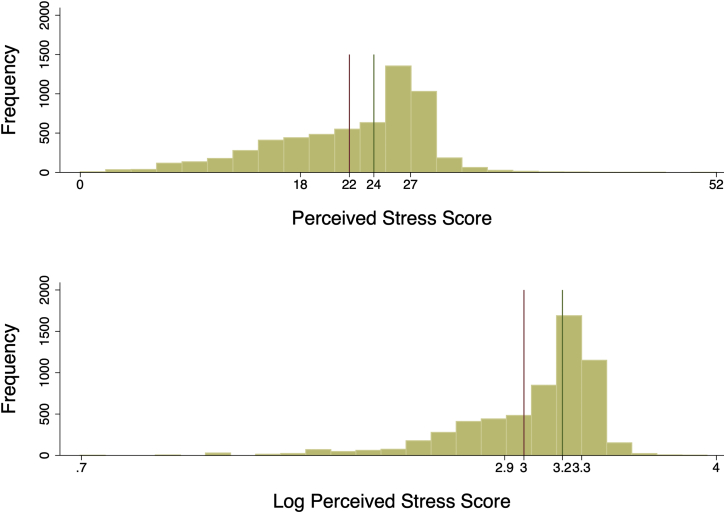
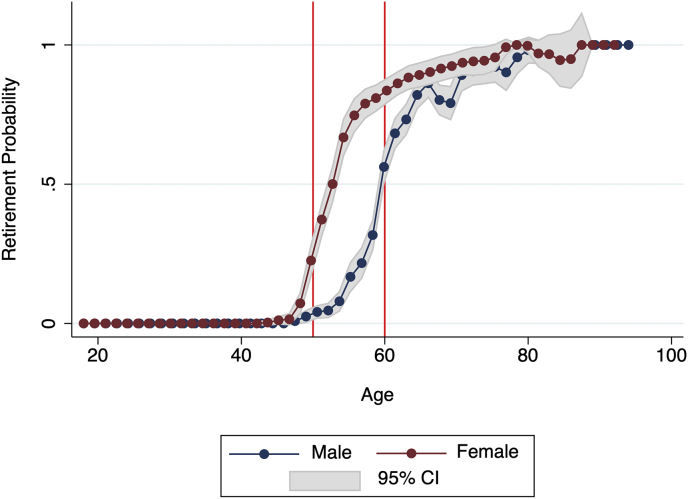
Population aging in middle-income countries, including China, has resulted in strong economic incentives to increase the retirement age. These economic incentives should be weighed up against the effects of later retirement on physical and mental health and wellbeing. We aimed to determine the causal effect of retirement on perceived stress, an important measure of mental well-being. We used data from the China Health and Nutrition Survey in 2015 and adopted a non-parametric regression discontinuity design (RDD) to measure the causal effect of retirement on stress. Stress was assessed using the Perceived Stress Scale (PSS)-14. On average, the effect of retirement on stress was close to the null value and insignificant. In subgroup analyses, we found that retirement reduces stress in men but raises stress in women. Though these gender-specific effects were not statistically significant, their magnitudes were large. Thus, the average null result in the entire population appears to hide opposite gender-specific effects. More research is needed to confirm this finding in studies with larger sample sizes and understand the gender-specific pathways leading from retirement to stress.
Keywords: China; Regression discontinuity design; Retirement; Stress.
© 2019 The Authors.
Figures
References
-
- Adams O., Lefebvre L. Retirement and mortality. Aging and Work. 1981;4:115–120. - PubMed
-
- Adams G.A., Prescher J., Beehr T.A., Lepisto L. Applying work-role attachment theory to retirement decision-making. The International Journal of Aging and Human Development. 2002;54:125–137. - PubMed
-
- Atchley R.C., Robinson J.L. Attitudes toward retirement and distance from the event. Research on Aging. 1982;4:299–313.
-
- Bärnighausen T., Oldenburg C., Tugwell P., Bommer C., Ebert C., Barreto M. Quasi-experimental study designs series-paper 7: Assessing the assumptions. Journal of Clinical Epidemiology. 2017;89:53–66. - PubMed
-
- Bertoni M., Brunello G. Pappa Ante Portas: The effect of the husband's retirement on the wife's mental health in Japan. Social Science & Medicine. 2017;175:135–142. - PubMed
Grants and funding
LinkOut - more resources
Full Text Sources
