


Disability and Recovery After Hospitalization for Medical Illness Among Community-Living Older Persons: A Prospective Cohort Study
- PMID: 32083319
- PMCID: PMC7735402
- DOI: 10.1111/jgs.16350
Disability and Recovery After Hospitalization for Medical Illness Among Community-Living Older Persons: A Prospective Cohort Study
Abstract
Objectives: To determine for each basic, instrumental, and mobility activity after hospitalization for acute medical illness: (1) disability prevalence immediately before and monthly for 6 months after hospitalization; (2) disability incidence 1 month after hospitalization; and (3) recovery time from incident disability during months 2 to 6 after hospitalization.
Design: Prospective cohort study.
Setting: New Haven, Connecticut.
Participants: A total of 515 community-living persons, mean age 82.7 years, hospitalized for acute noncritical medical illness and alive within 1 month of hospital discharge.
Measurements: Disability was defined monthly for each basic (bathing, dressing, walking, transferring), instrumental (shopping, housework, meal preparation, taking medications, managing finances), and mobility activity (walking a quarter mile, climbing flight of stairs, lifting/carrying 10 pounds, driving) if help was needed to perform the activity or if a car was not driven in the prior month.
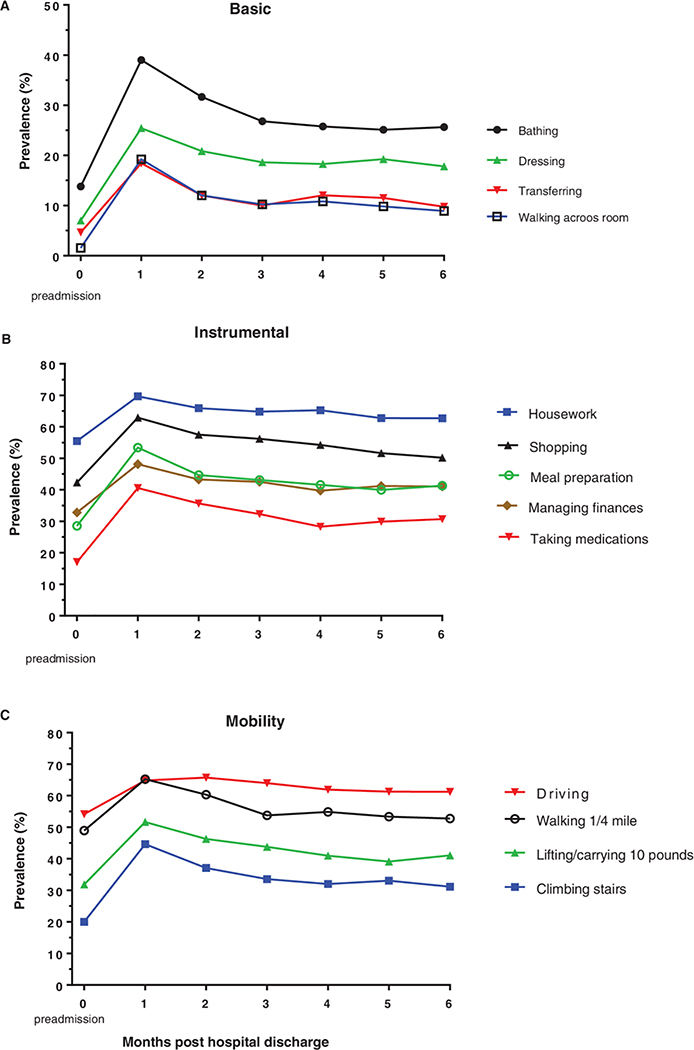
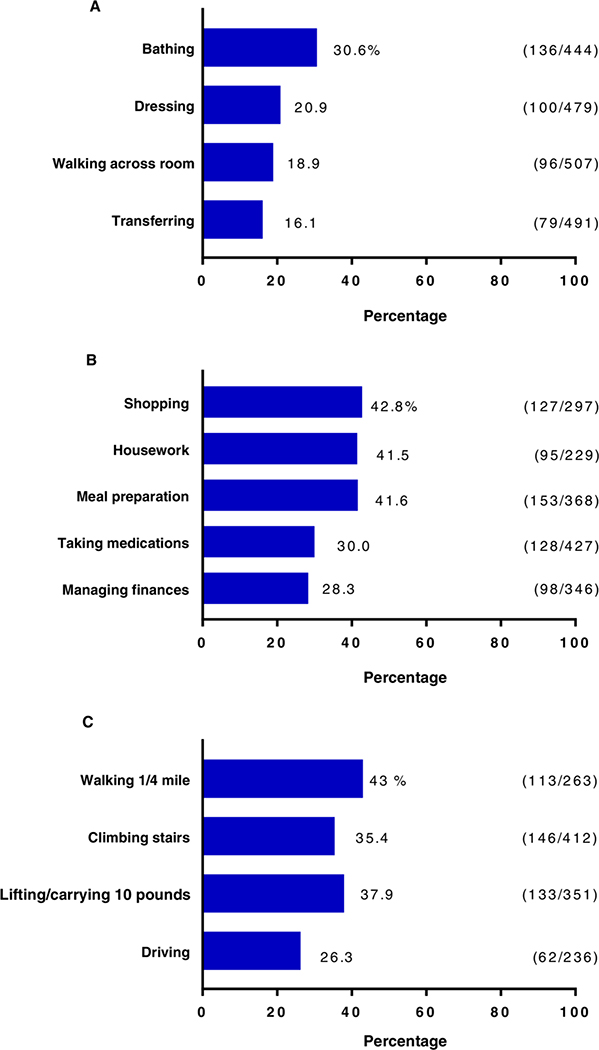
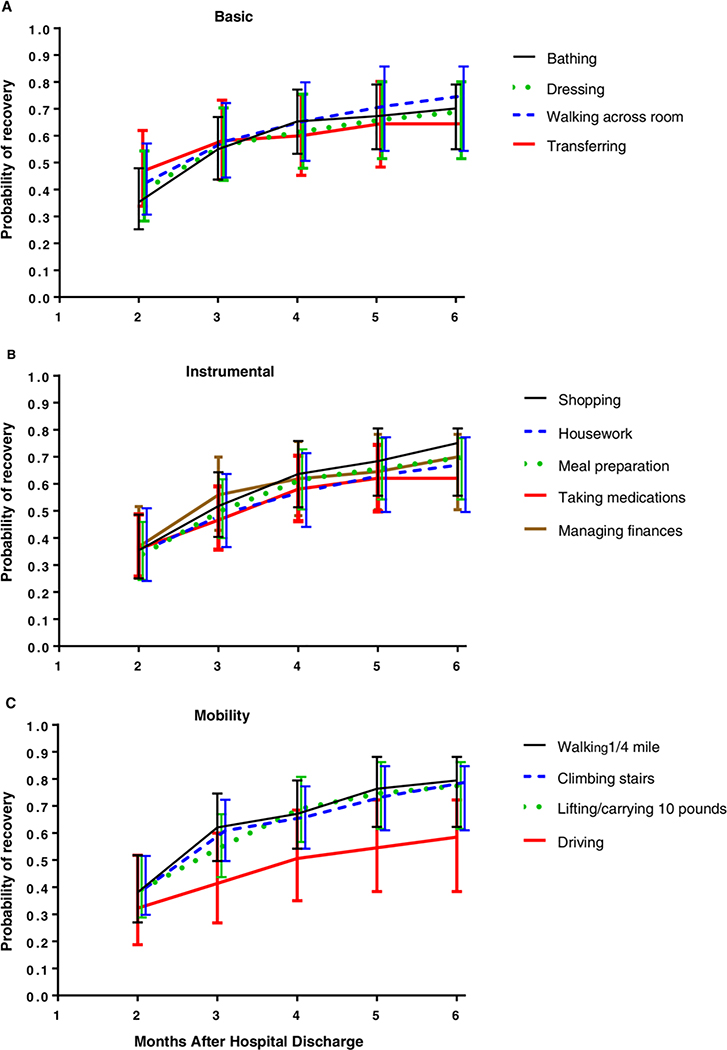
Results: Disability was common 1 and 6 months after hospitalization for activities frequently involved in leaving the home to access care including walking a quarter mile (prevalence 65% and 53%, respectively) and driving (65% and 61%). Disability was also common for activities involved in self-managing chronic health conditions including meal preparation (53% and 41%) and taking medications (41% and 31%). New disability was common and often prolonged. For example, 43% had new disability walking a quarter mile, and 30% had new disability taking medications, with mean recovery time of 1.9 months and 1.7 months, respectively. Findings were similar for the subgroup of persons residing at home (ie, not in a nursing home) at the first monthly follow-up interview after hospitalization.
Conclusion: Disability in specific functional activities important to leaving home to access care and self-managing health conditions is common, often new, and present for prolonged time periods after hospitalization for acute medical illness. Post-discharge care should support patients through extended periods of vulnerability beyond the immediate transitional period. J Am Geriatr Soc 68:486-495, 2020.
Keywords: disability; function; geriatrics; hospital care; transitional care.
© 2020 The American Geriatrics Society.
Conflict of interest statement
Conflict of Interest
Kumar Dharmarajan is the chief scientific officer of Clover Health, a Medicare Advantage company. The other authors have declared no conflicts of interest for this article.
Figures
Comment in
-
After Three Decades of Study, Hospital-Associated Disability Remains a Common Problem.J Am Geriatr Soc. 2020 Mar;68(3):465-466. doi: 10.1111/jgs.16349. Epub 2020 Feb 21. J Am Geriatr Soc. 2020. PMID: 32083324 No abstract available.
References
-
- Sager MA, Franke T, Inouye SK, et al. Functional outcomes of acute medical illness and hospitalization in older persons. Arch Intern Med. 1996; 156:645–652. - PubMed
-
- Gill TM, Allore HG, Holford TR, Guo Z. Hospitalization, restricted activity, and the development of disability among older persons. JAMA. 2004; 292:2115–2124. - PubMed
Publication types
MeSH terms
Grants and funding
LinkOut - more resources
Full Text Sources
Medical
