


Molecular Structure and Function of Janus Kinases: Implications for the Development of Inhibitors
- PMID: 32083640
- PMCID: PMC7395311
- DOI: 10.1093/ecco-jcc/jjz206
Molecular Structure and Function of Janus Kinases: Implications for the Development of Inhibitors
Abstract
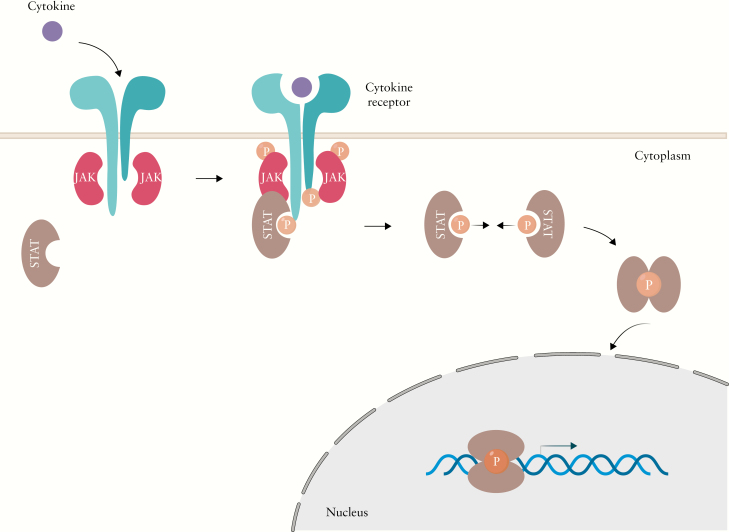
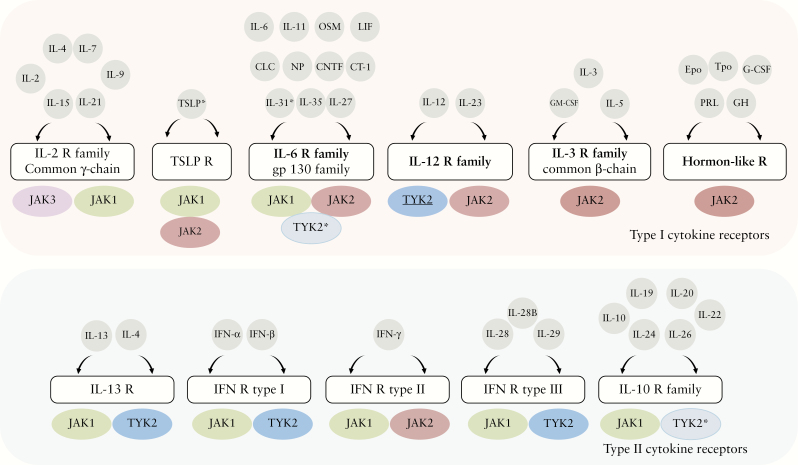
Cytokines can trigger multiple signalling pathways, including Janus tyrosine kinases [JAK] and signal transducers and activators of transcription [STATS] pathways. JAKs are cytoplasmic proteins that, following the binding of cytokines to their receptors, transduce the signal by phosphorylating STAT proteins which enter the nuclei and rapidly target gene promoters to regulate gene transcription. Due to the critical involvement of JAK proteins in mediating innate and adaptive immune responses, these family of kinases have become desirable pharmacological targets in inflammatory diseases, including ulcerative colitis and Crohn's disease. In this review we provide an overview of the main cytokines that signal through the JAK/STAT pathway and the available in vivo evidence on mutant or deleted JAK proteins, and discuss the implications of pharmacologically targeting this kinase family in the context of inflammatory diseases.
Keywords: Janus tyrosine kinase; cytokine signalling; inflammatory bowel disease.
© European Crohn’s and Colitis Organisation (ECCO) 2019.
Figures

References
-
- Fuss IJ, Neurath M, Boirivant M, et al. Disparate CD4+ lamina propria [LP] lymphokine secretion profiles in inflammatory bowel disease. Crohn’s disease LP cells manifest increased secretion of IFN-gamma, whereas ulcerative colitis LP cells manifest increased secretion of IL-5. J Immunol 1996;157:1261–70. - PubMed
-
- Kusugami K, Matsuura T, West GA, Youngman KR, Rachmilewitz D, Fiocchi C. Loss of interleukin-2-producing intestinal CD4+ T cells in inflammatory bowel disease. Gastroenterology 1991;101:1594–605. - PubMed
-
- Fiocchi C, Hilfiker ML, Youngman KR, Doerder NC, Finke JH. Interleukin 2 activity of human intestinal mucosa mononuclear cells. Decreased levels in inflammatory bowel disease. Gastroenterology 1984;86:734–42. - PubMed
-
- Sadlack B, Merz H, Schorle H, Schimpl A, Feller AC, Horak I. Ulcerative colitis-like disease in mice with a disrupted interleukin-2 gene. Cell 1993;75:253–61. - PubMed
-
- Kühn R, Löhler J, Rennick D, Rajewsky K, Müller W. Interleukin-10-deficient mice develop chronic enterocolitis. Cell 1993;75:263–74. - PubMed
Publication types
MeSH terms
Substances
LinkOut - more resources
Full Text Sources
Other Literature Sources
