


Application of Behavioral Risk Factor Surveillance System Sampling Weights to Transgender Health Measurement
- PMID: 32084102
- PMCID: PMC7329606
- DOI: 10.1097/NNR.0000000000000428
Application of Behavioral Risk Factor Surveillance System Sampling Weights to Transgender Health Measurement
Abstract
Background: Obtaining representative data from the transgender population is fundamental to improving their health and well-being and advancing transgender health research. The addition of the Behavioral Risk Factor Surveillance System (BRFSS) gender identity measure is a promising step toward better understanding transgender health. However, methodological concerns have emerged regarding the validity of data collected from transgender participants and its effect on the accuracy of population parameters derived from those data.
Objectives: The aim of the study was to provide rationale substantiating concerns with the formulation and application of the 2015 BRFSS sampling weights and address the methodological challenges that arise when using this surveillance data to study transgender population health.
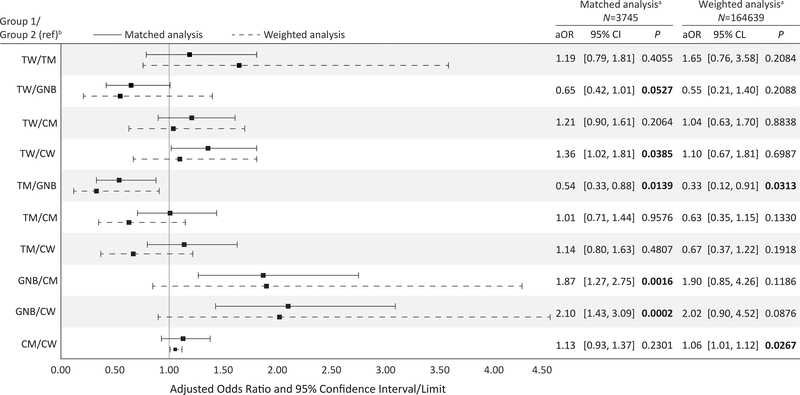
Methods: We examined the 2015 BRFSS methodology and used the BRFSS data to present a comparison of poor health status using two methodological approaches (a matched-subject design and the full BRFSS sample with sampling weights applied) to compare their effects on parameter estimates.
Results: Measurement error engendered by BRFSS data collection procedures introduced sex/gender identity discordance and contributed to problematic sampling weights. The sex-specific "raking" algorithm used by BRFSS to calculate the sampling weights was contingent on the classification accuracy of transgender by participants. Because of the sex/gender identity discordance of 74% of the transgender women and 66% of transgender men, sampling weights may not be able to adequately remove bias. The application of sampling weights has the potential to result in inaccurate parameter estimates when evaluating factors that may influence transgender health.
Discussion: Generalizations made from the weighted analysis may obscure the need for healthcare policy and clinical interventions aimed to promote health and prevent illness for transgender adults. Methods of public health surveillance and population surveys should be reviewed to help reduce systematic bias and increase the validity of data collected from transgender people.
Conflict of interest statement
The authors have no conflicts of interest to report.
Figures
References
-
- Benjamini Y, & Hochberg Y (1995). Controlling the false discovery rate: A practical and powerful approach to multiple testing. Journal of the Royal Statistical Society: Series B (Methodological), 57, 289–300. 10.1111/j.2517-6161.1995.tb02031.x - DOI
-
- Blosnich JR, Lehavot K, Glass JE, & Williams EC (2017). Differences in alcohol use and alcohol-related health care among transgender and nontransgender adults: Findings from the 2014 Behavioral Risk Factor Surveillance System. Journal of Studies on Alcohol and Drugs, 78, 861–866. 10.15288/jsad.2017.78.861 - DOI - PMC - PubMed
-
- Centers for Disease Control and Prevention. (2012). Methodologic changes in the Behavioral Risk Factor Surveillance System in 2011 and potential effects on prevalence estimates. MMWR: Morbidity and Mortality Weekly Report, 61, 410. - PubMed
-
- Centers for Disease Control and Prevention. (2014, December 29). 2015 Behavioral Risk Factor Surveillance System questionnaire. Retrieved from https://www.cdc.gov/brfss/questionnaires/pdf-ques/2015-brfss-questionnai... July 1, 2018
Publication types
MeSH terms
Grants and funding
LinkOut - more resources
Full Text Sources
