. 2020 Feb 7;61(2):32.
doi: 10.1167/iovs.61.2.32.

Long-term Evolution and Remodeling of Soft Drusen in Rhesus Macaques

Affiliations

Long-term Evolution and Remodeling of Soft Drusen in Rhesus Macaques

Glenn Yiu et al. Invest Ophthalmol Vis Sci. .

Abstract

Purpose: To characterize the evolution and structure of soft drusen in aged rhesus macaques using in vivo multimodal retinal imaging and ex vivo histologic and ultrastructural analyses as a nonhuman primate model of early age-related macular degeneration (AMD).

Methods: Multimodal imaging including fundus photography, spectral domain optical coherence tomography (SD-OCT), and fundus autofluorescence (FAF) were used to characterize and track individual drusen lesions in 20 aged rhesus macaques (mean age 23.3 ± 2.7 years) with drusenoid lesions over 2 years, followed by semithin histologic analysis and transmission electron microscopy (TEM).

Results: Although most drusen gradually increased in size, a portion spontaneously regressed or collapsed over 2 years. Histologic analyses showed that soft drusen exhibit hypertrophy and dysmorphia of overlying retinal pigment epithelium (RPE), as seen in early and intermediate AMD, but do not exhibit RPE atrophy, RPE migration, or photoreceptor degeneration characteristic of advanced AMD. Ultrastructure of soft drusen showed abundant lipid particles within Bruch's membrane and AMD-related basal linear deposits (BlinD) resembling those in human drusen.

Conclusions: The dynamic remodeling, histologic findings, and ultrastructural features of soft drusen in aged rhesus macaques support nonhuman primates as an animal model of early AMD and reveal important insights into drusen biogenesis and AMD development.


Conflict of interest statement

Disclosure: G. Yiu, Alimera (C), Allergan (C), Carl Zeiss Meditec (C), Clearside Biomedical (F), Genentech (F,C), Iridex (F,C), Verily (C); S.H. Chung, None; I.N. Mollhoff, None; Y. Wang, None; U.T. Nguyen, None; B. Shibata, None; D. Cunefare, None; S. Farsiu, None; J. Roberts, None; S.M. Thomasy, None

Figures

Figure 1.
Figure 1.
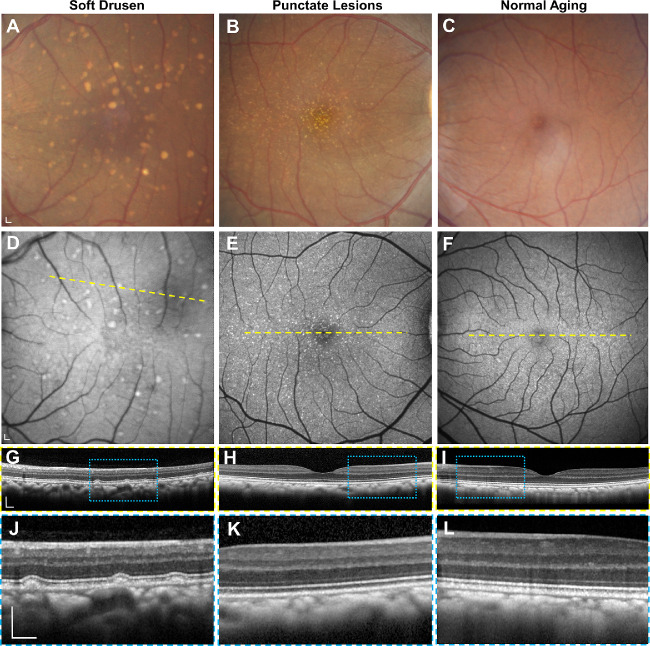
Multimodal imaging of rhesus macaque eyes with drusenoid lesions. Representative images of (AC) color fundus photography, (DF) fundus autofluorescence, and (GL) SD-OCT of the macular region of macaque eyes with (A, D, G, J) soft drusen, (B, E, H, K) punctate lesions, and (C, F, I, L) normal aging. SD-OCT scans in GI correspond to the location of the yellow dashed lines in DF. Magnified views in JL correspond to the blue-dashed regions in GI. Scale bars: 200 μm.
Figure 2.
Figure 2.
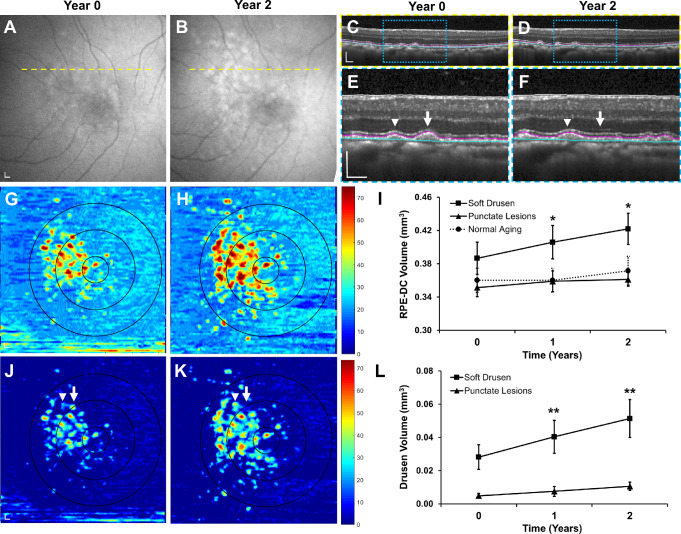
Progression of soft drusen volume in rhesus macaques over 2 years. Representative images of (A, B) fundus autofluorescence and (C, F) SD-OCT of an eye with soft drusen at years 0 and 2. SD-OCT scans in C and D correspond to the yellow dashed lines in A and B. Magnified views in E and F correspond to blue-dashed regions in C and D. Although most soft drusen increased in size (arrowheads) over 2 years, some lesions regressed or collapsed (arrow). Segmentation of the RPE (magenta line) and Bruch's membrane (cyan line) in CF were used to generate (G, H) RPE-DC maps and measure (I) change in RPE-DC volume in the 5-mm-diameter circular region from years 0 to 2. The concentric circles in G and H represent the corresponding 1-mm-, 3-mm-, and 5-mm-diameter regions centered on the fovea at different time points. Abnormal thickening of the RPE-DC more than 2 standard deviations greater than mean age-matched normative data was used to generate (J, K) drusen maps and measure (L) change in drusen volume within the central 5-mm-diameter region. Data are presented as means ± SEM. N = 5 animals (10 eyes) per group. *P < 0.05. **P < 0.01. Scale bars: 200 μm.
Figure 3.
Figure 3.
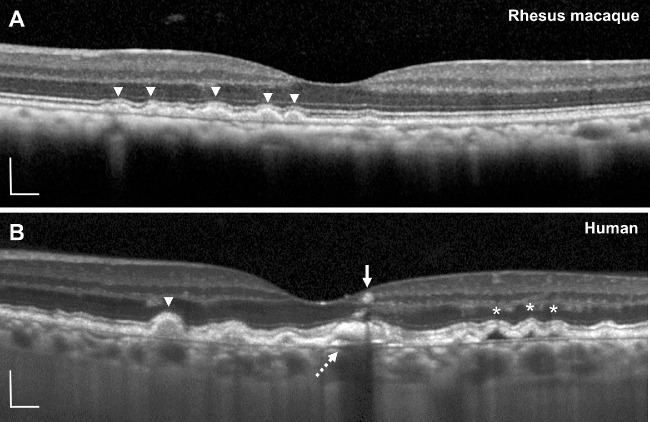
Comparison of soft drusen in rhesus macaques and humans using SD-OCT. Representative SD-OCT images of soft drusen in (A) rhesus macaques and (B) a 74-year-old human participant with intermediate nonneovascular AMD. Soft drusen in rhesus macaques uniformly exhibit homogeneous internal reflectivity similar to some in human AMD (arrowheads). Human drusen may have complex drusen substructures (dashed arrow), hyporeflective cores (asterisks), and intraretinal hyperreflective foci (arrow). Scale bars: 200 μm.
Figure 4.
Figure 4.
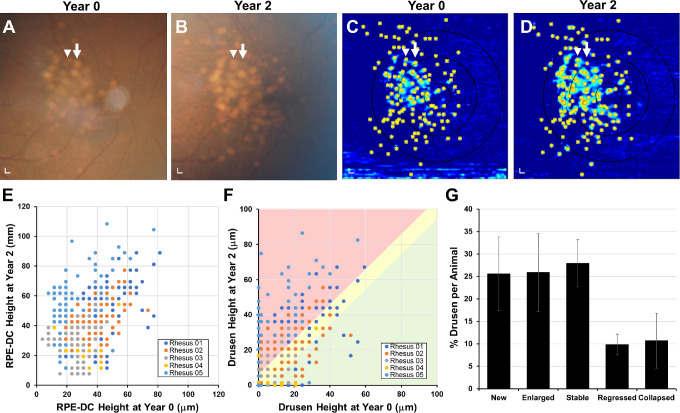
Evolution of individual drusen lesions in rhesus macaques over 2 years. Representative images of (A, B) color fundus photographs from the eye shown in Figure 2 at years 0 and 2, showing growth of some drusen (arrowhead) and collapse of others (arrow). (C, D) Corresponding drusen maps with each druse manually labeled (asterisks) allowed measurement of the change in (E) RPE-DC height and (F) drusen height at each location for five rhesus macaques at years 0 and 2. Over the 2 years, many drusen were new (on vertical axis) or increased in size (red-shaded area), although some remained stable (yellow-shaded area), and a minority regressed (green-shaded area) or completely collapsed (on horizontal axis). (G) Bar graph comparing the proportion of new, enlarged, stable, regressed, and collapsed drusen in this cohort of animals. Data are presented as means ± SEM. N = 5 animals (10 eyes) per group. Scale bars: 200 μm.
Figure 5.
Figure 5.
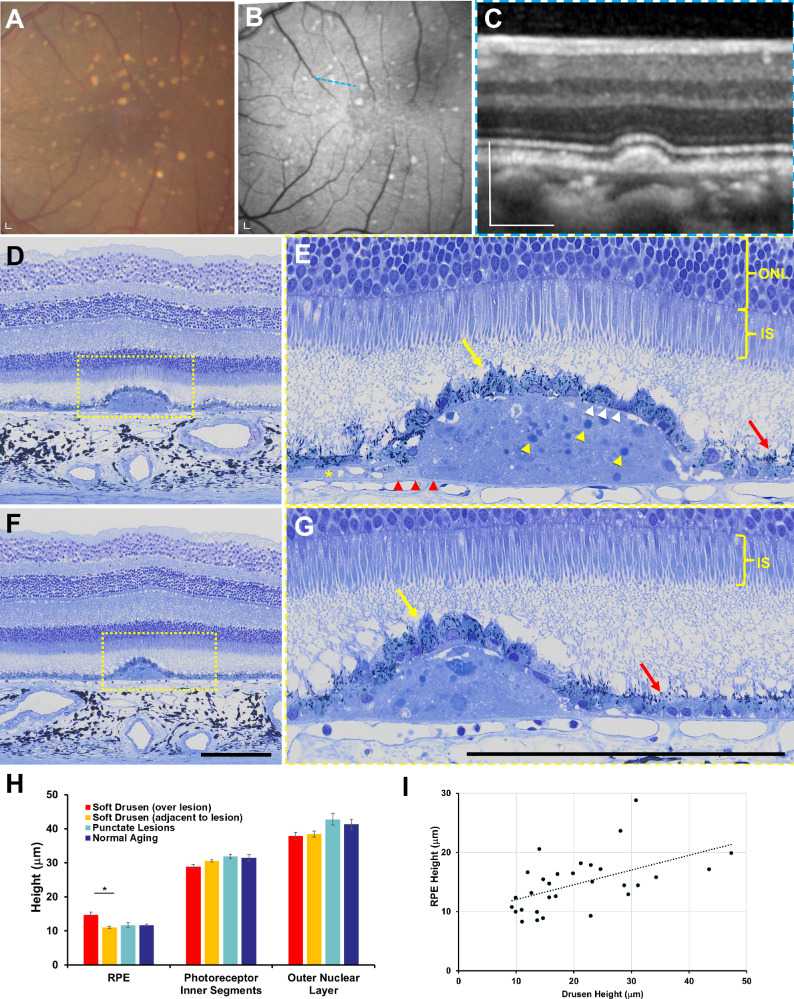
Semithin histologic analysis of soft drusen in rhesus macaques. (A) Color fundus photograph and (B) fundus autofluorescence image of the macular region of an eye with soft drusen, along with (C) SD-OCT image scan along the blue dashed line in B. (D, E) Semithin histologic section across the same druse seen in C shows soft drusen to be dome-shaped deposits between the basal lamina of the RPE (white arrowheads) and BM (red arrowheads) consisting of amorphous material and round droplets representing lipid pools (yellow arrowheads), which extend beyond the border of the mound as basal linear deposits (BlinD, yellow asterisk). The RPE cells overlying drusen (yellow arrow) are hypertrophic and dysmorphic with scattered melanosomes, although more normal-appearing RPE cells adjacent to the drusen (red arrow) have melanosomes that are located along the apical processes. The photoreceptor inner segments (IS) and outer nuclear layer (ONL) overlying drusen appear normal compared to adjacent regions. (F, G) Semithin histologic sections of a different soft druse showing again the hypertrophic and dysmorphic RPE overlying the lesion (yellow arrow) and more normal-appearing RPE with apically located melanosomes (red arrow) nearby. Photoreceptor outer segments were not well preserved in these sections. The magnified views in E and G correspond to the yellow-dashed regions in D and F. Scale bars: 200 μm. (H) Bar graphs comparing height of RPE cells, photoreceptor IS, and ONL in regions overlying and adjacent to lesions in eyes with soft drusen (orange bars) and in eyes with punctate lesions (blue bars) and no lesions/normal aging (green bars). Data are presented as means ± SEM. N = 3 animals (3 eyes) per group. *P < 0.05.
Figure 6.
Figure 6.
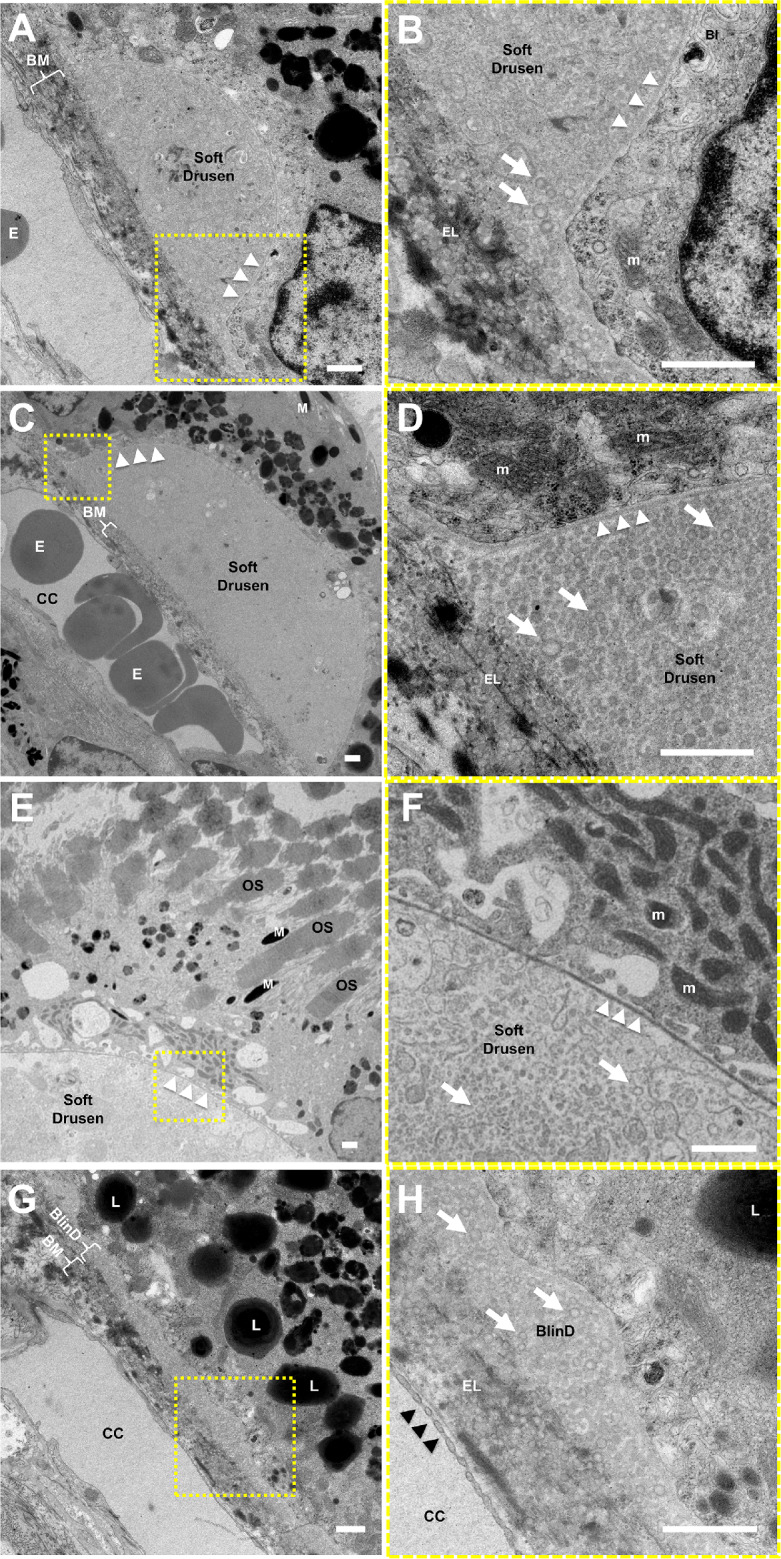
Ultrastructure of soft drusen in rhesus macaques. TEM images of (A, B) a small soft druse, (CF) larger drusen, and (G, H) thin basal linear deposits (BlinD) located between the RPE basal lamina (white arrowheads) and Bruch's membrane (BM). The magnified views in B, D, F, and H correspond to the dashed-yellow areas in A, C, E, and G. The neurosensory retina is located at the upper right and the choroid/sclera are toward the lower left. The soft drusen in AF and BlinD in G and H are both largely composed of vesicular particles with an electron-dense exterior and electron-lucent interior (arrows) consistent with partially extracted lipoprotein particles. Melanosomes (M), lipofuscin granules (L), and mitochondria (m) in RPE cells; overlying photoreceptor outer segments (OS); and erythrocytes (E) in the choriocapillaris (CC) can also be seen. The elastic layer (EL) of BM, scant RPE basal infoldings (BI), and fenestrations of the CC (black arrowheads) are better seen on the magnified views. Scale bars: 1 μm.
Figure 7.
Figure 7.
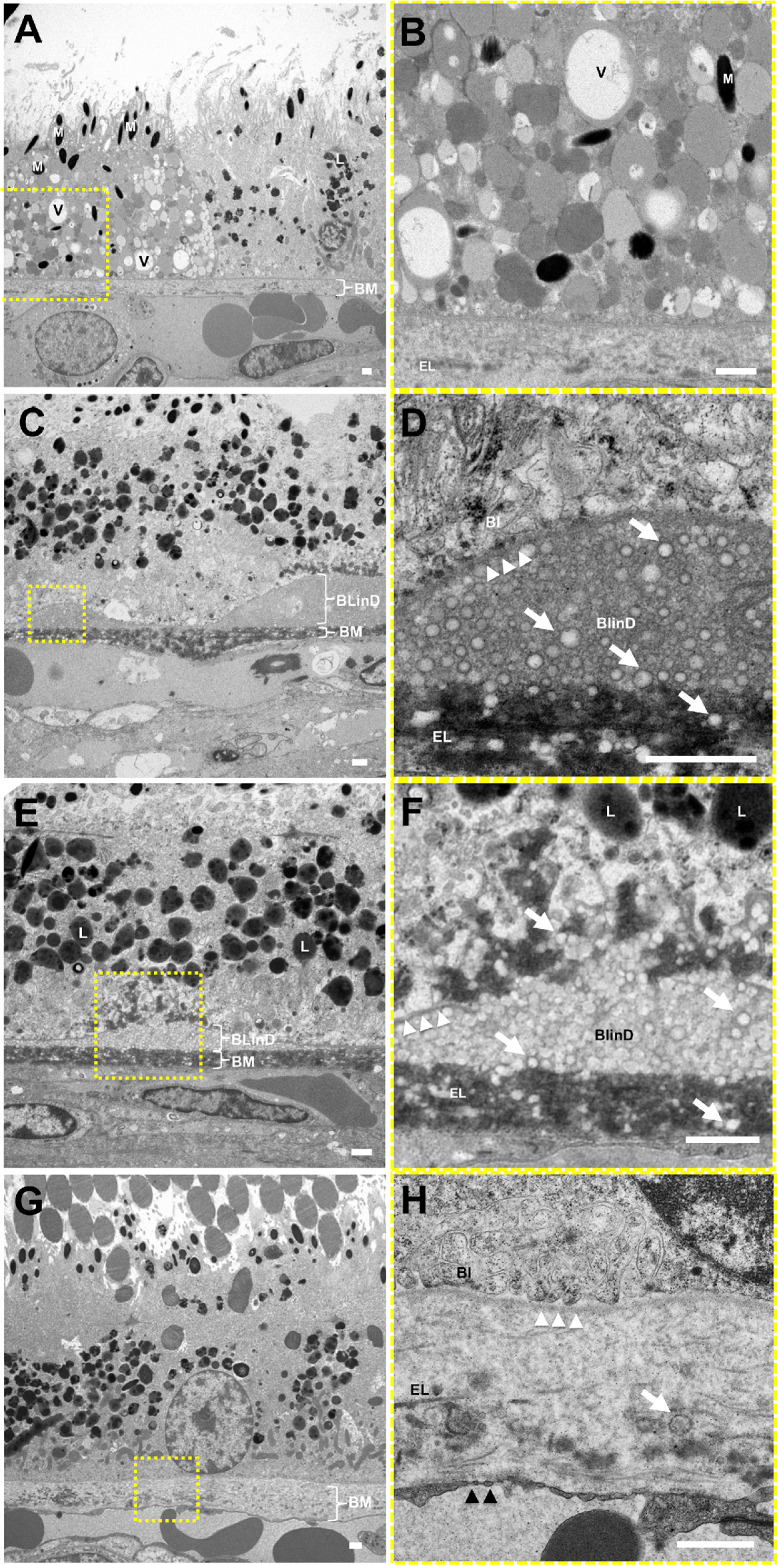
Ultrastructure of RPE lipoidal degeneration and extracellular lipid accumulation in rhesus macaques. TEM of eyes with punctate lesions without soft drusen show (A, B) individual RPE cells that appear swollen with vacuoles (V) and granules of various electron densities, likely lipid-filled, grossly normal melanosomes (M), and few lipofuscin granules (L), consistent with lipoidal degeneration. These eyes also exhibit (C, D) basal linear deposits (BlinD) of lipid particles (white arrows) located between the RPE basal lamina (white arrowheads) and Bruch's membrane (BM), and (E, F) areas showing the lipid particles extending beyond the RPE basal lamina into the RPE cytoplasm and into BM itself. By contrast, (G, H) normal aged eyes without visible lesions show no drusen or BlinD, rare lipid particles in BM (white arrow), and normal-appearing RPE cells with basal infoldings (BI). The magnified views in B, D, F, and H correspond to the dashed-yellow areas in A, C, E, and G. The neurosensory retina is located at the top and the choroid/sclera are toward the bottom. The elastic layer (EL) of BM, scant RPE basal infoldings (BI), and fenestrations of the CC (black arrowheads) are better seen on the magnified views. Scale bars: 1 μm.

References

    1. Holz FG, Strauss EC, Schmitz-Valckenberg S, van Lookeren Campagne M. Geographic atrophy: clinical features and potential therapeutic approaches. Ophthalmology. 2014; 121: 1079–1091. - PubMed
    1. Li M, Huisingh C, Messinger J, et al.. histology of geographic atrophy secondary to age-related macular degeneration: a multilayer approach. Retina. 2018; 38: 1937–1953. - PMC - PubMed
    1. Age-Related Eye Disease Study Research Group. The Age-Related Eye Disease Study system for classifying age-related macular degeneration from stereoscopic color fundus photographs: the Age-Related Eye Disease Study Report Number 6. Am J Ophthalmol. 2001; 132: 668–681. - PubMed

    1. Bowes Rickman C, Farsiu S, Toth CA, Klingeborn M. Dry age-related macular degeneration: mechanisms, therapeutic targets, and imaging. Invest Ophthalmol Vis Sci. 2013; 54: ORSF68–ORSF80. - PMC - PubMed
    1. Age-Related Eye Disease Study Research Group. A randomized, placebo-controlled, clinical trial of high-dose supplementation with vitamins C and E, beta carotene, and zinc for age-related macular degeneration and vision loss: AREDS report no. 8. Arch Ophthalmol. 2001; 119: 1417–1436. - PMC - PubMed

Publication types