Review
. 2020 Nov;9(6):e377.
doi: 10.1002/wdev.377. Epub 2020 Feb 21.

Signaling in the primary cilium through the lens of the Hedgehog pathway

Affiliations
Review

Signaling in the primary cilium through the lens of the Hedgehog pathway

Eduardo D Gigante et al. Wiley Interdiscip Rev Dev Biol. 2020 Nov.

Abstract

Cilia are microtubule-based, cell-surface projections whose machinery is evolutionarily conserved. In vertebrates, cilia are observed on almost every cell type and are either motile or immotile. Immotile sensory, or primary cilia, are responsive to extracellular ligands and signals. Cilia can be thought of as compartments, functionally distinct from the cell that provides an environment for signaling cascades. Hedgehog is a critical developmental signaling pathway which is functionally linked to primary cilia in vertebrates. The major components of the vertebrate Hedgehog signaling pathway dynamically localize to the ciliary compartment and ciliary membrane. Critically, G-protein coupled receptor (GPCR) Smoothened, the obligate transducer of the pathway, is enriched and activated in the cilium. While Smoothened is the most intensely studied ciliary receptor, many GPCRs localize within cilia. Understanding the link between Smoothened and cilia defines common features, and distinctions, of GPCR signaling within the primary cilium. This article is categorized under: Signaling Pathways > Global Signaling Mechanisms Signaling Pathways > Cell Fate Signaling.

Keywords: GPCR; Hedgehog; cilia; smoothened.


Figures

Figure 1.
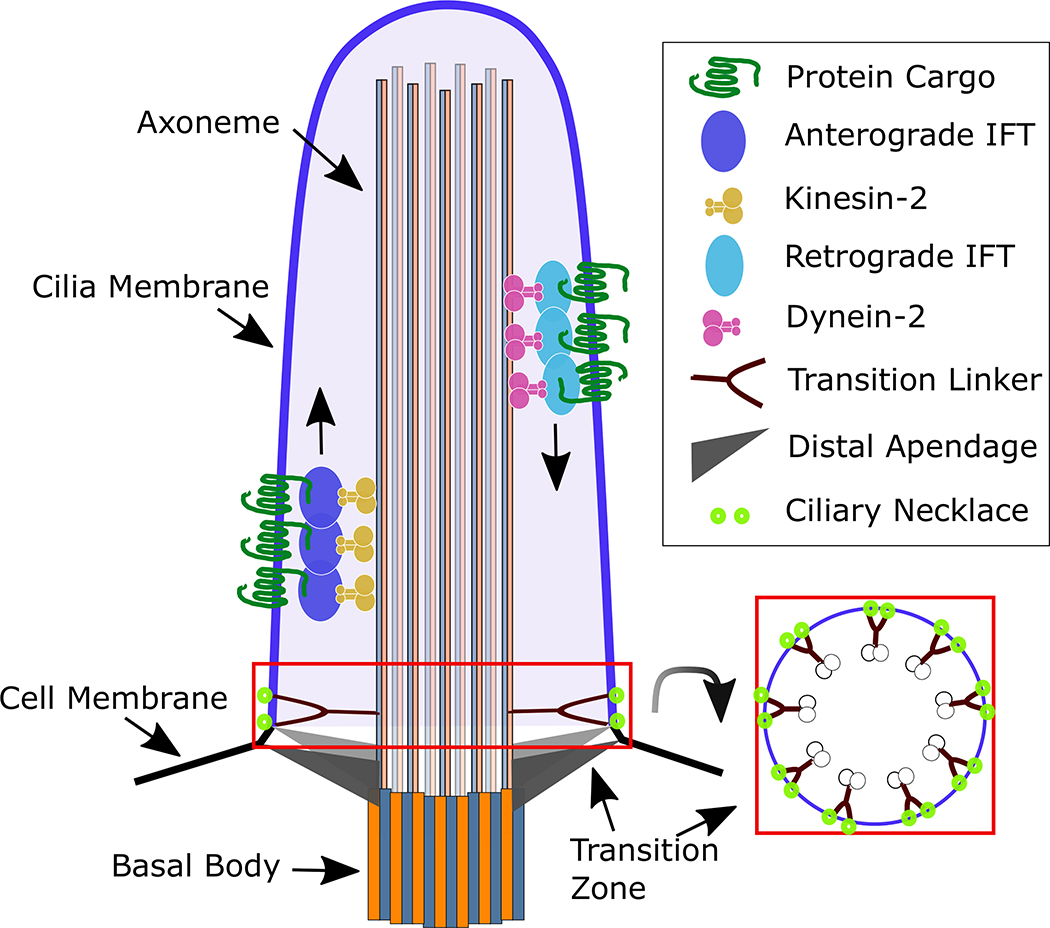
Figure 1.. Model of Ciliary Structure.
The cilium is a microtubule projection comprised of 9 microtubule doublets that make up the axoneme. The axoneme is anchored to the basal body, which resides in the cell. Trafficking into and out of cilia is regulated by the transition zone at the proximal end of the cilium. The transition zone is comprised of Y-shaped linker proteins, ciliary necklace membrane proteins, and distal and sub-distal appendages. Together, the transition zone acts as a diffusion barrier, preventing the free movement of proteins in to the cilium. Moreover, the transition zone regulates the active transport of proteins into and out of cilia. Finally, the transition zone provides structural support to the basal body and axoneme, anchoring the ciliary skeleton to the plasma membrane. Proteins are transported to the ciliary tip and back via anterograde and retrograde IFT, respectively. The ciliary membrane is contiguous to the cell’s plasma membrane but the ciliary membrane displays a distinct lipid composition being enriched for PI(4)P.
Figure 2.
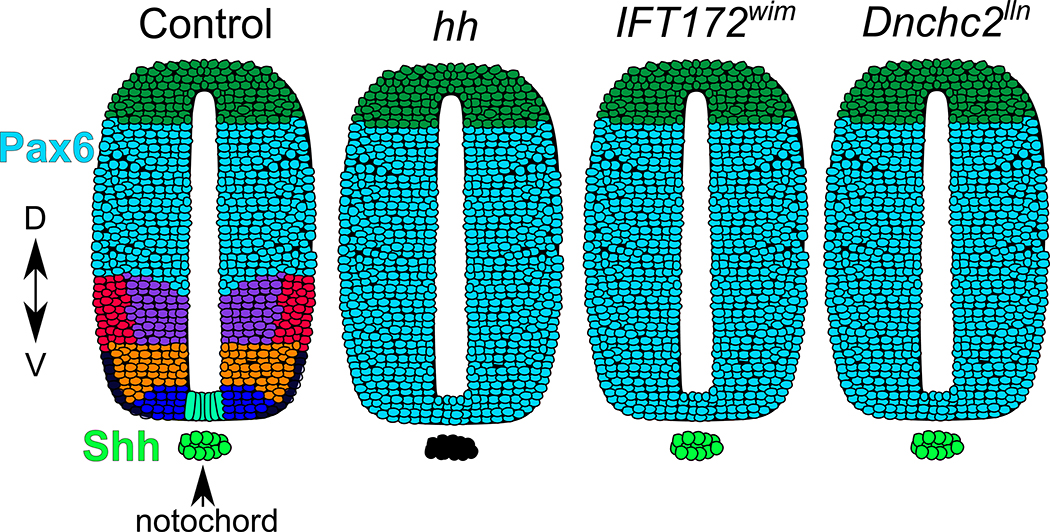
Figure 2.. IFT mutants, like Shh mutants, fail to specify ventral neural cell fates.
Ventral neural tube patterning (colored cell fates) is an in vivo readout of Sonic Hedgehog (SHH) pathway activation. Loss of Shh results in a complete loss of SHH-dependent ventral cell fates. Disruption of anterograde or retrograde IFT in Ift172wim and Dnchc2lln mutants results in a loss of SHH-dependent cell fates and ventral expansion of PAX6 (blue), which marks SHH-independent cell fates. As these mutants phenocopy Shh−/− mutants, the cilium itself is required for transduction of the SHH signalling pathway.
Figure 3.
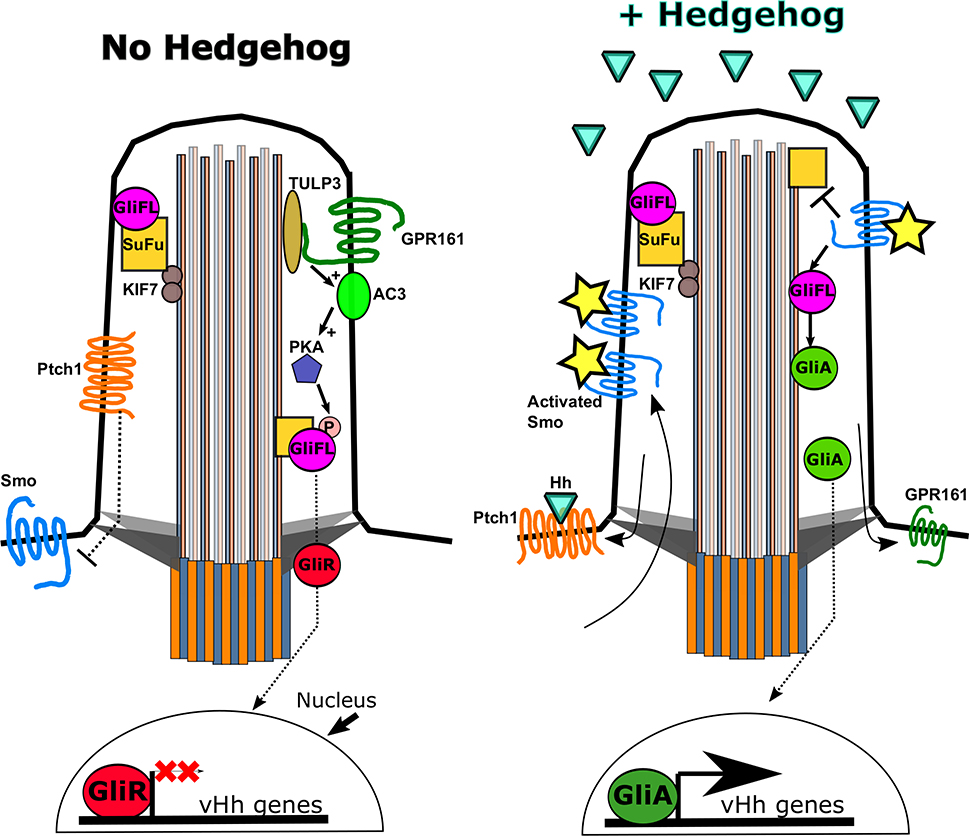
Figure 3.. The major components of the vertebrate Hedgehog pathway are dynamically localized to the primary cilium in response to Hedgehog ligand.
(Left) In the absence of vHH, the PTCH1 receptor is enriched in cilia, suppressing the ciliary enrichment and activation of SMO. KIF7 aids in shuttling the SUFU-GLI complex to the ciliary tip. Negative regulator GPR161 activates adenylyl cyclase 3 (AC3), facilitating PKA activation. PKA phosphorylates the full length GLI (GLIFL) which promotes the formation of GLI repressor (GLIR). GLIR translocates to the nucleus and suppresses vHH-dependent gene targets. (Right) vHH ligand binds PTCH1, which is subsequently removed from the cilium permitting ciliary SMO enrichment and activation (star). Activated SMO promotes the dissociation of the GLI-SUFU enabling activated GLI (GLIA) formation. GLIA translocates to the nucleus to promote HH-dependent gene transcription.
Figure 4.
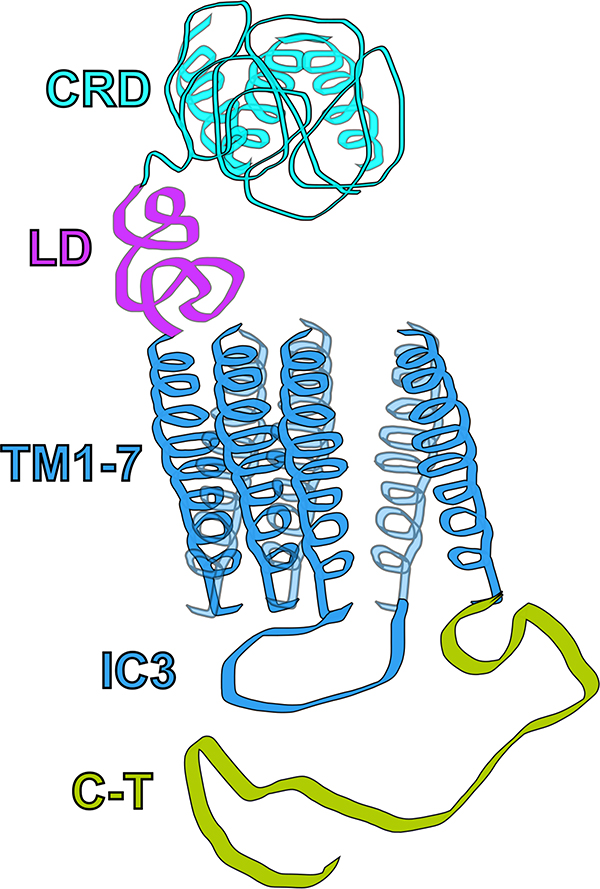
Figure 4.. G-protein coupled receptor Smoothened.
Smoothened is an F-class G-protein coupled receptor (GPCR) defined by the N-terminal cysteine rich domain (CRD) containing small α-helices and ligand binding domains. A linker domain (LD) connects the CRD with the 7 transmembrane (TM1–7) domain of the receptor. The intracellular loop 3 (IC3) associates with intracellular Gαi G-proteins that are activated following the conformational change. The intracellular C-terminal (C-T) tail is critical for SMO transport and enrichment in cilia. Mutations to the C-T affect ciliary SMO traffic (Y. Chen et al., 2011; Corbit et al., 2005).

References

    1. Aanstad P, Santos N, Corbit KC, Scherz PJ, Trinh le A, Salvenmoser W, . . . Stainier DY (2009). The extracellular domain of Smoothened regulates ciliary localization and is required for high-level Hh signaling. Curr Biol, 19(12), 1034–1039. doi:10.1016/j.cub.2009.04.053 - DOI - PMC - PubMed
    1. Adams GM, Huang B, & Luck DJ (1982). Temperature-Sensitive, Assembly-Defective Flagella Mutants of CHLAMYDOMONAS REINHARDTII. Genetics, 100(4), 579–586. - PMC - PubMed
    1. Alcedo J, Ayzenzon M, Von Ohlen T, Noll M, & Hooper JE (1996). The Drosophila smoothened gene encodes a seven-pass membrane protein, a putative receptor for the hedgehog signal. Cell, 86(2), 221–232. doi:10.1016/s0092-8674(00)80094-x - DOI - PubMed
    1. Alexandre C, Jacinto A, & Ingham PW (1996). Transcriptional activation of hedgehog target genes in Drosophila is mediated directly by the cubitus interruptus protein, a member of the GLI family of zinc finger DNA-binding proteins. Genes & development, 10(16), 2003–2013. - PubMed
    1. Allen BL, Song JY, Izzi L, Althaus IW, Kang JS, Charron F, . . . McMahon AP (2011). Overlapping roles and collective requirement for the coreceptors GAS1, CDO, and BOC in SHH pathway function. Dev Cell, 20(6), 775–787. doi:10.1016/j.devcel.2011.04.018 - DOI - PMC - PubMed

Publication types