


Biofilm Bacteria Use Stress Responses to Detect and Respond to Competitors
- PMID: 32084407
- PMCID: PMC7322538
- DOI: 10.1016/j.cub.2020.01.065
Biofilm Bacteria Use Stress Responses to Detect and Respond to Competitors
Abstract
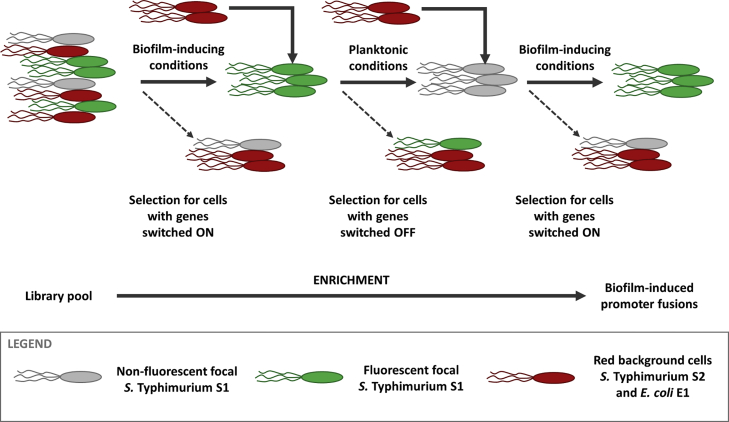
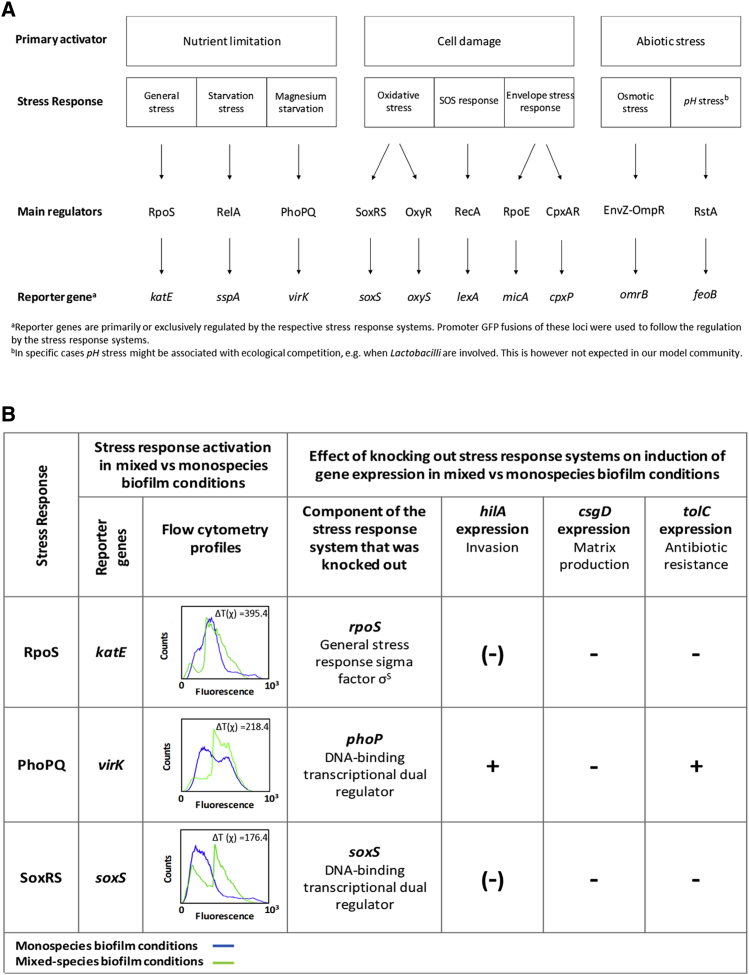
Bacteria use complex regulatory networks to cope with stress, but the function of these networks in natural habitats is poorly understood. The competition sensing hypothesis states that bacterial stress response systems can serve to detect ecological competition, but studying regulatory responses in diverse communities is challenging. Here, we solve this problem by using differential fluorescence induction to screen the Salmonella Typhimurium genome for loci that respond, at the single-cell level, to life in biofilms with competing strains of S. Typhimurium and Escherichia coli. This screening reveals the presence of competing strains drives up the expression of genes associated with biofilm matrix production (CsgD pathway), epithelial invasion (SPI1 invasion system), and, finally, chemical efflux and antibiotic tolerance (TolC efflux pump and AadA aminoglycoside 3-adenyltransferase). We validate that these regulatory changes result in the predicted phenotypic changes in biofilm, mammalian cell invasion, and antibiotic tolerance. We further show that these responses arise via activation of major stress responses, providing direct support for the competition sensing hypothesis. Moreover, inactivation of the type VI secretion system (T6SS) of a competitor annuls the responses to competition, indicating that T6SS-derived cell damage activates these stress response systems. Our work shows that bacteria use stress responses to detect and respond to competition in a manner important for major phenotypes, including biofilm formation, virulence, and antibiotic tolerance.
Keywords: Salmonella; antibiotic tolerance; biofilm; competition; competition sensing; epithelial invasion; microbial ecology; stress response systems.
Copyright © 2020 The Authors. Published by Elsevier Inc. All rights reserved.
Conflict of interest statement
Declaration of Interests The authors declare no competing interests.
Figures




Comment in
-
Biofilms: Managing Stress to Navigate Group Dynamics.Curr Biol. 2020 Apr 6;30(7):R324-R326. doi: 10.1016/j.cub.2020.02.045. Curr Biol. 2020. PMID: 32259509
References
-
- Costerton J.W., Stewart P.S., Greenberg E.P. Bacterial biofilms: a common cause of persistent infections. Science. 1999;284:1318–1322. - PubMed
-
- Davies D. Understanding biofilm resistance to antibacterial agents. Nat. Rev. Drug Discov. 2003;2:114–122. - PubMed
-
- Nadell C.D., Drescher K., Foster K.R. Spatial structure, cooperation and competition in biofilms. Nat. Rev. Microbiol. 2016;14:589–600. - PubMed
-
- Elias S., Banin E. Multi-species biofilms: living with friendly neighbors. FEMS Microbiol. Rev. 2012;36:990–1004. - PubMed
Publication types
MeSH terms
Grants and funding
LinkOut - more resources
Full Text Sources
Other Literature Sources
Medical
Molecular Biology Databases
