


Beyond an Updated Graded Prognostic Assessment (Breast GPA): A Prognostic Index and Trends in Treatment and Survival in Breast Cancer Brain Metastases From 1985 to Today
- PMID: 32084525
- PMCID: PMC7276246
- DOI: 10.1016/j.ijrobp.2020.01.051
Beyond an Updated Graded Prognostic Assessment (Breast GPA): A Prognostic Index and Trends in Treatment and Survival in Breast Cancer Brain Metastases From 1985 to Today
Erratum in
-
Erratum to: Sperduto PW, Mesko S, Li J, et al. Beyond an Updated Graded Prognostic Assessment (Breast GPA): A Prognostic Index and Trends in Treatment and Survival in Breast Cancer Brain Metastases From 1985 to Today. Int J Radiat Oncol Biol Phys 2020:107(2);334-343.Int J Radiat Oncol Biol Phys. 2021 Jan 1;109(1):303. doi: 10.1016/j.ijrobp.2020.09.057. Int J Radiat Oncol Biol Phys. 2021. PMID: 33308700 No abstract available.
Abstract
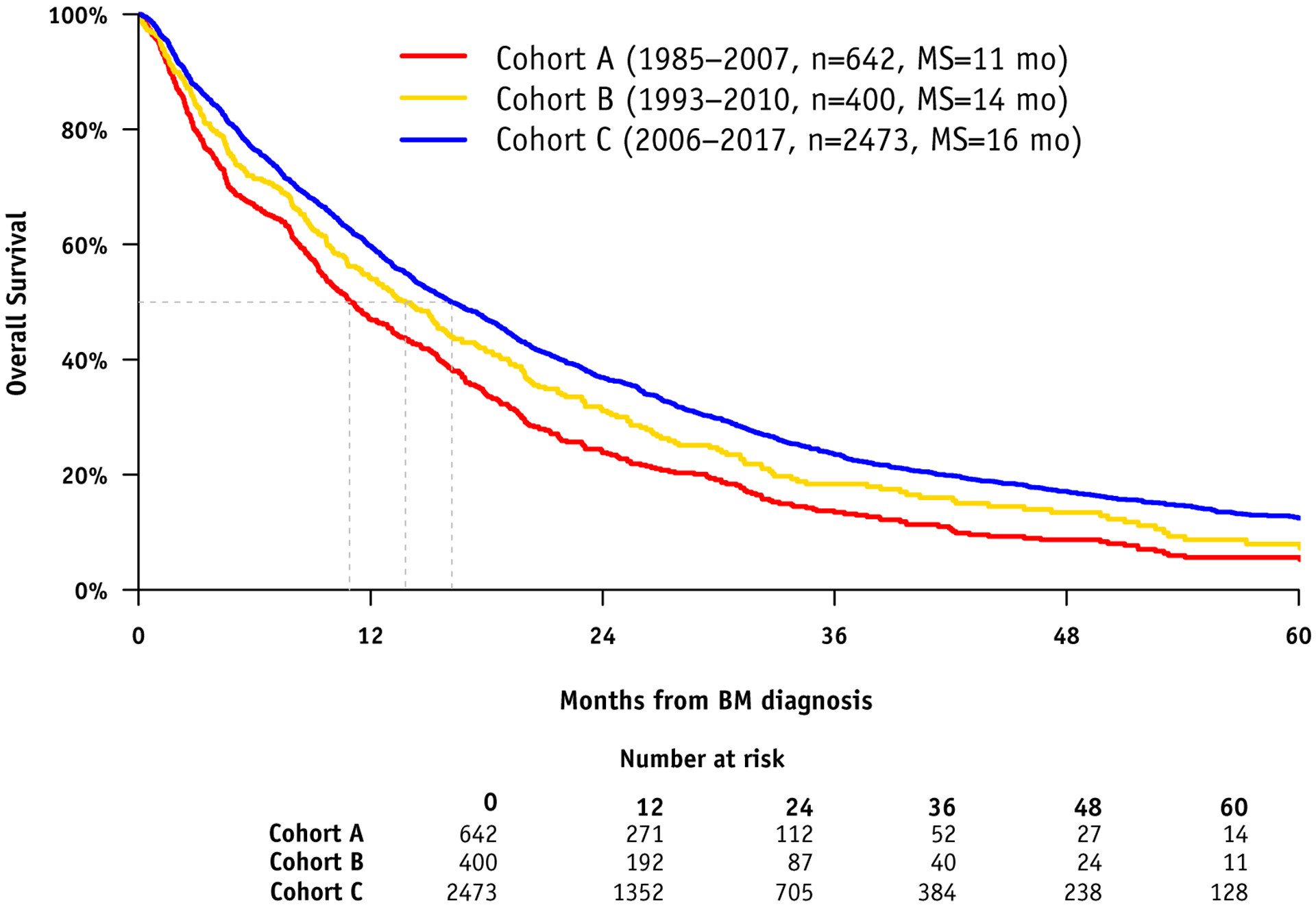
Purpose: Brain metastases are a common sequelae of breast cancer. Survival varies widely based on diagnosis-specific prognostic factors (PF). We previously published a prognostic index (Graded Prognostic Assessment [GPA]) for patients with breast cancer with brain metastases (BCBM), based on cohort A (1985-2007, n = 642), then updated it, reporting the effect of tumor subtype in cohort B (1993-2010, n = 400). The purpose of this study is to update the Breast GPA with a larger contemporary cohort (C) and compare treatment and survival across the 3 cohorts.
Methods and materials: A multi-institutional (19), multinational (3), retrospective database of 2473 patients with breast cancer with newly diagnosed brain metastases (BCBM) diagnosed from January 1, 2006, to December 31, 2017, was created and compared with prior cohorts. Associations of PF and treatment with survival were analyzed. Kaplan-Meier survival estimates were compared with log-rank tests. PF were weighted and the Breast GPA was updated such that a GPA of 0 and 4.0 correlate with the worst and best prognoses, respectively.
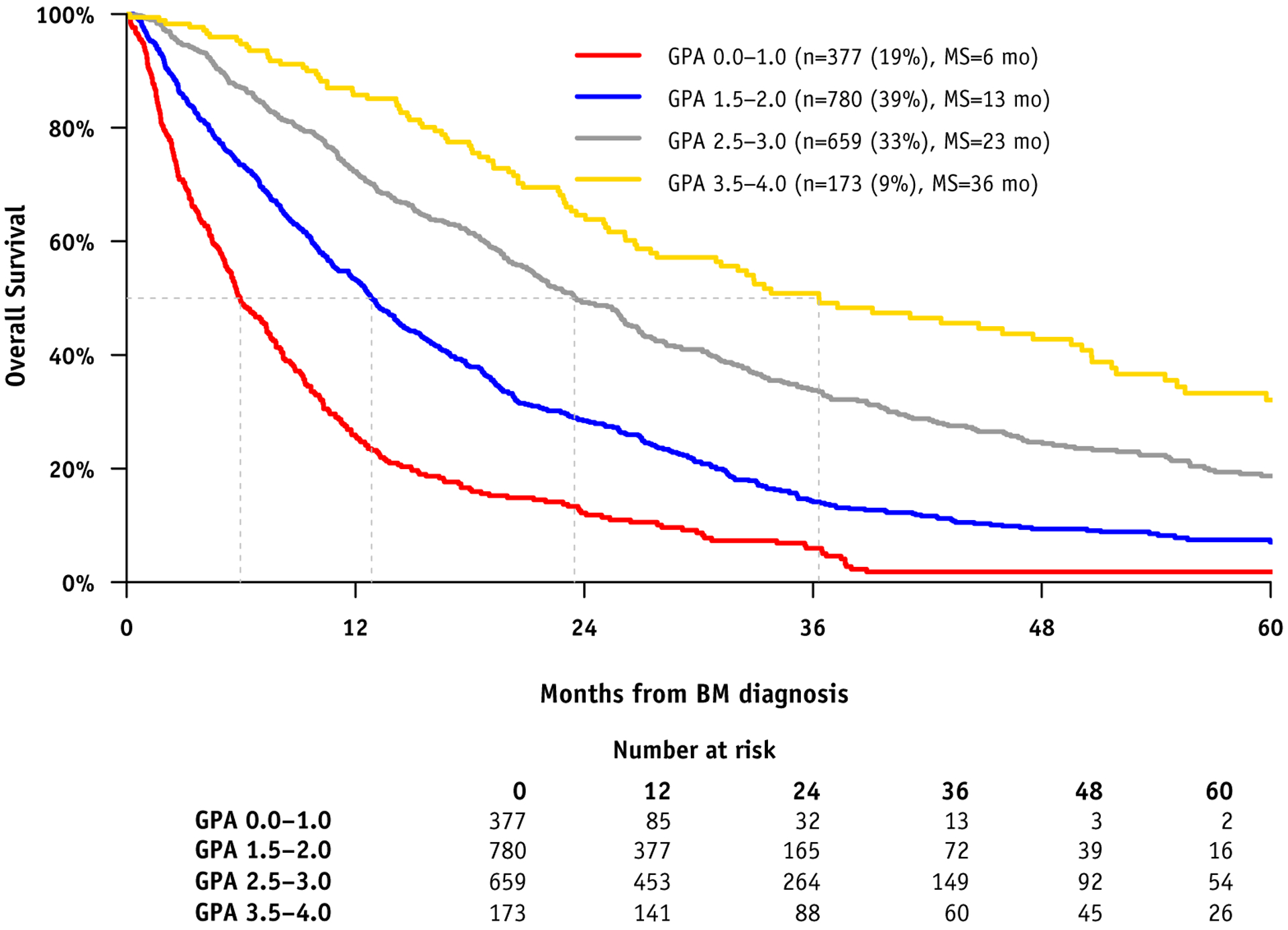
Results: Median survival (MS) for cohorts A, B, and C improved over time (from 11, to 14 to 16 months, respectively; P < .01), despite the subtype distribution becoming less favorable. PF significant for survival were tumor subtype, Karnofsky Performance Status, age, number of BCBMs, and extracranial metastases (all P < .01). MS for GPA 0 to 1.0, 1.5-2.0, 2.5-3.0, and 3.5-4.0 was 6, 13, 24, and 36 months, respectively. Between cohorts B and C, the proportion of human epidermal receptor 2 + subtype decreased from 31% to 18% (P < .01) and MS in this subtype increased from 18 to 25 months (P < .01).
Conclusions: MS has improved modestly but varies widely by diagnosis-specific PF. New PF are identified and incorporated into an updated Breast GPA (free online calculator available at brainmetgpa.com). The Breast GPA facilitates clinical decision-making and will be useful for stratification of future clinical trials. Furthermore, these data suggest human epidermal receptor 2-targeted therapies improve clinical outcomes in some patients with BCBM.
Copyright © 2020 Elsevier Inc. All rights reserved.
Figures
References
-
- Bray F, Ferlay J, Soerjomataram I, et al. Global cancer statistics 2018: GLOBOCAN estimates of incidence and mortality worldwide for 36 cancers in 185 countries. CA Cancer J for Clin 2018;68:394–424. - PubMed
-
- Siegel RL, Miller KD, Jemal A. Cancer statistics 2019. CA Cancer J Clin 2019;69:7–34. - PubMed
-
- Pestalozzi BC, Holmes E, de Azambuja E, et al. CNS relapse in patients with HER2-positive early breast cancer who have and have not received adjuvant trastuzumab: A retrospective substudy of the HERA trial (BIG 1–01). Lancet Oncol 2013;14:244–248. - PubMed
-
- Kennecke H, Yerushalmi R, Woods R, et al. Metastatic behavior of breast cancer subtypes. J Clin Oncol 2010;28:3271–3277. - PubMed
