


Genetic Characterization of Piroplasms in Donkeys and Horses from Nigeria
- PMID: 32085574
- PMCID: PMC7070495
- DOI: 10.3390/ani10020324
Genetic Characterization of Piroplasms in Donkeys and Horses from Nigeria
Abstract
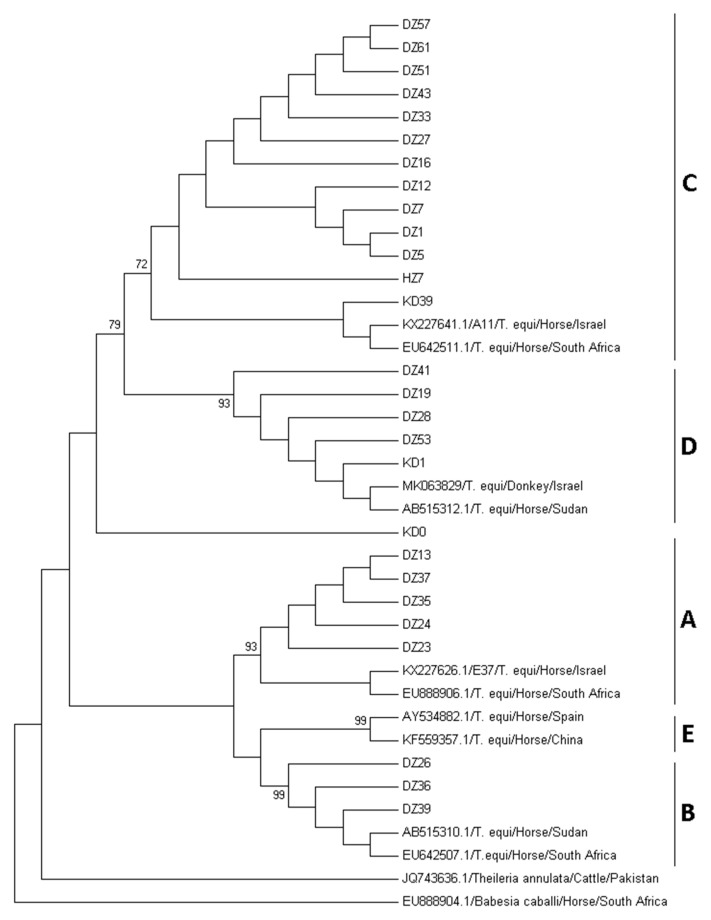
Equine piroplasmosis (EP) is a tick-borne disease of equids, caused by the two haemoprotozoal parasites: Theileria equi and Babesia caballi. Nigeria constitutes a major crossroads of animal transport in West Africa and may serve as a factor in EP dissemination in the region. The study aim was to characterize EP parasites in donkeys and horses in northern Nigeria using a molecular approach. Blood was collected from 57 donkeys and 47 horses. EP infection was detected and characterized by polymerase chain reaction (PCR). Twenty five donkeys (43.8%) were infected with T. equi, five (8.8%) with B. caballi, three (5.3%) with dual infections. Four horses (8.5%) were infected by T. equi and none by B. caballi. Four of the five known T. equi 18S rRNA genotypes (A, B, C and D) were identified. Theileria equi ema-1 and ema-2 genes were amplified in only 2 and 10 samples, respectively, showing no genetic variation. All B. caballi isolates were classified as rap-1 genotype A1. Twenty-two (42.3%) of the donkeys were positive for anti-T. equi antibodies and 29 (55.8%) were positive for anti-B. caballi antibodies, using immunofluorescence antibody test (IFAT). The study results demonstrate high genetic variation within T. equi parasites, suggesting that donkeys may be reservoirs of EP parasites in West Africa.
Keywords: Babesia caballi; Nigeria; Theileria equi; donkeys; horses.
Conflict of interest statement
The authors declare no conflict of interest.
Figures
References
-
- Rothschild C.M. Equine piroplasmosis. J. Equine Vet. Sci. 2013;33:497–508. doi: 10.1016/j.jevs.2013.03.189. - DOI
-
- Margalit Levi M., Tirosh-Levy S., Dahan R., Berlin D., Steinman A., Edery N., Savitski I., Lebovich B., Knowles D., Suarez C.E., et al. First Detection of Diffuse and Cerebral Theileria equi Infection in Neonatal Filly. J. Equine Vet. Sci. 2018;60:23–28. doi: 10.1016/j.jevs.2017.10.016. - DOI
LinkOut - more resources
Full Text Sources
Research Materials
