


Evaluation of MR elastography as a response parameter for transarterial chemoembolization of colorectal liver metastases
- PMID: 32086582
- PMCID: PMC7305258
- DOI: 10.1007/s00330-020-06706-y
Evaluation of MR elastography as a response parameter for transarterial chemoembolization of colorectal liver metastases
Abstract
Objective: The aim of this study was to evaluate magnetic resonance elastography (MRE) as a response parameter in patients who received transarterial chemoembolization (TACE) for the treatment of colorectal liver metastases.
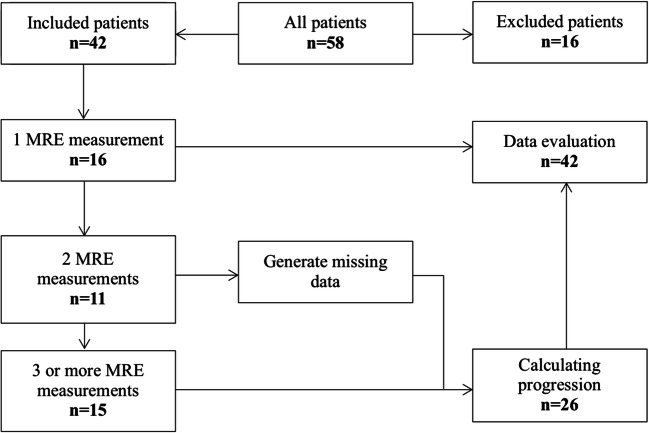
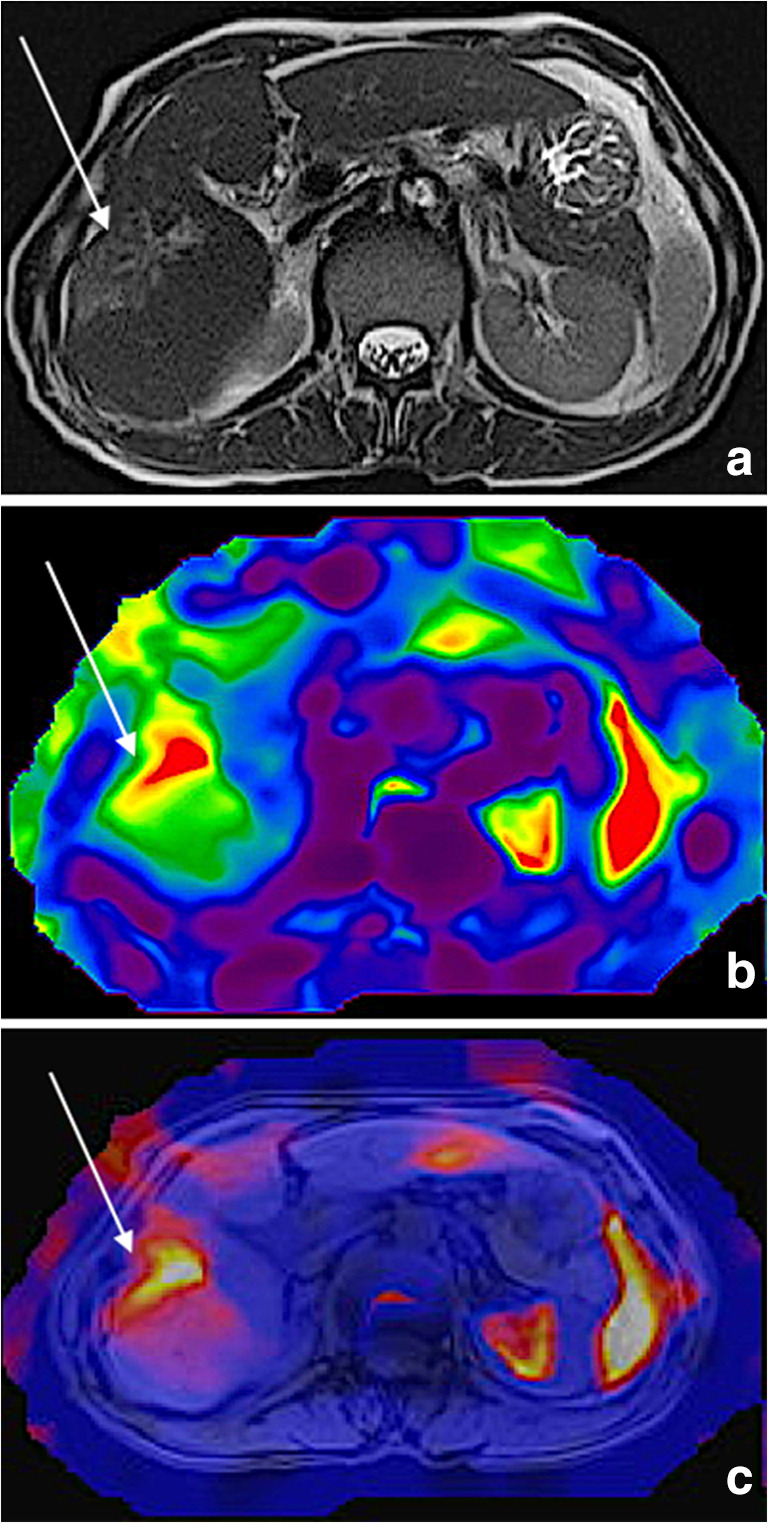
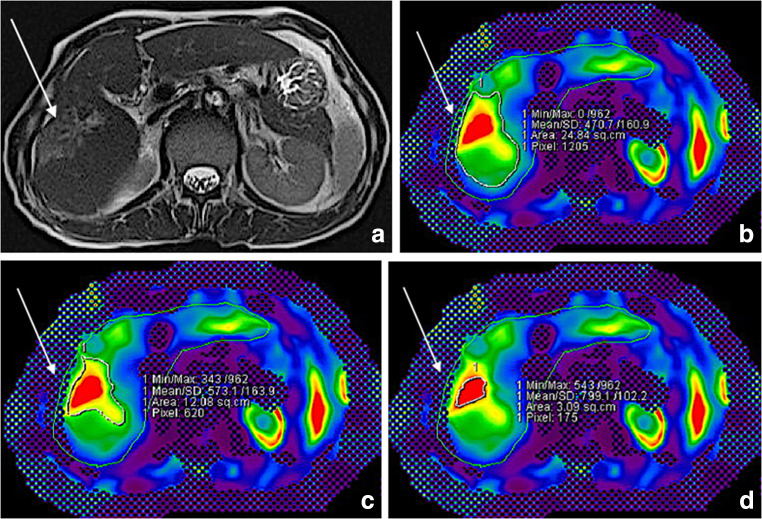
Materials and methods: Forty-two patients (29 male patients; mean age, 61.5 years; range, 41-84 years) with repeated TACE therapy of colorectal liver metastases underwent on average 2 repetitive magnetic resonance imaging (MRI) and MRE exams in 4- to 6-week intervals using a 1.5-T scanner. MRE-based liver stiffness measurements were performed in normal liver parenchyma and in metastatic lesions. Moreover, the size of the liver metastases was assessed during treatment and compared with the results of the MRE analysis.
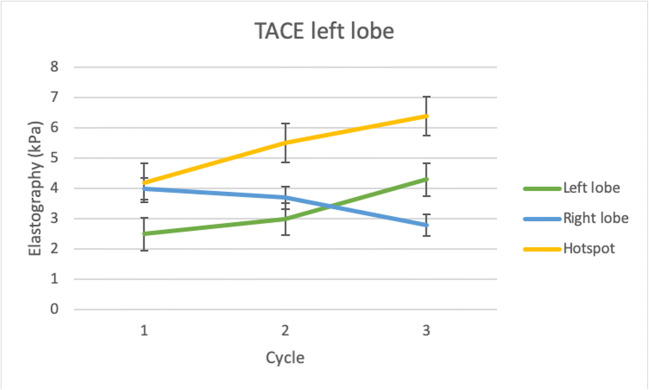
Results: Liver metastases showed a significantly higher degree of stiffness compared with the normal liver parenchyma (p < 0.001). However, only a weak correlation was found between the lesion size and stiffness (r = - 0.32, p = 0.1). MRE analysis revealed an increase in stiffness of the colorectal liver metastases from 4.4 to 7.1 kPa after three cycles of TACE (p < 0.001). Also, the mean size of the metastases decreased from 17.0 to 11.3 cm2 (p < 0.001). Finally, the entire liver stiffness increased from 2.9 to 3.1 kPa over the three cycles of TACE therapy.
Conclusion: In conclusion, MRE showed a significant change in stiffness and size of liver metastases. Therefore, MRE may provide an added value for an evaluation of treatment response in patients with colorectal liver metastases undergoing TACE.
Key points: • MRE showed an increase in stiffness of the colorectal liver metastases during TACE therapy. • Liver metastases showed a significantly higher degree of stiffness compared with the normal liver parenchyma. • However, only a weak correlation was found between the lesion size and stiffness.
Keywords: Chemotherapy; Liver; Magnetic resonance imaging; Metastasis; Therapeutic chemoembolization.
Conflict of interest statement
All authors of this manuscript declare no relationships with any companies whose products or services may be related to the subject matter of the article.
Figures
Similar articles
-
Response comparison of PLC and SLC with magnetic resonance elastography after TACE.Sci Rep. 2022 May 18;12(1):8317. doi: 10.1038/s41598-022-12478-w. Sci Rep. 2022. PMID: 35585124 Free PMC article.
-
Liver stiffness measured by MR elastography is a predictor of early HCC recurrence after treatment.Eur Radiol. 2020 Aug;30(8):4182-4192. doi: 10.1007/s00330-020-06792-y. Epub 2020 Mar 18. Eur Radiol. 2020. PMID: 32189053
-
Neoadjuvant TACE before laser induced thermotherapy (LITT) in the treatment of non-colorectal non-breast cancer liver metastases: feasibility and survival rates.Eur J Radiol. 2014 Oct;83(10):1804-10. doi: 10.1016/j.ejrad.2014.06.029. Epub 2014 Jul 7. Eur J Radiol. 2014. PMID: 25082479
-
Transarterial (chemo)embolisation versus no intervention or placebo for liver metastases.Cochrane Database Syst Rev. 2020 Mar 12;3(3):CD009498. doi: 10.1002/14651858.CD009498.pub4. Cochrane Database Syst Rev. 2020. PMID: 32163181 Free PMC article.
-
Transarterial chemoembolization (TACE) for colorectal liver metastases--current status and critical review.Langenbecks Arch Surg. 2015 Aug;400(6):641-59. doi: 10.1007/s00423-015-1308-9. Epub 2015 Jun 19. Langenbecks Arch Surg. 2015. PMID: 26088872 Review.
Cited by
-
Elastic modulus-reflected liver lesion stiffness relates to worse prognosis in pancreatic cancer patients with liver metastasis.World J Surg Oncol. 2023 Aug 24;21(1):262. doi: 10.1186/s12957-023-03140-4. World J Surg Oncol. 2023. PMID: 37620975 Free PMC article.
-
Viscoelastic properties of colorectal liver metastases reflect tumour cell viability.J Transl Med. 2024 Aug 16;22(1):774. doi: 10.1186/s12967-024-05559-z. J Transl Med. 2024. PMID: 39152426 Free PMC article.
-
The Advance of Magnetic Resonance Elastography in Tumor Diagnosis.Front Oncol. 2021 Aug 31;11:722703. doi: 10.3389/fonc.2021.722703. eCollection 2021. Front Oncol. 2021. PMID: 34532290 Free PMC article. Review.
-
Targeting the mechano-microenvironment and liver cancer stem cells: a promising therapeutic strategy for liver cancer.Cancer Biol Med. 2023 Nov 24;20(11):816-29. doi: 10.20892/j.issn.2095-3941.2023.0229. Cancer Biol Med. 2023. PMID: 38009775 Free PMC article. Review.
-
Value of shear wave elastography with maximal elasticity in differentiating benign and malignant solid focal liver lesions.World J Gastroenterol. 2020 Dec 14;26(46):7416-7424. doi: 10.3748/wjg.v26.i46.7416. World J Gastroenterol. 2020. PMID: 33362393 Free PMC article.
References
-
- Torre LA, Bray F, Siegel RL, Ferlay J, Lortet-Tieulent J, Jemal A (2015) Global cancer statistics. CA Cancer J Clin. 10.3322/caac.21262 - PubMed
-
- McMillan DC, McArdle CS (2007) Epidemiology of colorectal liver metastases. Surg Oncol. 10.1016/j.suronc.2007.04.008 - PubMed
-
- Van Cutsem E, Köhne CH, Hitre E et al (2009) Cetuximab and chemotherapy as initial treatment for metastatic colorectal cancer. N Engl J Med. 10.1056/NEJMoa0805019 - PubMed
MeSH terms
LinkOut - more resources
Full Text Sources
Medical
Miscellaneous
