


Multi-Faceted Constructs in Abnormal Psychology: Implications of the Bifactor S - 1 Model for Individual Clinical Assessment
- PMID: 32086729
- PMCID: PMC7305063
- DOI: 10.1007/s10802-020-00624-9
Multi-Faceted Constructs in Abnormal Psychology: Implications of the Bifactor S - 1 Model for Individual Clinical Assessment
Abstract
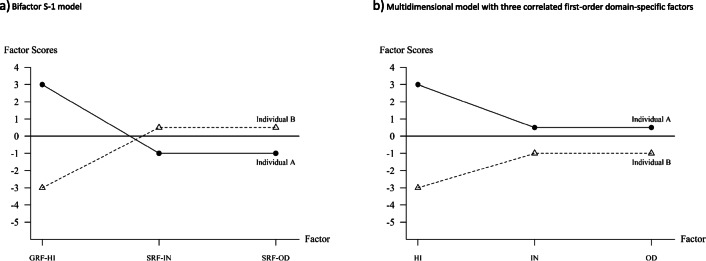
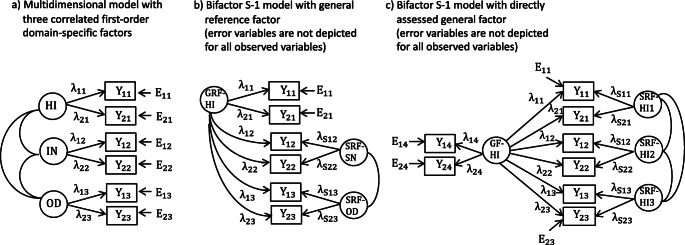
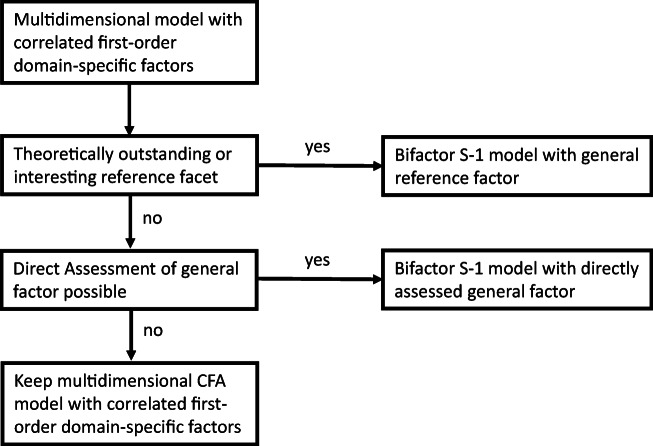
Burns et al. (this issue) have shown that the application of the symmetrical bifactor model to attention-deficit/hyperactivity disorder (ADHD) and oppositional defiant disorder (ODD) symptoms leads to anomalous and inconsistent results across different rater groups. In contrast to the symmetrical bifactor model, applications of the bifactor S-1 model showed consistent and theoretically well-founded results. The implications of the bifactor S-1 model for individual clinical assessment are discussed. It is shown that individual factor scores of the bifactor S-1 model reveal important information about the profile of individual symptoms that is not captured by factor scores of the multidimensional model with correlated first-order factors. It is argued that for individual clinical assessment factor scores from both types of model (multidimensional model with correlated first-order factors, bifactor S -1 model) should be estimated and compared. Finally, a general strategy for choosing an appropriate model for analyzing multi-faceted constructs is presented that compares areas of applications for (1) the multidimensional model with correlated first-order factors, (2) the bifactor S-1 model with a general reference factor, and (3) the bifactor S - 1 model with a directly assessed general factor.
Keywords: Bifactor S-1 model; Bifactor model; Clinical assessment.
Conflict of interest statement
The authors of the current study have no conflicts of interest. Because this is only a coment and no empirical data is presented, no ethical approval was necessary.
Figures
Comment on
-
Application of the Bifactor S - 1 Model to Multisource Ratings of ADHD/ODD Symptoms: an Appropriate Bifactor Model for Symptom Ratings.J Abnorm Child Psychol. 2020 Jul;48(7):881-894. doi: 10.1007/s10802-019-00608-4. J Abnorm Child Psychol. 2020. PMID: 31834589 Free PMC article.
References
-
- Geiser, C., Eid, M., West, S. G., Lischetzke, T., Nussbeck, F. W., (2012) A Comparison of Method Effects in Two Confirmatory Factor Models for Structurally Different Methods. Structural Equation Modeling: A Multidisciplinary Journal, 19(3):409–436
Publication types
MeSH terms
LinkOut - more resources
Full Text Sources
