. 2020 Feb 21;12(4):3205-3217.
doi: 10.18632/aging.102799. Epub 2020 Feb 21.

MIR210HG promotes cell proliferation and invasion by regulating miR-503-5p/TRAF4 axis in cervical cancer

Affiliations

MIR210HG promotes cell proliferation and invasion by regulating miR-503-5p/TRAF4 axis in cervical cancer

Ai-Hong Wang et al. Aging (Albany NY). .

Abstract

Long non-coding RNAs (lncRNAs) play important roles in the progression of cervical cancer (CC). However, the roles and underlying molecular mechanisms of lncRNAs in CC remain unclear. In the current study, we discovered a new lncRNA MIR210HG which was upregulated in CC tissues through microarray. The upregulation of MIR210HG was associated with advanced FIGO stage, metastasis, and poor prognosis in CC patients. Function assays showed that MIR210HG inhibition significantly suppressed the proliferation, invasion, and epithelial-mesenchymal transition (EMT) processes in CC and reduced tumor growth in vivo. Mechanistically, we identified that MIR210HG might serve as a competing endogenous RNA (ceRNA) of miR-503-5p to relieve the repressive effect of miR-503-5p on TRAF4 expression in CC cells. In conclusion, we demonstrated that MIR210HG promoted CC progression through regulating the MIR210HG/miR-503-5p/TRAF4 axis, indicating that MIR210HG might act as a novel insight into CC treatment.

Keywords: MIR210HG; TRAF4; cervical cancer; miR-503-5p.


Conflict of interest statement

CONFLICTS OF INTEREST: This article has not been published elsewhere in whole or in part. All authors have read and approved the content and agree to submit for consideration for publication in the journal. The authors declared no conflicts of interest.

Figures

Figure 1
Figure 1
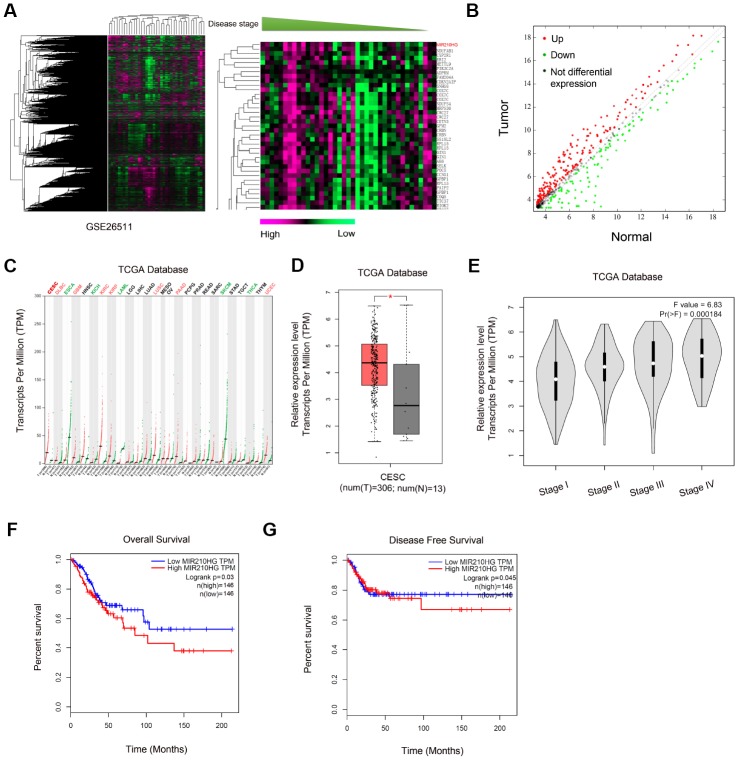
Screening and expression of MIR210HG in CC. (A, B) Heat map of differentially expressed lncRNAs from CC lncRNA array (GSE26511). (B) Volcano plot analyses of lncRNA array (GSE26511). (C) MIR210HG expression in tumors from TCGA database. (D, E) MIR210HG was upregulated in CESC tissues and associated with advanced pathological stage. (F, G) High MIR210HG expression was associated with poor overall survival and disease-free survival in CC patients. *P<0.05. CESC: Cervical squamous cell carcinoma and endocervical adenocarcinoma.
Figure 2
Figure 2
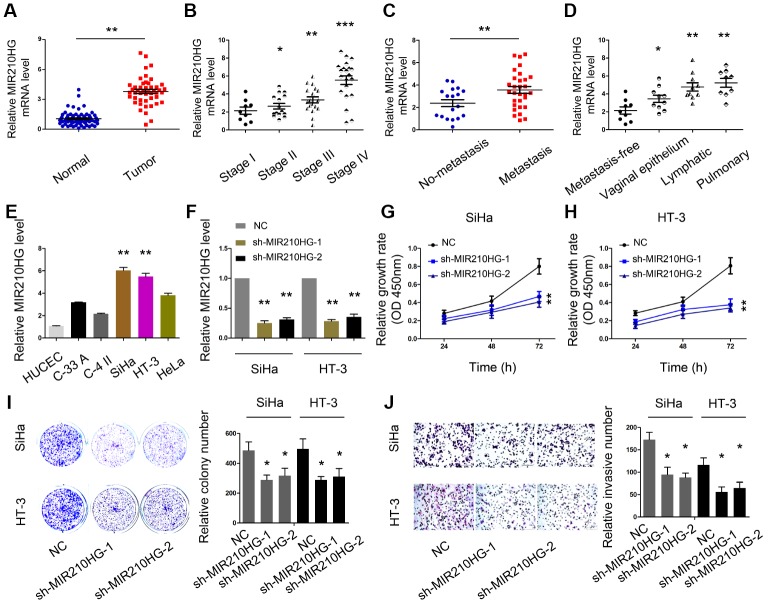
MIR210HG promoted CC cell proliferation and invasion in vitro. (A) MIR210HG was upregulated in CC tissues. (BD) High MIR210HG expression was positively correlated with advanced FIGO stage and metastasis. (E) MIR210HG expression was upregulated in CC cell lines. (F) The knockdown efficiency of sh-MIR210HG was determined by qRT-PCR. (GI) CCK-8 and colony formation assays were used to determine the effects of MIR210HG inhibition on CC cell proliferation abilities. (J) Transwell assay showed that MIR210HG inhibition reduced CC cell invasion abilities. *P<0.05.
Figure 3
Figure 3
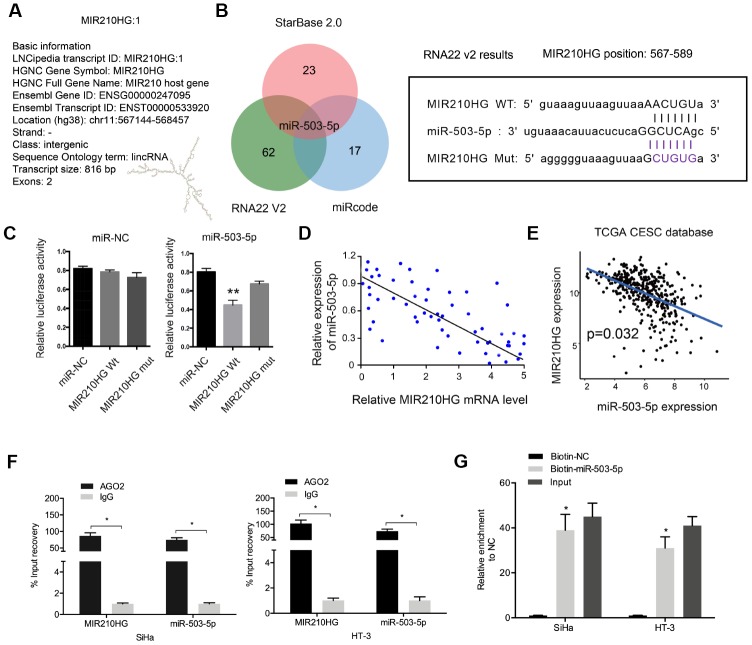
MIR210HG interacted with miR-503-5p in CC. (A) The information about MIR210HG. (B) Sequence alignments between miR-503-5p and seed sequence of the 3′-UTR of MIR210HG. (C) MiR-503-5p mimics reduced the luciferase activity of MIR210HG-Wt group. (D, E) MiR-503-5p expression was negatively correlated with MIR210HG expression in CC tissues. (F, G) RIP and pull-down assays verified the interaction between MIR210HG and miR-503-5p in CC. *P<0.05.
Figure 4
Figure 4
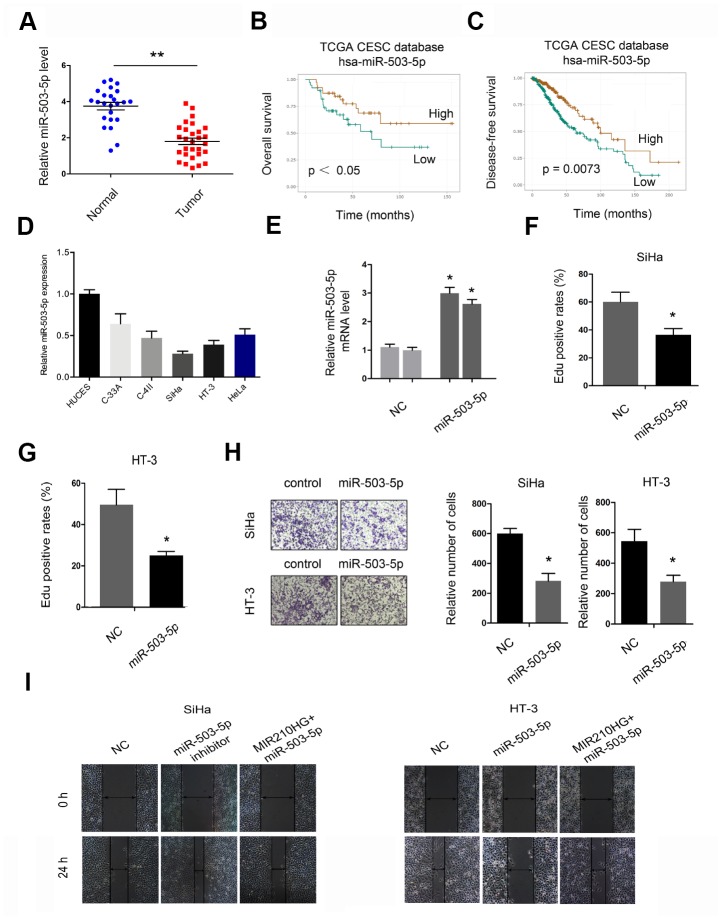
The roles of miR-503-5p in CC progression. (A, D) MiR-503-5p expression was downregulated in CC tissues and cell lines. (B, C) Low miR-503-5p expression was associated with poor overall survival and disease-free survival in CC patients. (E) The overexpression efficiency of miR-503-5p was confirmed by qRT-PCR. (F, G) MiR-503-5p mimics reduced CC cell proliferation abilities. (H) MiR-503-5p mimics reduced CC cell invasion abilities. (I) MiR-503-5p mimics abolished the effects of MIR210HG on CC cell migration abilities. *P<0.05.
Figure 5
Figure 5
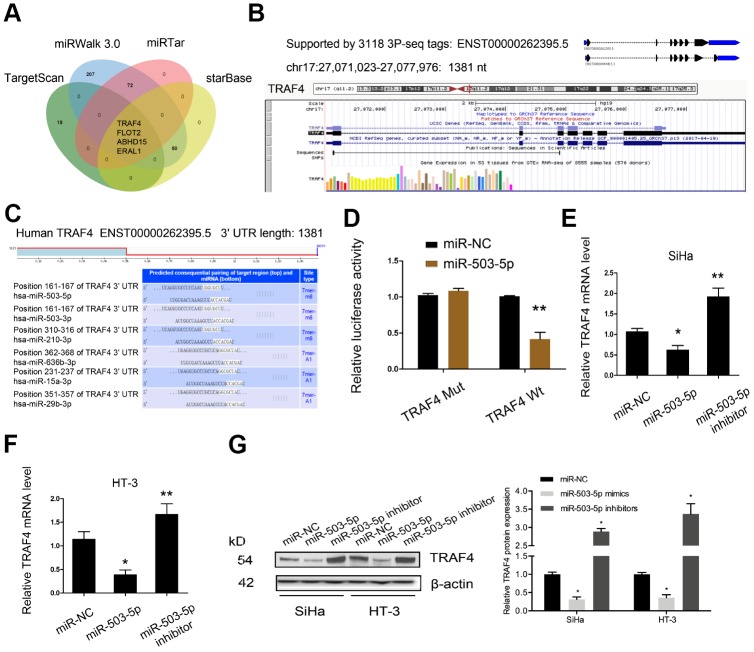
TRAF4 was a target gene for miR-503-5p. (AC) MiR-503-5p target TRAF4 mRNA 3′UTR with a high score. (D) MiR-503-5p mimics reduced the luciferase activity of TRAF4-Wt group. (EG) The effects of miR-503-5p on TRAF4 expression both in mRNA and protein levels. *P<0.05.
Figure 6
Figure 6
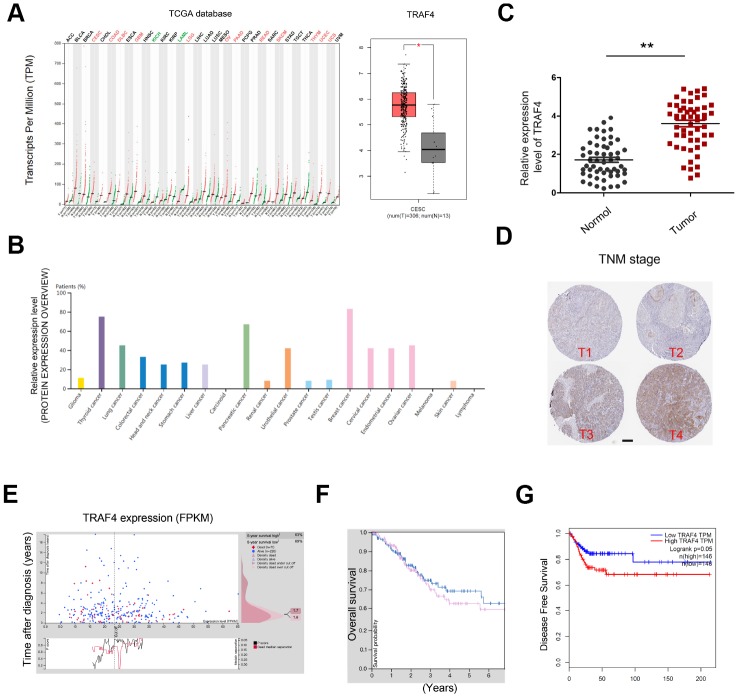
TRAF4 expression in CC. (A, B) TRAF4 expression in the TCGA database. (C) TRAF4 expression was upregulated in CC tissues. (D) High TRAF4 expression was associated with advanced TNM stage. (EG) High TRAF4 expression was associated with poor overall survival and disease-free survival in CC patients. *P<0.05.
Figure 7
Figure 7
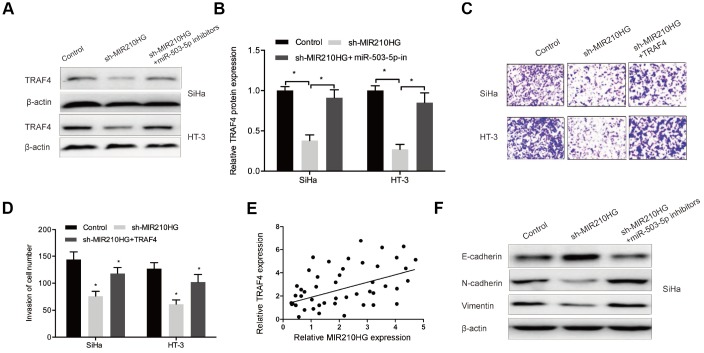
The MIR210HG/miR-503-5p/TRAF4 axis in CC. (A, B) MiR-503-5p inhibitors abolished the effects of MIR210HG suppression on TRAF4 expression in CC cells. (C, D) TRAF4 upregulation rescued the effects of MIR210HG suppression on CC cell invasion abilities. (E) MIR210HG expression was positively associated with TRAF4 expression in CC tissues. (F) MiR-503-5p inhibitors abolished the effects of MIR210HG suppression on EMT related gene expression in SiHa cells. *P<0.05.
Figure 8
Figure 8
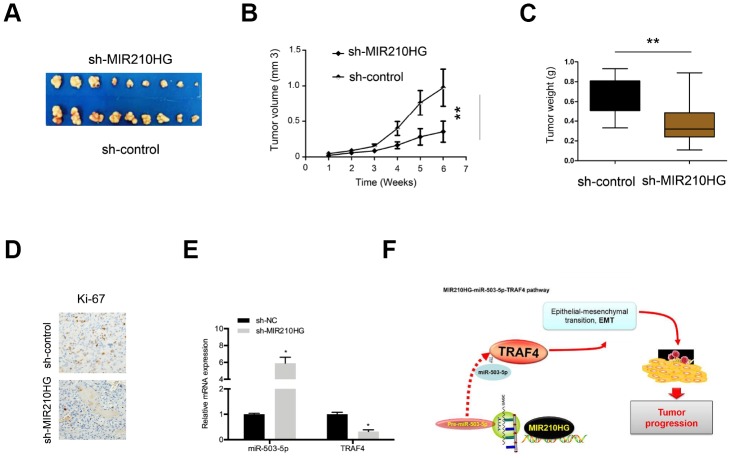
MIR210HG suppression reduced tumor growth in vivo. (A) Representative image of nude mice injected with SiHa cells. (B, C) MIR210HG suppression decreased tumor growth and weight. (D) MIR210HG suppression reduced Ki-67 expression in nude mice. (E) The effects of MIR210HG suppression on miR-503-5p and TRAF4 expression in nude mice. (F) The schematic diagram of the MIR210HG/miR-503-5p/TRAF4 axis in CC. *P<0.05.

References

    1. Torre LA, Islami F, Siegel RL, Ward EM, Jemal A. Global Cancer in Women: Burden and Trends. Cancer Epidemiol Biomarkers Prev. 2017; 26:444–57. 10.1158/1055-9965.EPI-16-0858 - DOI - PubMed
    1. Franco EL, Schlecht NF, Saslow D. The epidemiology of cervical cancer. Cancer J. 2003; 9:348–59. 10.1097/00130404-200309000-00004 - DOI - PubMed
    1. Schiffman M. Cervical cancer screening: epidemiology as the necessary but not sufficient basis of public health practice. Prev Med. 2017; 98:3–4. 10.1016/j.ypmed.2016.12.028 - DOI - PMC - PubMed
    1. Boulet GA, Horvath CA, Berghmans S, Bogers J. Human papillomavirus in cervical cancer screening: important role as biomarker. Cancer Epidemiol Biomarkers Prev. 2008; 17:810–17. 10.1158/1055-9965.EPI-07-2865 - DOI - PubMed
    1. Mercer TR, Dinger ME, Mattick JS. Long non-coding RNAs: insights into functions. Nat Rev Genet. 2009; 10:155–59. 10.1038/nrg2521 - DOI - PubMed

Publication types

MeSH terms