


Profile of American tegumentary leishmaniasis in transmission areas in the state of Minas Gerais, Brazil, from 2007 to 2017
- PMID: 32087701
- PMCID: PMC7036229
- DOI: 10.1186/s12879-020-4860-z
Profile of American tegumentary leishmaniasis in transmission areas in the state of Minas Gerais, Brazil, from 2007 to 2017
Abstract
Background: American tegumentary leishmaniasis (ATL) is a widespread anthropozoonosis caused by protozoa of the genus Leishmania and is considered a serious public health problem. The aim of this study was to provide a descriptive analysis of confirmed ATL cases and evaluate the spatial distribution of ATL in high-risk transmission areas from the state of Minas Gerais, Brazil.
Methods: An ecological, analytical, and retrospective study of the confirmed cases of ATL in Minas Gerais from 2007 to 2017 was conducted. To characterize these cases, multiple correspondence analysis and georeferencing of the ATL prevalence rates in the municipalities were conducted based on variables obtained at Sistema Nacional de Agravos de Notificação and Instituto Brasileiro de Geografia e Estatística databases.
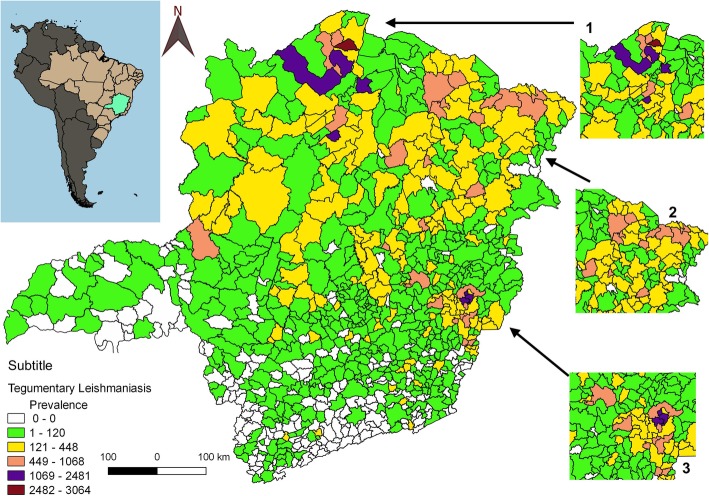
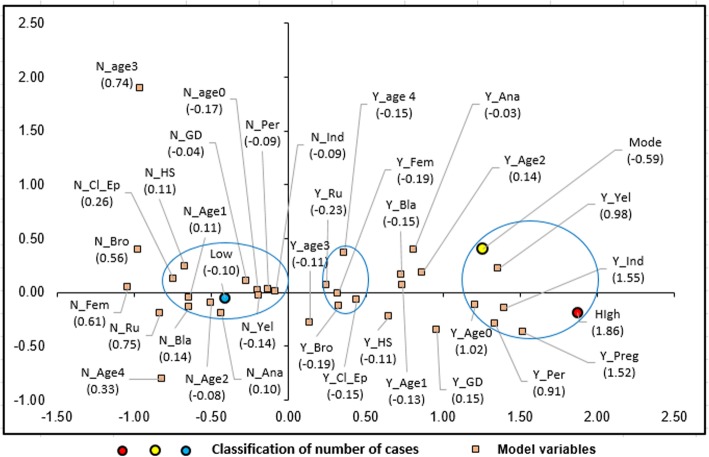
Results: There were 13,025 confirmed cases of ATL from 74.4% (635) municipalities of Minas Gerais, corresponding to a prevalence rate of 66.5 cases for every 100,000 inhabitants. Males aged 20 to 59 years and individuals who attended elementary school were most affected with ATL. Multiple correspondence analysis presented an accumulated qui-squared value of 44.74%, proving that there was a relationship between the variables, including ethnicity, age, pregnancy status, zone of infection, and number of cases.
Conclusion: We confirmed that ATL is endemic to Minas Gerais, and there is high risk of infection within the municipalities due to a high rate of parasite transmission. The occurrence of infection in children, pregnant women, and the indigenous population demonstrates the need for the government to expand social policies aimed at vulnerable groups.
Keywords: Cutaneous leishmaniasis; Epidemiology; Public health; Zoonoses.
Conflict of interest statement
The authors declare that they have no competing interests.
Figures
References
-
- Gosch CS, Marques CP, Resende BS, Souza JD, Rocha RAD, Lopes DSS, et al. American tegumentary leishmaniasis: epidemiological and molecular characterization of prevalent Leishmania species in the state of Tocantins, Brazil, 2011-2015. Rev Inst Med Trop S Paulo. 2017;59:e91. doi: 10.1590/s1678-9946201759091. - DOI - PMC - PubMed
-
- Chagas ECD, Silva AS, Fe NF, Ferreira LS, Sampaio VD, Terrazas WCM, et al. Composition of sand fly fauna (Diptera: Psychodidae) and detection of Leishmania DNA (Kinetoplastida: Trypanosomatidae) in different ecotopes from a rural settlement in the Central Amazon. Brazil Parasit Vectors. 2018;11:180. doi: 10.1186/s13071-018-2743-6. - DOI - PMC - PubMed
MeSH terms
LinkOut - more resources
Full Text Sources
