


Whole-genome sequencing to explore nosocomial transmission and virulence in neonatal methicillin-susceptible Staphylococcus aureus bacteremia
- PMID: 32087747
- PMCID: PMC7036242
- DOI: 10.1186/s13756-020-0699-8
Whole-genome sequencing to explore nosocomial transmission and virulence in neonatal methicillin-susceptible Staphylococcus aureus bacteremia
Abstract
Background: Neonatal Staphylococcus aureus (S. aureus) bacteremia is an important cause of morbidity and mortality. In this study, we examined whether methicillin-susceptible S. aureus (MSSA) transmission and genetic makeup contribute to the occurrence of neonatal S. aureus bacteremia.
Methods: A retrospective, single-centre study was performed. All patients were included who suffered from S. aureus bacteremia in the neonatal intensive care unit (NICU), Erasmus MC-Sophia, Rotterdam, the Netherlands, between January 2011 and November 2017. Whole-genome sequencing (WGS) was used to characterize the S. aureus isolates, as was also done in comparison to reference genomes. Transmission was considered likely in case of genetically indistinguishable S. aureus isolates.
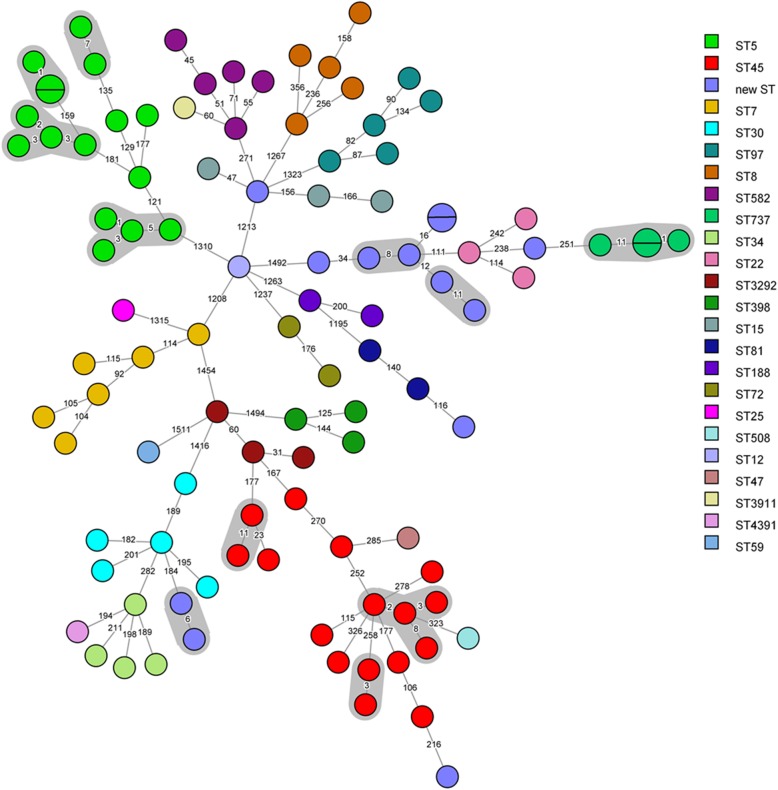
Results: Excluding coagulase-negative staphylococci (CoNS), S. aureus was the most common cause of neonatal bacteremia. Twelve percent (n = 112) of all 926 positive blood cultures from neonates grew S. aureus. Based on core genome multilocus sequence typing (cgMLST), 12 clusters of genetically indistinguishable MSSA isolates were found, containing 33 isolates in total (2-4 isolates per cluster). In seven of these clusters, at least two of the identified MSSA isolates were collected within a time period of one month. Six virulence genes were present in 98-100% of all MSSA isolates. In comparison to S. aureus reference genomes, toxin genes encoding staphylococcal enterotoxin A (sea) and toxic shock syndrome toxin 1 (tsst-1) were present more often in the genomes of bacteremia isolates.
Conclusion: Transmission of MSSA is a contributing factor to the occurrence of S. aureus bacteremia in neonates. Sea and tsst-1 might play a role in neonatal S. aureus bacteremia.
Keywords: Bacteremia; Neonatal intensive care unit; Staphylococcus aureus; Transmission; Whole-genome sequencing.
Conflict of interest statement
All other authors declare that there are no competing personal or institutional interests.
Figures
References
Publication types
MeSH terms
Substances
LinkOut - more resources
Full Text Sources
Medical
