


Rodents as intermediate hosts of cestode parasites of mammalian carnivores and birds of prey in Poland, with the first data on the life-cycle of Mesocestoides melesi
- PMID: 32087754
- PMCID: PMC7036256
- DOI: 10.1186/s13071-020-3961-2
Rodents as intermediate hosts of cestode parasites of mammalian carnivores and birds of prey in Poland, with the first data on the life-cycle of Mesocestoides melesi
Abstract
Background: Rodents constitute an important part of the diet of many carnivore species. This predator-prey food chain is exploited by helminth parasites, such as cestodes, whose larval stages develop in rodents and then mature to the adult stage in predators. The main aim of our study was to use molecular techniques for identification of cestode species recovered from both intermediate and definitive hosts, with a particular focus on the genus Mesocestoides.
Methods: Larval cestodes were obtained during our long-term studies on rodent helminth communities in the Mazury Lake District in the north-east Poland in 2000-2018. Cestode larvae/cysts were collected from body cavities or internal organs (e.g. liver) during autopsies. Adult tapeworms were derived from nine red foxes, three Eurasian badgers and one Eurasian lynx. PCR amplification, sequencing and phylogenetic analyses were conducted employing three genetic markers: 18S rDNA, mitochondrial (mt) 12S rDNA and the mt cytochrome c oxydase subunit 1 (cox1) gene fragment.
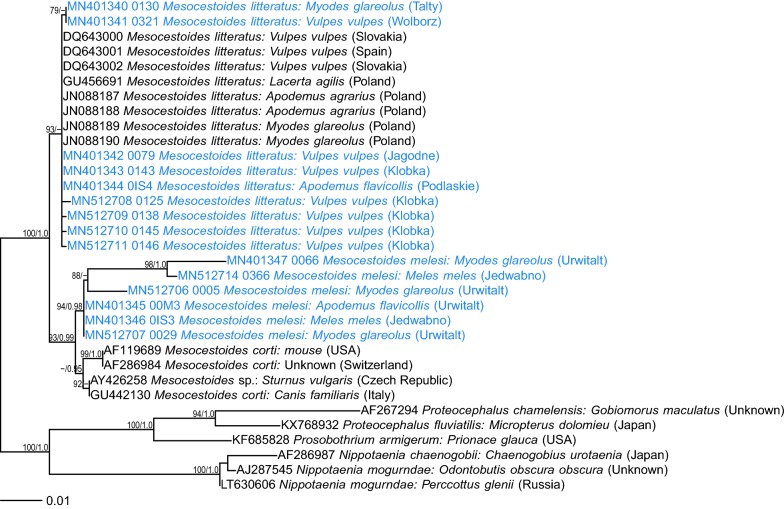
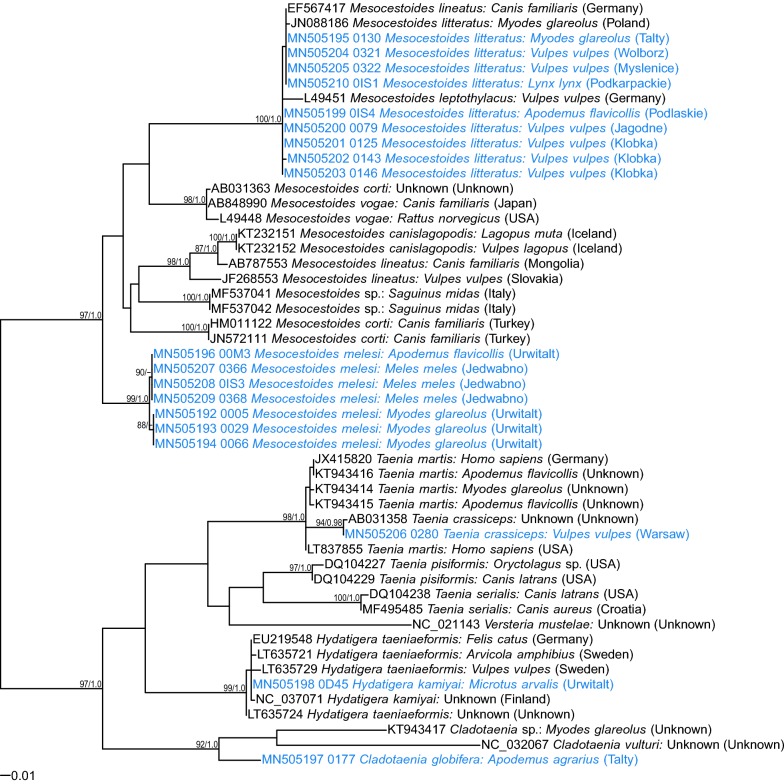
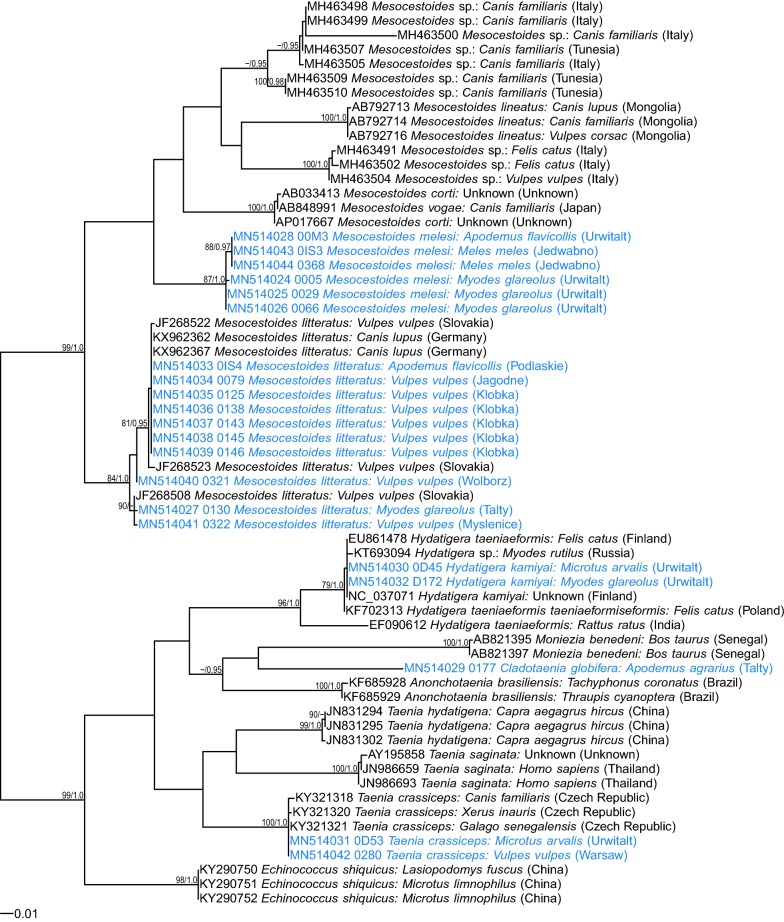
Results: Altogether 19 Mesocestoides samples were analyzed, including 13 adult tapeworms from definitive hosts and six larval samples from 4 bank voles and 2 yellow-necked mice. Phylogenetic analyses revealed three well-supported trees of similar topology. In each case the Mesocestoides samples formed two separate clades. All isolates from foxes, the lynx isolate and two isolates from rodents grouped with Mesocestoides litteratus. Four isolates from rodents and all three isolates from Eurasian badgers were resolved in a separate clade, most similar to North American M. vogae (syn. M. corti). Examination of fixed, stained adult specimens from Eurasian badgers revealed consistency with the morphology of Mesocestoides melesi. Therefore, this clade is likely to represent M. melesi, a species first described in 1985 from the Eurasian badger Meles meles. Molecular analysis allowed also the identification of Taenia crassiceps, Hydatigera kamiyai and Cladotaenia globifera among larvae derived from rodents.
Conclusions: Molecular and phylogenetic analyses support the recognition of M. melesi as a valid species. Our data represent the first record of the larvae of this species in rodents. This is the first report on the occurrence of H. kamiyai in rodents from Poland.
Keywords: Badger; Fox; Hydatigera; Lynx; Mesocestoides; Rodents; Taenia crassiceps.
Conflict of interest statement
The authors declare that they have no competing interests.
Figures
References
-
- Bajer A, Behnke JM, Pawelczyk A, Kuliś K, Sereda MJ, Siński E. Medium-term temporal stability of the helminth component community structure in bank voles (Clethrionomys glareolus) from the Mazury Lake District region of Poland. Parasitology. 2005;130:213–228. doi: 10.1017/S0031182004006389. - DOI - PubMed
-
- Behnke JM, Barnard CJ, Bajer A, Bray D, Dinmore J, Frake K, et al. Variation in the helminth community structure in bank voles (Clethrionomys glareolus) from three comparable localities in the Mazury Lake District region of Poland. Parasitology. 2001;123:401–414. doi: 10.1017/S0031182001008605. - DOI - PubMed
-
- Behnke JM, Bajer A, Harris PD, Newington L, Pidgeon E, Rowlands G, et al. Temporal and between-site variation in helminth communities of bank voles (Myodes glareolus) from NE Poland. 1. Regional fauna and component community levels. Parasitology. 2008;135:985–997. doi: 10.1017/S0031182008004393. - DOI - PubMed
MeSH terms
Grants and funding
LinkOut - more resources
Full Text Sources
Miscellaneous
