. 2020 May 1;87(9):857-865.
doi: 10.1016/j.biopsych.2019.12.010. Epub 2019 Dec 17.

Genetic Risk Underlying Psychiatric and Cognitive Symptoms in Huntington's Disease

Affiliations

Genetic Risk Underlying Psychiatric and Cognitive Symptoms in Huntington's Disease

Natalie Ellis et al. Biol Psychiatry. .

Abstract

Background: Huntington's disease (HD) is an inherited neurodegenerative disorder caused by an expanded CAG repeat in the HTT gene. It is diagnosed following a standardized examination of motor control and often presents with cognitive decline and psychiatric symptoms. Recent studies have detected genetic loci modifying the age at onset of motor symptoms in HD, but genetic factors influencing cognitive and psychiatric presentations are unknown.

Methods: We tested the hypothesis that psychiatric and cognitive symptoms in HD are influenced by the same common genetic variation as in the general population by 1) constructing polygenic risk scores from large genome-wide association studies of psychiatric and neurodegenerative disorders and of intelligence and 2) testing for correlation with the presence of psychiatric and cognitive symptoms in a large sample (n = 5160) of patients with HD.

Results: Polygenic risk score for major depression was associated specifically with increased risk of depression in HD, as was schizophrenia risk score with psychosis and irritability. Cognitive impairment and apathy were associated with reduced polygenic risk score for intelligence.

Conclusions: Polygenic risk scores for psychiatric disorders, particularly depression and schizophrenia, are associated with increased risk of the corresponding psychiatric symptoms in HD, suggesting a common genetic liability. However, the genetic liability to cognitive impairment and apathy appears to be distinct from other psychiatric symptoms in HD. No associations were observed between HD symptoms and risk scores for other neurodegenerative disorders. These data provide a rationale for treatments effective in depression and schizophrenia to be used to treat depression and psychotic symptoms in HD.

Keywords: Cognition; Depression; Huntington’s disease; Polygenic risk; Psychiatric; Schizophrenia.


Figures

Figure 1
Figure 1
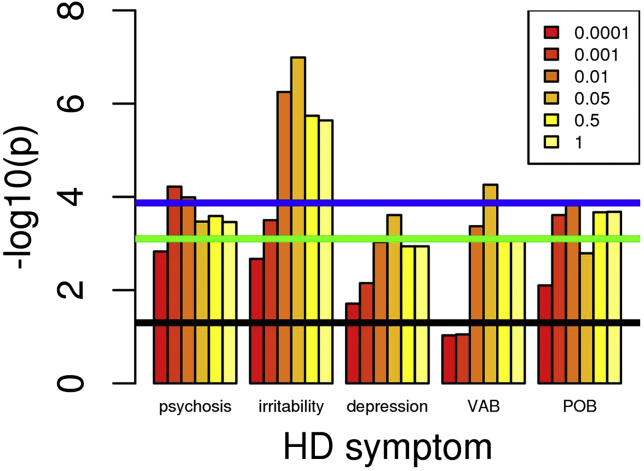
Association of increased schizophrenia polygenic risk score (PRS) with increased Huntington’s disease (HD) symptom frequency. Numbers in the box correspond to the p-value thresholds used to derive the PRS. Black line corresponds to nominally significant association (p = .05). Green line indicates associations significant after Bonferroni correction for 63 PRS-symptom comparisons (9 PRS × 7 symptoms). Blue line indicates associations significant after Bonferroni correction for 63 PRS-symptom comparisons and 6 PRS cutoffs. Note: Only symptoms with at least one p value reaching the green line are shown. POB, perseverative/obsessive behavior; VAB, violent/aggressive behavior.
Figure 2
Figure 2
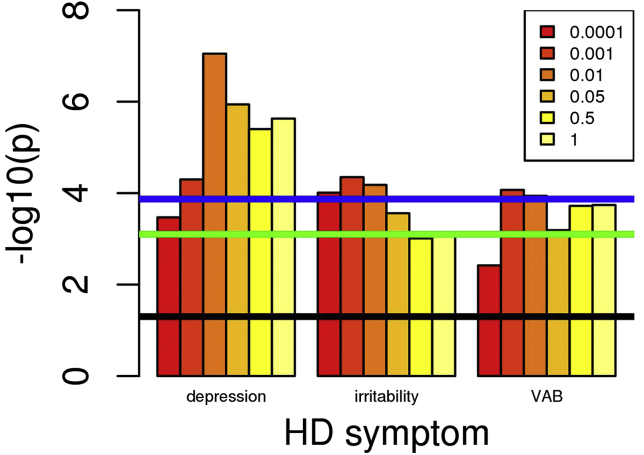
Association of increased major depression polygenic risk score (PRS) with increased Huntington’s disease (HD) symptom frequency. Numbers in the box correspond to the p-value thresholds used to derive the PRS. Black line corresponds to nominally significant association (p = .05). Green line indicates associations significant after Bonferroni correction for 63 PRS-symptom comparisons (9 PRS × 7 symptoms). Blue line indicates associations significant after Bonferroni correction for 63 PRS-symptom comparisons and 6 PRS cutoffs. Note: Only symptoms with at least one p value reaching the green line are shown. VAB, violent/aggressive behavior.
Figure 3
Figure 3
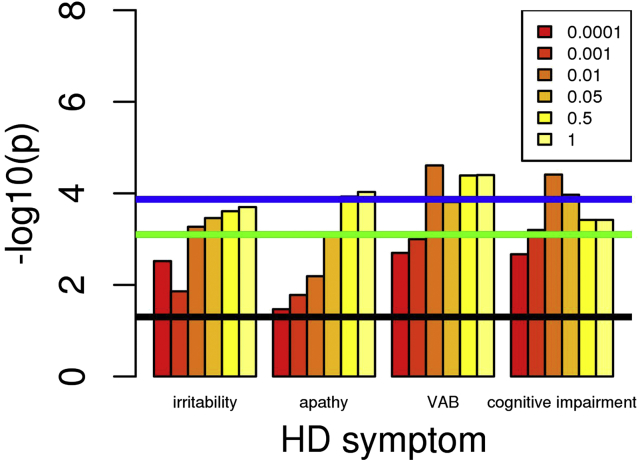
Association of decreased intelligence polygenic risk score (PRS) with increased Huntington’s disease (HD) symptom frequency. Numbers in the box correspond to the p-value thresholds used to derive the PRS. Black line corresponds to nominally significant association (p = .05). Green line indicates associations significant after Bonferroni correction for 63 PRS-symptom comparisons (9 PRS × 7 symptoms). Blue line indicates associations significant after Bonferroni correction for 63 PRS-symptom comparisons and 6 PRS cutoffs. Note: Only symptoms with at least one p value reaching the green line are shown. VAB, violent/aggressive behavior.
Figure 4
Figure 4
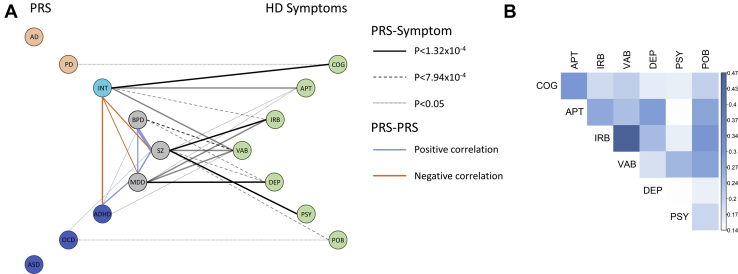
Pattern of association between Huntington’s disease (HD) symptoms and polygenic risk score (PRS) from psychiatric, neurodegenerative, and cognitive disorders. (A) PRS grouped into psychiatric (black), neurodevelopmental (blue), neurodegenerative (orange), and cognitive (cyan) disorders. Significant correlations between the PRSs associated with HD symptoms are shown by blue (positive correlations) and orange (negative correlations) lines, with line width proportional to the correlation magnitude. Solid lines between PRS and symptoms show associations significant after correcting for 63 PRS-symptom combinations (9 PRS × 7 symptoms) and 6 PRS cutoffs (p < 1.32 × 10−4). Dashed lines show associations significant after correcting for 63 PRS-symptom combinations (p < 7.94 × 10−4). Dotted lines show nominally significant associations (p < .05) in PRS-symptom combinations that were part of the primary analysis. Bold lines show PRS-symptom associations that are significant after correcting for other PRS and symptoms (Table 3). (B) Heat map showing correlations between symptoms (numerical values in Supplemental Table S2). All correlations are positive, and statistically significant (p < 2.2 × 10−16). AD, Alzheimer’s disease; ADHD, attention-deficit/hyperactivity disorder; APT, apathy; ASD, autism spectrum disorder; BPD, bipolar disorder; COG, cognitive impairment; DEP, depression; INT, intelligence; IRB, irritability; MDD, major depressive disorder; OCD, obsessive-compulsive disorder; PD, Parkinson’s disease; POB, perseverative/obsessive behavior; PSY, psychosis; SZ, schizophrenia; VAB, violent/aggressive behavior.

Comment in

References

    1. Bates G.P., Dorsey R., Gusella J.F., Hayden M.R., Kay C., Leavitt B.R. Huntington disease. Nat Rev Dis Prim. 2015;1:15005. - PubMed
    1. Craufurd D., Snowden J. Neuropsychiatry and neuropsychology. In: Bates G.P., Tabrizi S.J., Jones L., editors. Huntington’s Disease. 4th ed. Oxford University Press; New York: 2014. pp. 36–65.
    1. Huntington’s GM of, Disease Consortium (GeM-HD) Identification of genetic factors that modify clinical onset of Huntington’s disease. Cell. 2015;162:516–526. - PMC - PubMed
    1. Holmans P.A., Massey T.H., Jones L. Genetic modifiers of Mendelian disease: Huntington’s disease and the trinucleotide repeat disorders. Hum Mol Genet. 2017;26:R83–R90. - PubMed
    1. Lee J.-M., Correia K., Loupe J., Kim K.-H., Barker D., Hong E.P. Huntington’s disease onset is determined by length of uninterrupted CAG, not encoded polyglutamine, and is modified by DNA maintenance mechanisms. bioRxiv. 2019

Publication types