


Per- and polyfluoroalkyl substances and blood pressure in pre-diabetic adults-cross-sectional and longitudinal analyses of the diabetes prevention program outcomes study
- PMID: 32088543
- PMCID: PMC7094005
- DOI: 10.1016/j.envint.2020.105573
Per- and polyfluoroalkyl substances and blood pressure in pre-diabetic adults-cross-sectional and longitudinal analyses of the diabetes prevention program outcomes study
Abstract
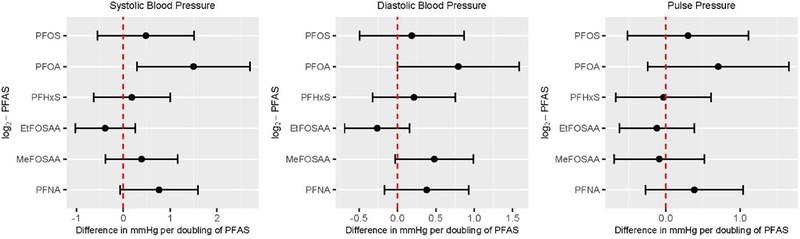
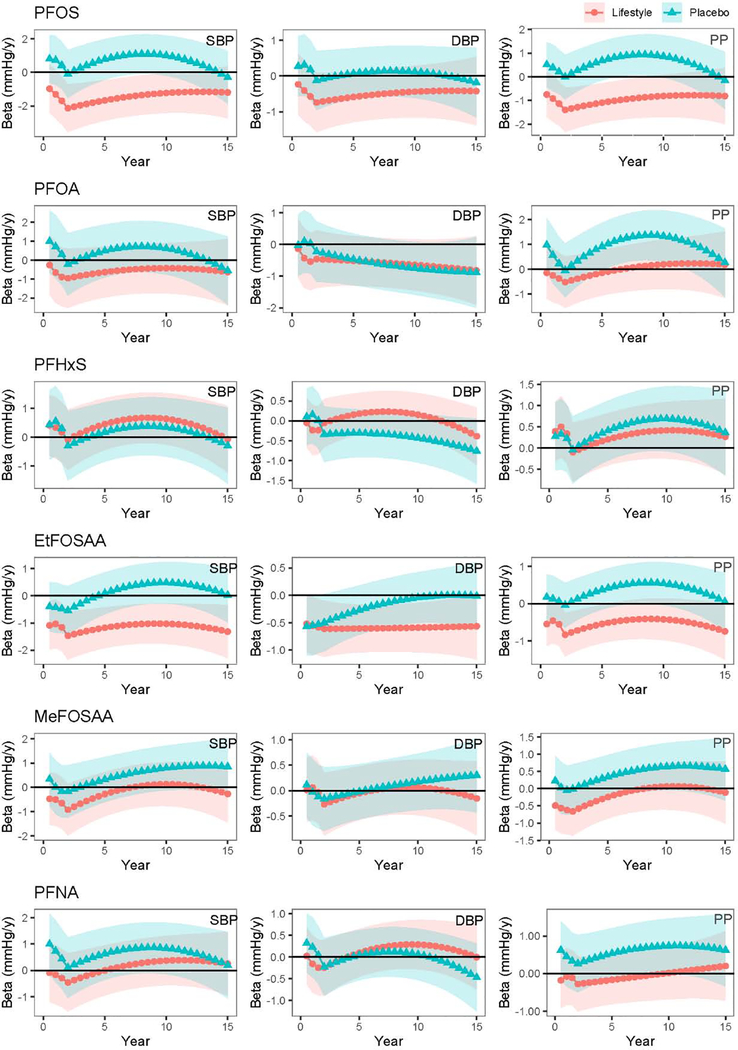
The relationship of plasma concentration of per- and polyfluoroalkyl substances (PFAS) with blood pressure (BP) is uncertain. This study examined cross-sectional and prospective associations of PFAS with BP and hypertension. We quantified plasma PFAS concentrations from 957 participants enrolled in the lifestyle and placebo arms of the Diabetes Prevention Program (DPP), a randomized controlled trial with approximately 15 years of follow-up. We used multivariable linear and logistic regressions to test cross-sectional associations of six PFAS, including perfluorooctanesulfonic acid (PFOS), perfluorooctanoic acid (PFOA), perfluorohexane sulfonic acid (PFHxS), N-ethyl-perfluorooctane sulfonamido acetic acid (EtFOSAA), N-methyl-perfluorooctane sulfonamido acetic acid (MeFOSAA), and perfluorononanoic acid (PFNA), with BP and hypertension prevalence, respectively, at baseline. We used generalized linear mixed models to estimate longitudinal associations between baseline PFAS and the rate of BP changes, and Cox-Proportional hazard models to estimate risk of developing hypertension relative to baseline PFAS. Models were adjusted for baseline age, sex, race/ethnicity, treatment arm, educational attainment, income, marital status, smoking habit, alcohol drinking, and diet. We tested for effect modification by the treatment arm and sex, and accounted for multiple comparisons using the False-Discovery Rate (FDR). PFAS concentrations and hypertension prevalence within the study population (65.3% female, 57.7% White, 65.3% aged 40-59 years) were comparable to the general U.S. population. Cross-sectionally, we found small but statistically significant associations of baseline plasma concentrations of PFOA with systolic BP (β per doubling: 1.49 mmHg, 95% CI: 0.29, 2.70); and MeFOSAA with hypertension (RR = 1.09 per doubling, 95% CI: 1.01, 1.19). Estimates were not statistically significant after FDR adjustment. Longitudinally, we observed null associations in the placebo arm, but some inverse associations of baseline PFOS and MeFOSAA with systolic BP in the lifestyle arm, perhaps due to regression toward the mean. Baseline PFAS concentrations also were not prospectively associated with hypertension risk. Overall, there were modest and mostly null associations of plasma PFAS concentrations with BP and hypertension.
Keywords: Blood pressure; Diabetes Prevention Program; Hypertension; Longitudinal study; Per- and polyfluoroalkyl substances; Prediabetic adults.
Copyright © 2020 The Authors. Published by Elsevier Ltd.. All rights reserved.
Conflict of interest statement
Declaration of Competing Interest The authors declare that they have no known competing financial interests or personal relationships that could have appeared to influence the work reported in this paper.
Figures
References
-
- Benjamini Y, Hochberg Y. 1995. Controlling the false discovery rate: A practical and powerful approach to multiple testing. Journal of the Royal Statistical Society, B 57:289–300.
-
- Berg V, Nost TH, Huber S, Rylander C, Hansen S, Veyhe AS, et al. 2014. Maternal serum concentrations of per- and polyfluoroalkyl substances and their predictors in years with reduced production and use. Environ Int 69:58–66. - PubMed
Publication types
MeSH terms
Substances
Grants and funding
LinkOut - more resources
Full Text Sources
Medical
