. 2020 Feb 5:2020:6318520.
doi: 10.1155/2020/6318520. eCollection 2020.

Aloe Emodin Reduces Cardiac Inflammation Induced by a High-Fat Diet through the TLR4 Signaling Pathway

Affiliations

Aloe Emodin Reduces Cardiac Inflammation Induced by a High-Fat Diet through the TLR4 Signaling Pathway

Yingfu Chen et al. Mediators Inflamm. .

Abstract

Background: Aloe emodin (AE) is a lipid-lowering agent, which could be used to treat hyperlipidemia, thereby reducing the risk of cardiovascular disease. Recent evidence suggests that hyperlipidemia is associated with many cardiac pathological alterations and might worsen myocardial damages.

Purpose: The purpose of this study is to evaluate the potential roles and mechanisms of AE in hyperlipidemia-induced oxidative stress and inflammation in the heart. Study Design. We established a hyperlipidemia-induced cardiac inflammation model in rats and cells then administered AE and observed its effect on hyperlipidemia-induced cardiac inflammation.

Methods: We used a mouse model of hyperlipidemia caused by a high-fat diet (HFD) for 10 weeks and cell culture experimental models of inflammation in the heart stimulated by PA for 14 h. Inflammatory markers were detected by qRT-PCR, WB, and immunofluorescence.

Results: We demonstrated that the expression levels of proinflammatory cytokines IL-1β, IL-6, and TNF-α were increased in the HFD group compared to the normal diet (ND) group, whereas AE treatment significantly reduced their levels in the myocardium. In addition, vascular cell adhesion molecule 1 (VCAM1) and intercellular adhesion molecule 1 (ICAM-1) protein expressions were also inhibited by AE. Our in vitro study showed AE treatment dose-dependently decreased the expression of IL-1β, IL-6, and TNF-α were increased in the HFD group compared to the normal diet (ND) group, whereas AE treatment significantly reduced their levels in the myocardium. In addition, vascular cell adhesion molecule 1 (VCAM1) and intercellular adhesion molecule 1 (ICAM-1) protein expressions were also inhibited by AE. Our κB, and p-P65l in vivo and in vitro study showed AE treatment dose-dependently decreased the expression of IL-1.

Conclusion: Taken together, our findings disclose that AE could alleviate HFD/PA-induced cardiac inflammation via inhibition of the TLR4/NF-κB signaling pathway. Thus, AE may be a promising therapeutic strategy for preventing hyperlipidemia-induced myocardial injury.κB, and p-P65l.


Conflict of interest statement

We wish to confirm that there are no known conflicts of interest associated with this publication and there has been no significant financial support for this work that could have influenced its outcome.

Figures
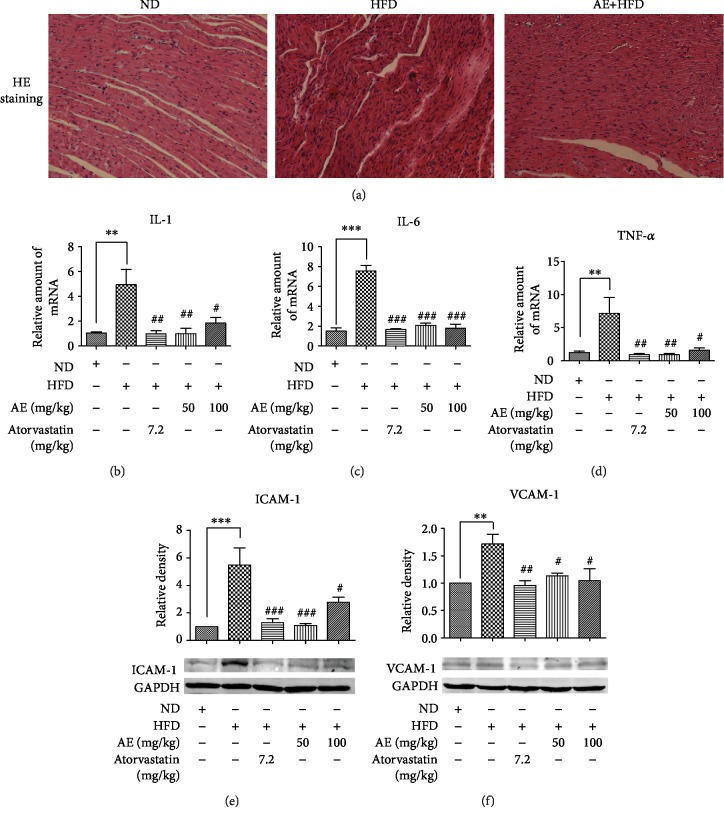
Figure 1
Figure 1
AE reduces myocardial inflammatory injury in HFD experimental model; HFD also increased the mRNA levels of IL-1β, IL-6, and TNF-α. Staining as described in the Material and Methods section. The frozen heart tissues were sectioned at 5 μm for HE staining (n = 4). All images were obtained by an optical microscope with 200x amplification as shown in (a). The representative data of qRT-PCR analysis of RNA extracted from the heart are shown in (b)–(d). All the samples were normalized with GAPDH (n = 6). (e, f) The heart tissues in the control group, HFD group, HFD+atorvastatin group (positive control group), and HFD+AE group (the treatment group) were collected and homogenized to detect ICAM-1 and VCAM-1 level by western blot analysis as shown in (e) and (f). GAPDH was used as a loading control. The column figures show the normalized optical density of each protein (n = 5; ∗∗P < 0.01 and ∗∗∗P < 0.001 compared to the ND group; #P < 0.05, ##P < 0.01, and ###P < 0.001 compared to the HFD group).
Figure 2
Figure 2
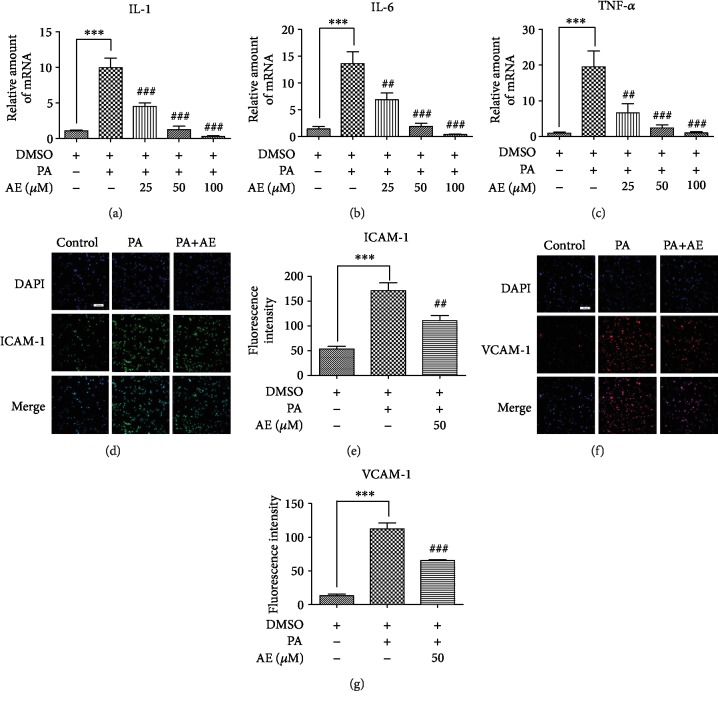
AE inhibits PA-induced inflammatory cytokine production in H9C2 cells. (a–c) H9C2 cells pretreated with different concentrations of AE for 1 h and incubated with 500 μM PA for 14 h. The total RNAs were extracted from cells for real-time qPCR analysis as shown in (a)–(c). All the genes were normalized with GAPDH as a control (n = 6). (d, f) The cells were harvested and processed to immunofluorescence staining of vascular adhesion factor (ICAM-1 and VCAM-1) as described in the Material and Methods section. (e, g) Representative group fluorescence intensity was shown. Transverse line = 100 μm (n = 4; ∗∗∗P < 0.001 compared to the control group; ##P < 0.01 and ###P < 0.001 compared to the PA group).
Figure 3
Figure 3
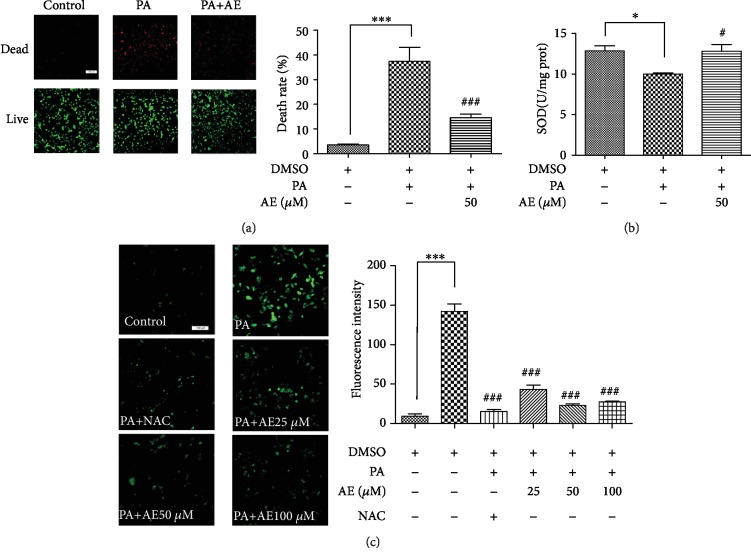
AE enhanced H9C2 cell viability and reduced ROS production after PA challenge. H9C2 cells pretreated with different concentrations of AE for 1 h and incubated with PA (500 μM) for 14 h were used for calcein-AM/PI staining, DCFH-DA assay, and investigation of SOD expression. The images from fluorescence microscopy and data from the microplate reader are shown in (a)–(c). Data are expressed as the mean ± SD. Transverse line = 100 μm (n = 4; P < 0.05 and ∗∗∗P < 0.001 compared to the control group; #P < 0.05 and ###P < 0.001 compared to the PA group).
Figure 4
Figure 4
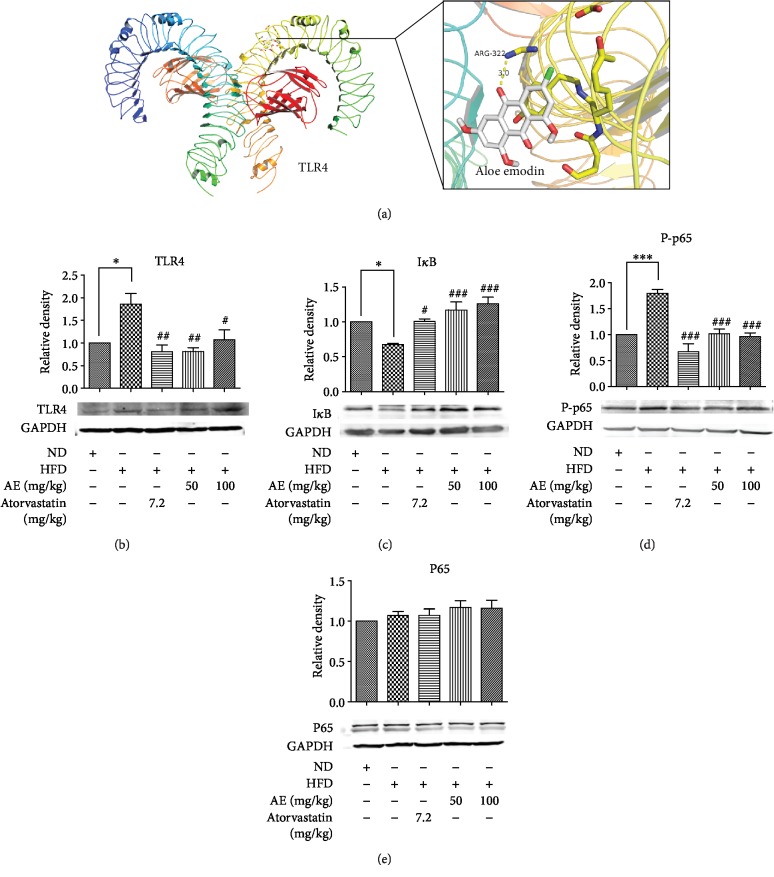
AE has an important repressor effect on the HFD-stimulated TLR4 pathway signaling. 3D schematic diagram of interaction between AE and TLR4 active site residues: the yellow dotted line is hydrogen bonding (a). Heart tissue homogenate was extracted for western blot assay. GAPDH was used as a loading control. The column figures have shown the normalized optical density of each protein as follows: (b) Toll-like receptor 4 (TLR4), (c) inhibitor of NF-κB (IκB), (d) nuclear factor-kappa B P65 (NF-κB P65), and (e) p-nuclear factor- kappa B P65 (p-NF-κB P-P65) (n = 5; P < 0.0 and ∗∗∗P < 0.001 compared to the ND group; #P < 0.05, ##P < 0.01, and ###P < 0.001 compared to the HFD group).
Figure 5
Figure 5
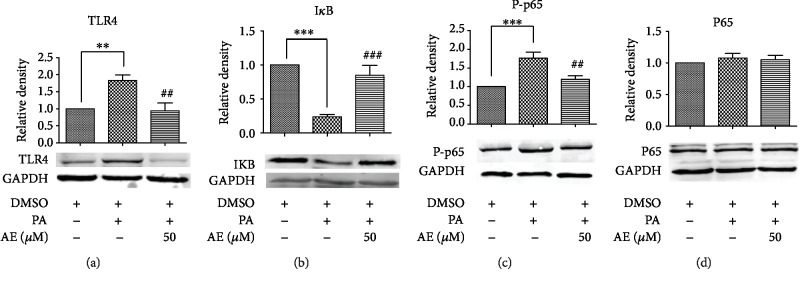
AE has an important repressor effect on the PA-induced TLR4 pathway signaling. The extracted total proteins were processed to western blot analysis with GAPDH as the loading control. The column figures demonstrated the normalized optical density of (a) Toll-like receptor 4 (TLR4), (b) inhibitor of NF-κB (IκB), (c) nuclear factor-kappa B P65 (NF-κB P65), and (d) p-nuclear factor-kappa B P65 (p-NF-κB P-P65) proteins (n = 5; ∗∗P < 0.01 and ∗∗∗P < 0.001 compared to the control group; ##P < 0.01 and ###P < 0.001 compared to the PA group).

References

    1. Yang D., Hu C., Deng X., et al. Therapeutic effect of chitooligosaccharide tablets on lipids in high-fat diets induced hyperlipidemic rats. Molecules. 2019;24(3):p. 514. doi: 10.3390/molecules24030514. - DOI - PMC - PubMed
    1. Sato-Mito N., Suzui M., Yoshino H., Kaburagi T., Sato K. Long term effects of high fat and sucrose diets on obesity and lymphocyte proliferation in mice. The Journal of Nutrition, Health & Aging. 2009;13(7):602–606. doi: 10.1007/s12603-009-0170-2. - DOI - PubMed
    1. Dai S., Huang B., Zou Y., Liu Y. Associations of dipping and non-dipping hypertension with cardiovascular diseases in patients with dyslipidemia. Archives of Medical Science. 2019;15(2):337–342. doi: 10.5114/aoms.2018.72609. - DOI - PMC - PubMed
    1. Sepulveda C., Palomo I., Fuentes E. Antiplatelet activity of drugs used in hypertension, dyslipidemia and diabetes: additional benefit in cardiovascular diseases prevention. Vascular Pharmacology. 2017;91:10–17. doi: 10.1016/j.vph.2017.03.004. - DOI - PubMed
    1. Manzoni A. G., Passos D. F., da Silva J. L. G., et al. Rutin and curcumin reduce inflammation, triglyceride levels and ADA activity in serum and immune cells in a model of hyperlipidemia. Blood Cells, Molecules, and Diseases. 2019;76:13–21. doi: 10.1016/j.bcmd.2018.12.005. - DOI - PubMed

MeSH terms

LinkOut - more resources