. 2020 Feb 3:2020:1841527.
doi: 10.1155/2020/1841527. eCollection 2020.

Resveratrol Prevents Right Ventricle Remodeling and Dysfunction in Monocrotaline-Induced Pulmonary Arterial Hypertension with a Limited Improvement in the Lung Vasculature

Affiliations

Resveratrol Prevents Right Ventricle Remodeling and Dysfunction in Monocrotaline-Induced Pulmonary Arterial Hypertension with a Limited Improvement in the Lung Vasculature

Eduardo Vázquez-Garza et al. Oxid Med Cell Longev. .

Abstract

Pulmonary arterial hypertension (PAH) is a life-threatening disease that is characterized by an increase in pulmonary vascular pressure, leading to ventricular failure and high morbidity and mortality. Resveratrol, a phenolic compound and a sirtuin 1 pathway activator, has known dietary benefits and is used as a treatment for anti-inflammatory and cardiovascular diseases. Its therapeutic effects have been published in the scientific literature; however, its benefits in PAH are yet to be precisely elucidated. Using a murine model of PAH induced by monocrotaline, the macroscopic and microscopic effects of a daily oral dose of resveratrol in rats with PAH were evaluated by determining its impact on the lungs and the right and left ventricular function. While most literature has focused on smooth muscle cell mechanisms and lung pathology, our results highlight the relevance of therapy-mediated improvement of right ventricle and isolated cardiomyocyte physiology in both ventricles. Although significant differences in the pulmonary architecture were not identified either micro- or macroscopically, the effects of resveratrol on right ventricular function and remodeling were observed to be beneficial. The values for the volume, diameter, and contractility of the right ventricular cardiomyocytes returned to those of the control group, suggesting that resveratrol has a protective effect against ventricular dysfunction and pathological remodeling changes in PAH. The effect of resveratrol in the right ventricle delayed the progression of findings associated with right heart failure and had a limited positive effect on the architecture of the lungs. The use of resveratrol could be considered a future potential adjunct therapy, especially when the challenges to making a diagnosis and the current therapy limitations for PAH are taken into consideration.


Conflict of interest statement

The authors declare that there is no conflict of interest regarding the publication of this paper.

Figures
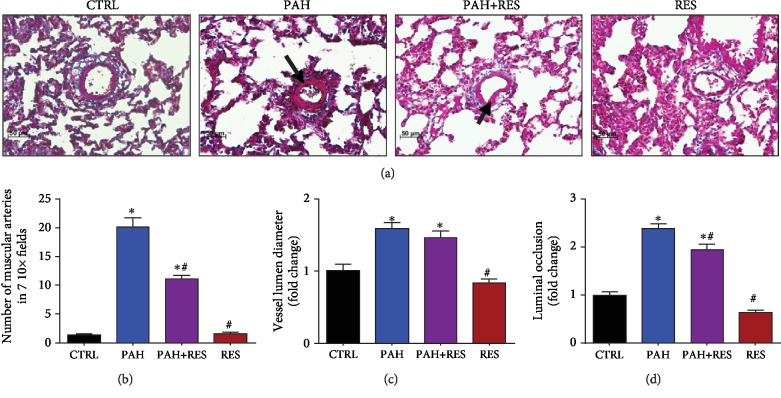
Figure 1
Figure 1
There is a limited effect of RES exerted in the lung vessel histopathology structure. (a) Representative microphotographs of pulmonary blood vessels. PAH induced hypertrophy and proliferation of the tunica media; this effect is decreased by RES. 20x magnification; H&E staining. Arrows indicate the muscularized vessel wall. (b) Amount of muscular arteries in 7 random fields in lung tissue. (c) Diameter of pulmonary blood vessels. (d) Luminal occlusion by the media layer in lung arteries. The values are given as the mean and fold change ± SEM; p < 0.05 vs. control; #p < 0.05 vs. PAH; n = 15 for CTRL, PAH, and PAH+RES; n = 11 for RES.
Figure 2
Figure 2
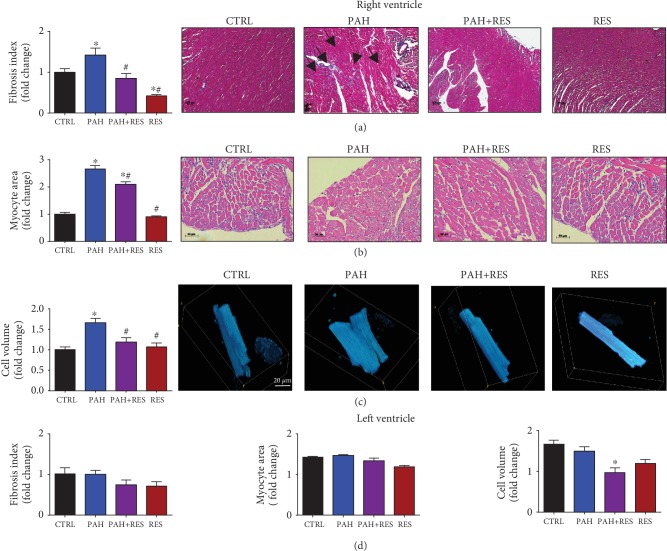
RES reduces the fibrotic index and myocyte hypertrophy in RV of PAH-treated specimens. (a) Fibrotic index. Representative right ventricles stained with Masson's trichrome of all treated groups (5x). Black arrows indicate the zones of fibrotic tissue. (b) Myocyte area. Representative cross-section cardiomyocytes from groups (H&E, 10x). (c) Cell volume analysis. Representative right ventricle cardiomyocytes stained with calcein and analyzed by confocal microscopy. (d) Unchanged LV morphological features in the PAH model and the lack of effect of RES on these features. Fibrotic index, myocyte area, and isolated cell volume. All data have been normalized to RV CTRL mean values. The values are given as the mean and fold change ± SEM (n = 15 for CTRL, PAH, and PAH+RES; n = 11 for RES). The values are given as the mean and fold change ± SEM; p < 0.05 vs. CTRL; #p < 0.05 vs PAH.
Figure 3
Figure 3
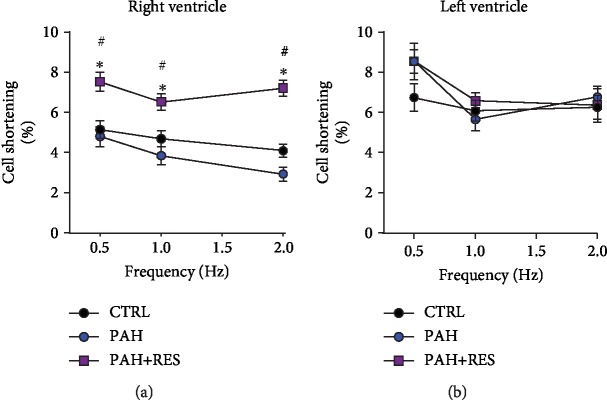
RES improves cardiomyocyte shortening isolated from RV, and had with on LV isolated cardiomyocytes. Percentage of cell shortening after 1 Hz stimulation in isolated cardiomyocyte from the (a) right ventricle and (b) left ventricle. The values are given as the mean ± SEM (p < 0.05 vs. control, #p < 0.05 vs. PAH; n = 26-44 cells from 2 animals for CTRL, n = 15-26 cells from 2-3 animals for PAH, and n = 19-61 cells from 2-4 animals for PAH+RES).
Figure 4
Figure 4
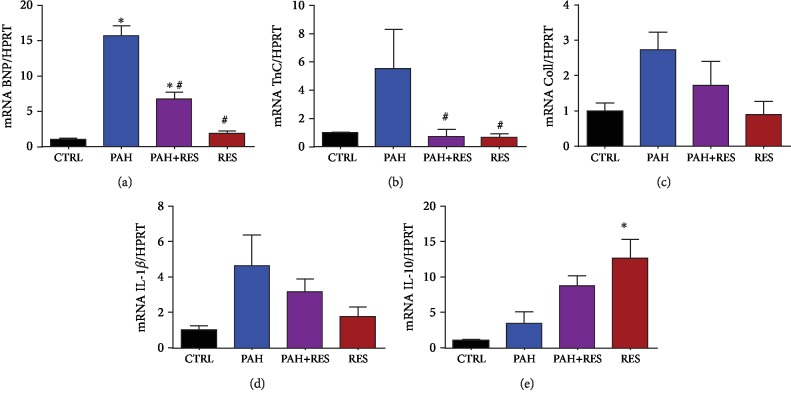
RES modulates the decrease of tissue remodeling and inflammatory mRNA on the RV of PAH-treated specimens. qPCR analysis of RV from the tissue samples show (a) BNP, (b) troponin C, (c) collagen type 1, (d) IL-1β, and (e) IL-10. All data have been normalized to RV CTRL mean values. The values are given as the mean and fold change ± SEM (n = 4 for CTRL, n = 3 for PAH and PAH+RES, and n = 6 for RES). The values are given as the mean and fold change ± SEM; p < 0.05 vs. control; #p < 0.05 vs. PAH.
Figure 5
Figure 5
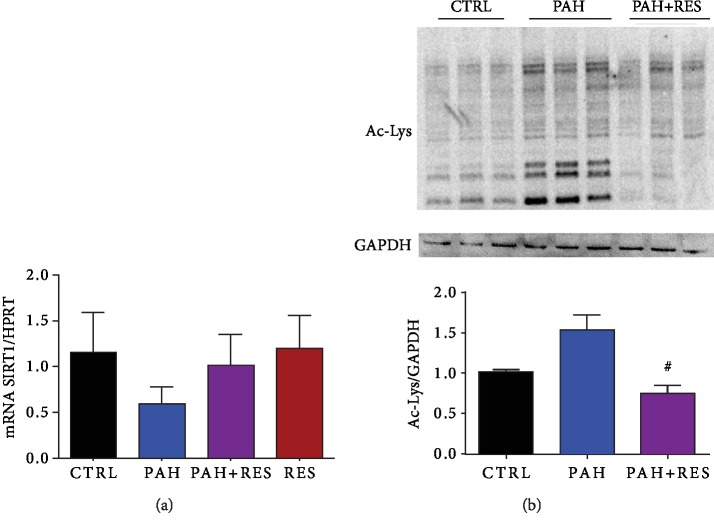
There is a decrease in the mediated SIRT1 deacetylation. (a) qPCR analysis of SIRT1 mRNA expression on heart tissue. (b) Representative western blot membrane of Ac lysine of heart tissue proteins and below the acetylation profile in heart tissue in fold change. For (a), n = 4 for all groups; for (a), n = 3 for all groups. The values are given as the mean and fold change ± SEM; p < 0.05 vs. control; #p < 0.05 vs PAH.
Figure 6
Figure 6
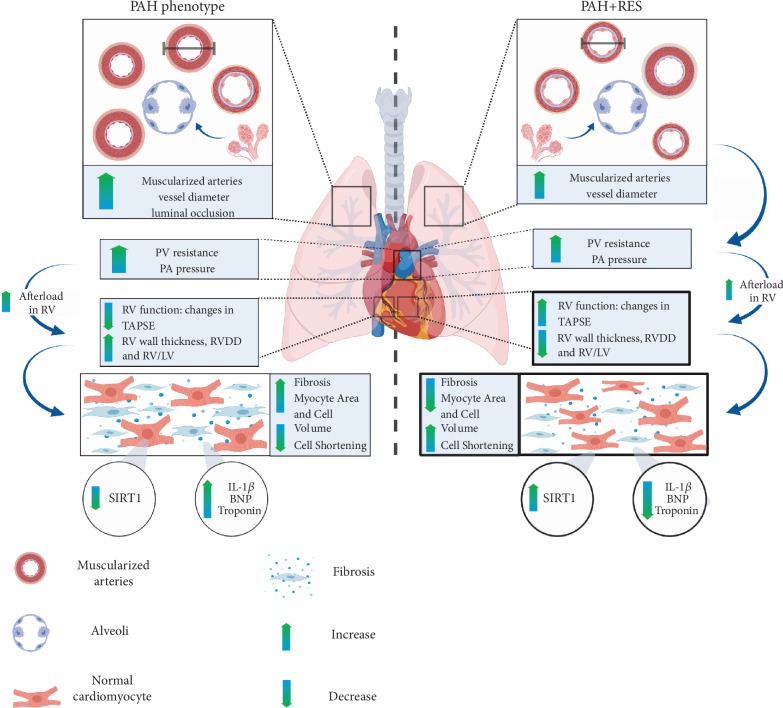
Effects of resveratrol in the PAH phenotype. Monocrotaline-induced PAH is a disease characterized by a progressive remodeling of the pulmonary vasculature, as a consequence of excessive proliferation and migration of pulmonary artery endothelial and smooth muscle cells. With the progression of the disease, the increase of the mean pulmonary artery pressure leads to a chamber pressure overload in the right ventricle (RV). When the optimal RV-arterial coupling is lost, the RV systolic function cannot remain matched to the afterload, and subsequently, dilation of the RV occurs, as well as diastolic dysfunction, secondary to myocardial fibrosis and sarcomeric stiffening. These changes ultimately lead to right heart failure and death. Even though the administration of resveratrol decreased the pathological remodeling of the pulmonary vasculature, it did not change the afterload for the RV (represented in the figure as a change in arrows' thickness). Nevertheless, resveratrol was able to protect directly the RV, improving its function, evidentiated with microscopic changes: less fibrosis, decreased cardiomyocyte area and volume and better cell function, with increased cell shortening, increasing SIRT1-mediated deacetylation, and decreasing inflammatory and remodeling markers. The arrows in the PAH model indicate the changes compared to the CTRL group; the arrows in the PAH+RES model indicate the changes compared to the PAH group.

References

    1. White R. J., Jerjes-Sanchez C., Bohns Meyer G. M., et al. Combination therapy with oral treprostinil for pulmonary arterial hypertension: a double-blind, placebo-controlled study. American Journal of Respiratory and Critical Care Medicine. 2019 doi: 10.1164/rccm.201908-1640OC. https://www.atsjournals.org/doi/abs/10.1164/rccm.201908-1640OC. - DOI - PMC - PubMed
    1. Sandoval Zarate J., Jerjes-Sanchez C., Ramirez-Rivera A., et al. Mexican registry of pulmonary hypertension: REMEHIP. Archivos de Cardiología de México. 2017;87(1):13–17. doi: 10.1016/j.acmx.2016.11.006. - DOI - PubMed
    1. Galiè N., Channick R. N., Frantz R. P., et al. Risk stratification and medical therapy of pulmonary arterial hypertension. The European Respiratory Journal. 2018;53(1, article 1801889) doi: 10.1183/13993003.01889-2018. - DOI - PMC - PubMed
    1. Ren X., Johns R. A., Gao W. D. Right heart in pulmonary hypertension: from adaptation to failure. Pulmonary Circulation. 2019;9(3) doi: 10.1177/2045894019845611. - DOI - PMC - PubMed
    1. Garcia-Rivas G., Jerjes-Sánchez C., Rodriguez D., Garcia-Pelaez J., Trevino V. A systematic review of genetic mutations in pulmonary arterial hypertension. BMC Medical Genetics. 2017;18(1, article 82) doi: 10.1186/s12881-017-0440-5. - DOI - PMC - PubMed