


Incidence of lower extremity amputations among patients with type 1 and type 2 diabetes in the United States from 2010 to 2014
- PMID: 32090430
- PMCID: PMC7318669
- DOI: 10.1111/dom.14012
Incidence of lower extremity amputations among patients with type 1 and type 2 diabetes in the United States from 2010 to 2014
Abstract
Aim: To compare the incidence of lower extremity amputation (LEA) among patients with type 1 diabetes (T1D) and patients with type 2 diabetes (T2D) with those without diabetes using US commercial claims and to assess the presence of key co-morbidities and precipitating factors at the time of the LEA.
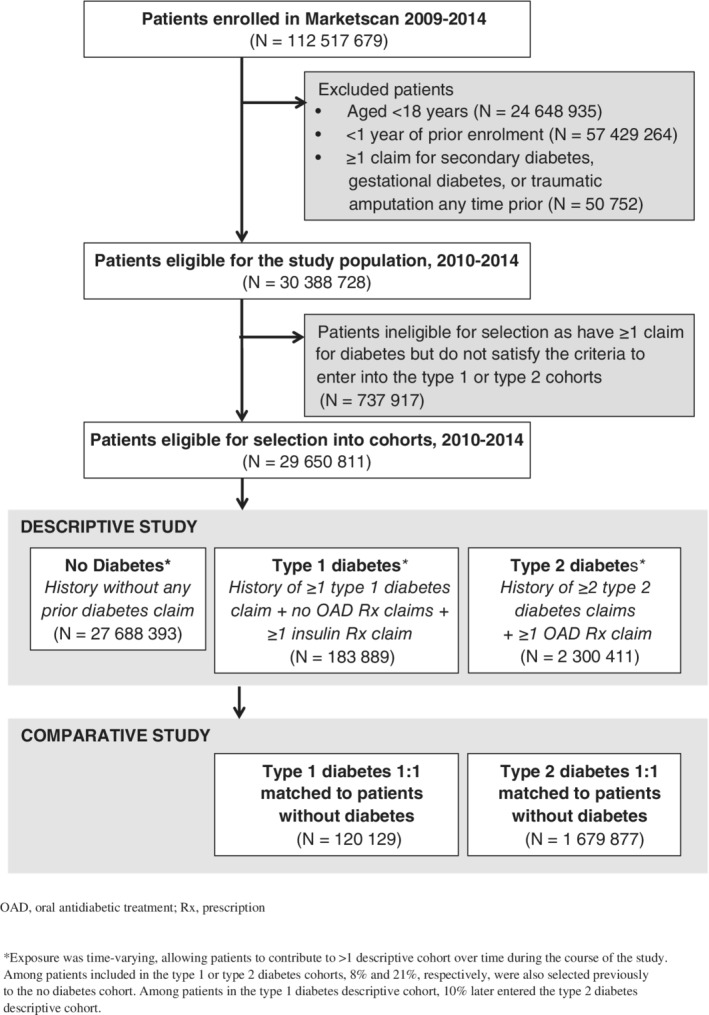
Methods: Cohorts were defined via IBM MarketScan research databases for beneficiaries with T1D and T2D during 2010-2014. For each T1D and T2D patient, one patient without a prior diabetic claim matched on calendar time, sex and age, was randomly selected. Multivariable Cox proportional hazards models were used to estimate adjusted hazard ratios (aHRs) and 95% confidence intervals.
Results: Among the matched cohorts of 120 129 T1D patients and 1.7 million T2D patients, the incidence of LEA was higher among patients with T1D than patients with T2D, with the most frequent cases being minor LEAs (4.85 and 1.53 per 1000 patient years [PY], respectively), largely toe amputations (4.49 and 1.43 per 1000 PY, respectively). Compared with non-diabetic patients matched on age, sex and calendar time, T1D and T2D patients had more co-morbidities and a higher incidence of LEA (6.02 vs. 0.14 per 1000 PY; aHR, 22.47 [16.42-30.73] and 1.90 vs. 0.23 per 1000 PY; aHR, 4.64 [4.32-4.98]).
Conclusions: Our data showed a higher incidence of LEA, especially minor LEA, in patients with T1D and T2D compared with those without diabetes, with a greater risk among patients with T1D than patients with T2D. Accounting for known and measurable risk factors for LEA reduced the relative hazard by nearly 50%; the majority of LEA cases were minor LEAs and toe amputations.
Keywords: cohort study; database research; diabetes complications; observational study; population study.
© 2020 The Authors. Diabetes, Obesity and Metabolism published by John Wiley & Sons Ltd.
Conflict of interest statement
ADL, CR and KGB are employees of Boehringer Ingelheim. LAL received speaker fees from Osiris, Integra and Cardinal; consulting fees from Aplion Medical Users, Harbor MedTech, Medline Industries, Inc. and Boehringer Ingelheim; and a research grant from Cardinal. EMG is an employee of Aetion, Inc., a software and data analytics company, of which she holds stock options.
References
-
- International Diabetes Federation . Chapter 1: What is diabetes? In: Diabetes Atlas. 7th ed. Brussels, Belgium: International Diabetes Federation; 2015:21‐34.
-
- American Diabetes Association . 10. Microvascular complications and foot care. Diabetes Care. 2017;40:S88‐S98. - PubMed
-
- Markowitz JS, Gutterman EM, Magee G, Margolis DJ. Risk of amputation in patients with diabetic foot ulcers: a claims‐based study. Wound Repair Regen. 2006;14:11‐17. - PubMed
-
- Prevention CfDCa . National Diabetes Statistics Report, 2017. Atlanta, GA: Centers for Disease Control and Prevention, U.S. Department of Health and Human Services; 2017.
-
- Moxey PW, Gogalniceanu P, Hinchliffe RJ, et al. Lower extremity amputations‐a review of global variability in incidence. Diabet Med. 2011;28:1144‐1153. - PubMed
Publication types
MeSH terms
Grants and funding
LinkOut - more resources
Full Text Sources
Medical
