Comparison of BRCA versus non-BRCA germline mutations and associated somatic mutation profiles in patients with unselected breast cancer
- PMID: 32091409
- PMCID: PMC7066887
- DOI: 10.18632/aging.102783
Comparison of BRCA versus non-BRCA germline mutations and associated somatic mutation profiles in patients with unselected breast cancer
Abstract
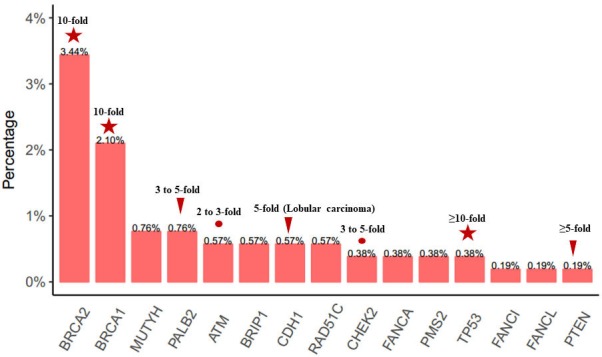
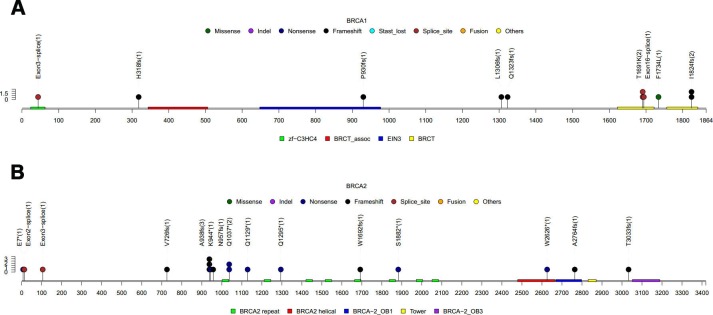
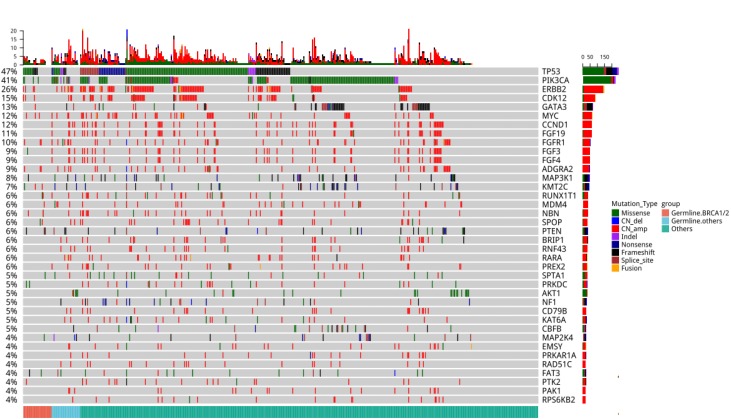
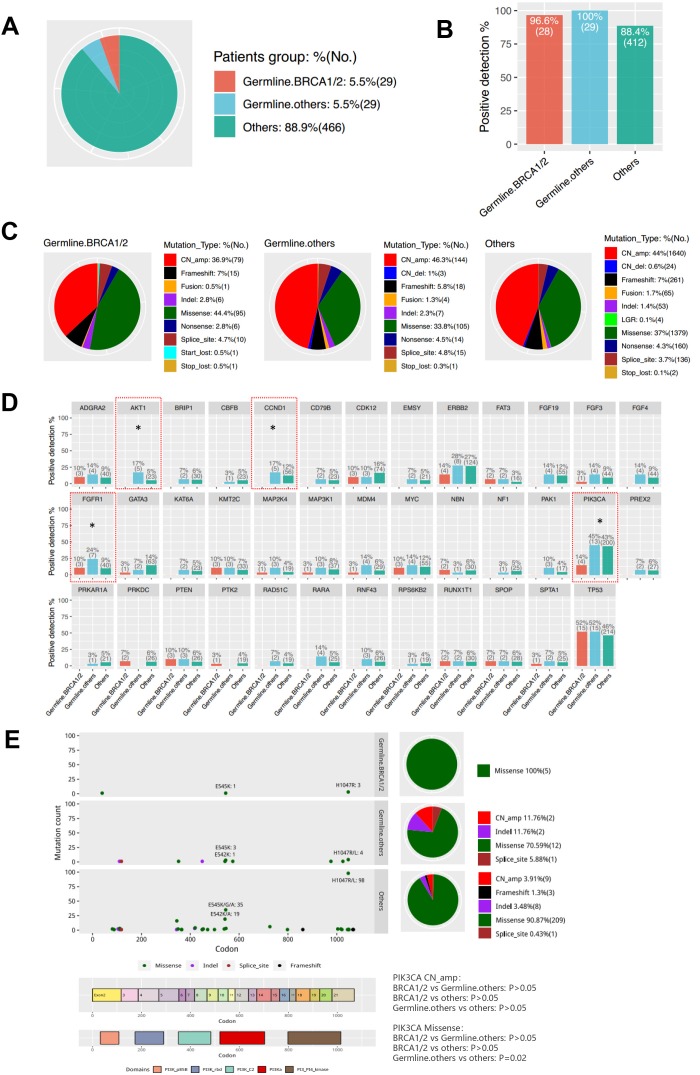
The data on the phenotypes associated with some rare germline mutations in Chinese breast cancer patients are limited. The difference in somatic mutation profiles in breast cancer patients with germline BRCA and non-BRCA mutations remains unexplored. We interrogated the germline and somatic mutational profile of 524 Chinese breast cancer patients with various stages unselected for predisposing factors using a panel consisting of 520 cancer-related genes including 62 cancer susceptibility genes. We divided the patients into three groups according to germline mutations: Germline-BRCA1/2, Germline-others (non-BRCA) and Others (non-carriers). A total of 58 patients (11.1%) carried 76 likely pathogenic or pathogenic (LP/P) germline variants in 15 cancer predisposition genes. Germline BRCA1/2 mutations were detected from 29 (5.53%) patients; with 11 (2.10%) BRCA1 carriers and 18 (3.44%) BRCA2 carriers. In addition, LP/P germline mutations were detected in other genes including MUTYH (n=4), PALB2 (n=4), ATM (n=3), BRIP1 (n=3), CDH1 (n=3), RAD51C (n=3), CHEK2 (n=2), FANCA (n=2), PMS2 (n=2), TP53 (n=2), FANCI (n=1), FANCL (n=1) and PTEN (n=1). At least one variant of uncertain significance (VUS) was identified in 490 (93.5%) patients. Young age (P=0.011), premenopausal status (P=0.013), and breast/ovarian cancer family history (P=0.001) were correlated with germline mutations. Germline-BRCA1/2 group was detected with more missense (P=0.02) and less copy-number amplification (P=0.04) than Germline-others group. Meanwhile, Germline-others group and Others group are very similar (P>0.05). The mutation rates of AKT1, CCND1, FGFR1, and PIK3CA were different among the three groups. By investigating all breast and ovarian cancer-related genes listed in the US genetic guidelines, we identified 15 cancer susceptibility genes frequently mutated in the germline of our population and must be included in cancer predisposition screening. Our study contributed a better understanding of the tumor characteristics of patients with LP/P germline mutations.
Keywords: BRCA; breast cancer; germline mutations; non-BRCA; somatic mutations.
Conflict of interest statement
Figures
References
-
- Khatcheressian JL, Wolff AC, Smith TJ, Grunfeld E, Muss HB, Vogel VG, Halberg F, Somerfield MR, Davidson NE, and American Society of Clinical Oncology. American Society of Clinical Oncology 2006 update of the breast cancer follow-up and management guidelines in the adjuvant setting. J Clin Oncol. 2006; 24:5091–97. 10.1200/JCO.2006.08.8575 - DOI - PubMed
-
- Han MR, Zheng W, Cai Q, Gao YT, Zheng Y, Bolla MK, Michailidou K, Dennis J, Wang Q, Dunning AM, Brennan P, Chen ST, Choi JY, et al. Evaluating genetic variants associated with breast cancer risk in high and moderate-penetrance genes in Asians. Carcinogenesis. 2017; 38:511–18. 10.1093/carcin/bgx010 - DOI - PMC - PubMed
Publication types
MeSH terms
Substances
LinkOut - more resources
Full Text Sources
Medical
Research Materials
Miscellaneous