Review
. 2020 May:126:242-252.
doi: 10.1016/j.cortex.2019.12.031. Epub 2020 Jan 28.

Mentalizing during social InterAction: A four component model

Affiliations
Review

Mentalizing during social InterAction: A four component model

Haiyan Wu et al. Cortex. 2020 May.

Abstract

Mentalizing, conventionally defined as the process in which we infer the inner thoughts and intentions of others, is a fundamental component of human social cognition. Yet its role, and the nuanced layers involved, in real world social interaction are rarely discussed. To account for this lack of theory, we propose the interactive mentalizing theory (IMT) -to emphasize the role of metacognition in different mentalizing components. We discuss the connection between mentalizing, metacognition, and social interaction in the context of four elements of mentalizing: (i) Metacognition-inference of our own thought processes and social cognitions and which is central to all other components of mentalizing including: (ii) first-order mentalizing-inferring the thoughts and intentions of an agent's mind; (iii) personal second-order mentalizing-inference of other's mentalizing of one's own mind; (iv) Collective mentalizing: which takes at least two forms (a) vicarious mentalizing: adopting another's mentalizing of an agent (i.e., what we think others think of an agent) and (b) co-mentalizing: mentalizing about an agent in conjunction with others' mentalizing of that agent (i.e., conforming to others beliefs about another agent's internal states). The weights of these four elements is determined by metacognitive insight and confidence in one's own or another's mentalizing ability, yielding a dynamic interaction between these circuits. To advance our knowledge on mentalizing during live social interaction, we identify how these subprocesses can be organized by different target agents and facilitated by combining computational modeling and interactive brain approaches.

Keywords: Co-mentalizing; Mentalizing; Metacognition; Social inference; Vicarious mentalizing.


Figures

Figure 1.
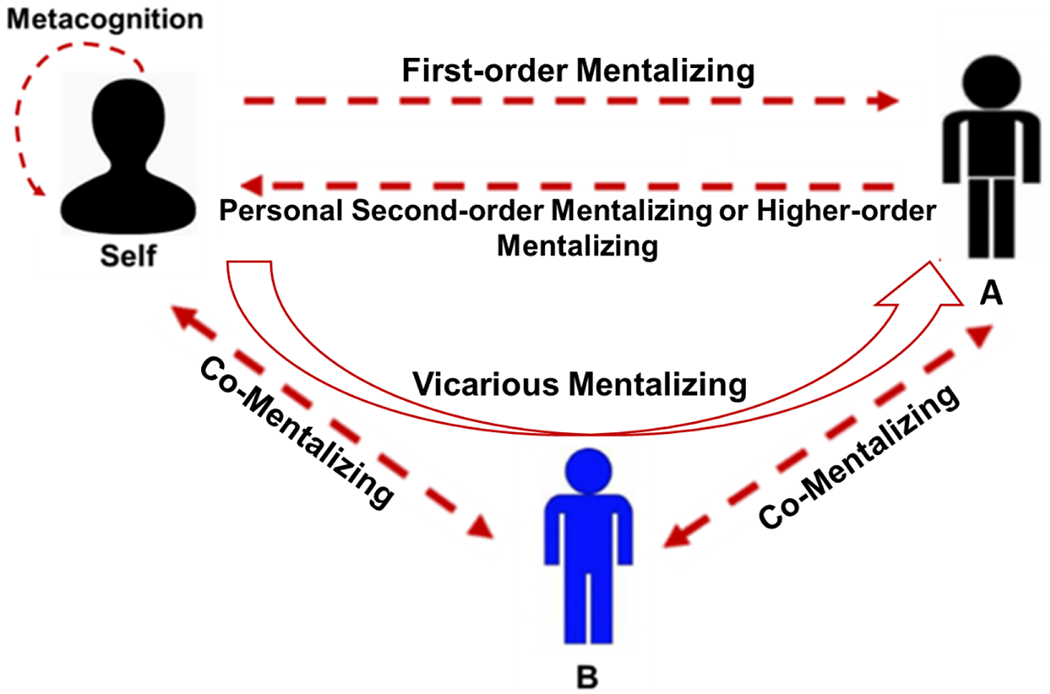
Figure 1.. An depiction of the four elements in our interactive mentalizing theory:
1) First-order mentalizing: mentalizing of others’ mental states from the perspective of the self (i.e., self-other); 2) personal second-order mentalizing/higher-order mentalizing: mentalizing of how much others can mentalize one’s mental states from the perspective of others (i.e., other-self); and 3) vicarious mentalizing: mentalizing of other’s mind from the perspective of others (i.e., other-other); and, 4) co-mentalizing: mentalizing of another’s mind through others in combination with oneself. Metacognitive processes govern the weights we assign to the components within each element. In this figure, the self, A, and B, all could be the mentalizer, and people can mentalize other’s thoughts in a direct or vicarious/indirect way. For example, the self can infer A’s belief by mentalizing A directly or try to infer B’s mentalizing about A.
Figure 2.
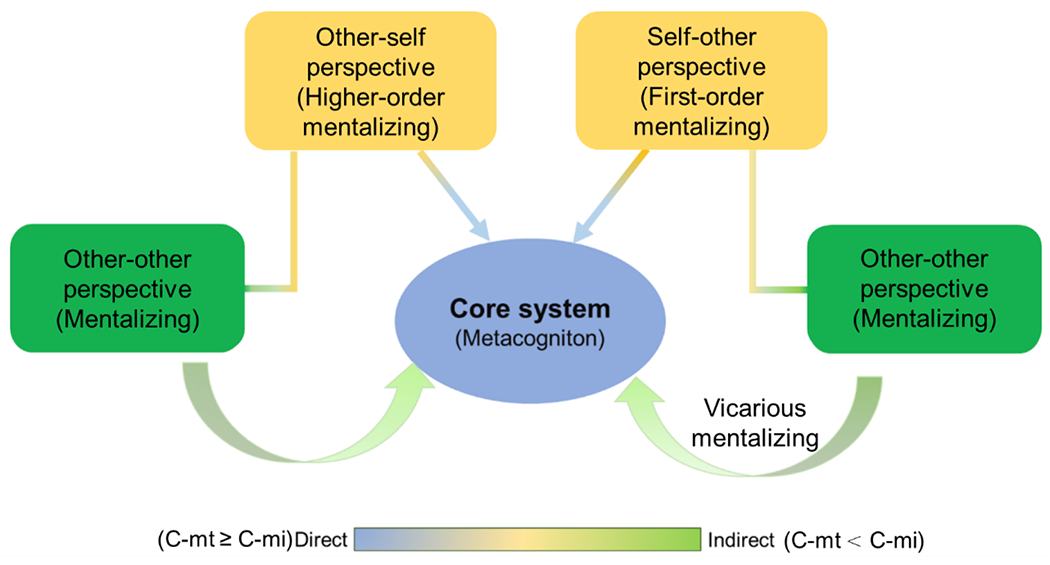
Figure 2.. The box diagram of different inputs of mentalizing in social interaction.
The core metacognition system receives inputs from one’s mental states from the self-other perspective, other-other perspective (e.g., inferring other’s mental state from other’s perspective) and other-self perspective; 2) People rely more on the other-other perspective (Vicarious mentalizing) when the inputs from self-other perspective and other-self perspective are insufficient or with low self-confidence. C-mt: confidence about the mentalizing of the target agent, C-mi: confidence of the mentalizing to the intermediary agent (C-mi).
Figure 3.
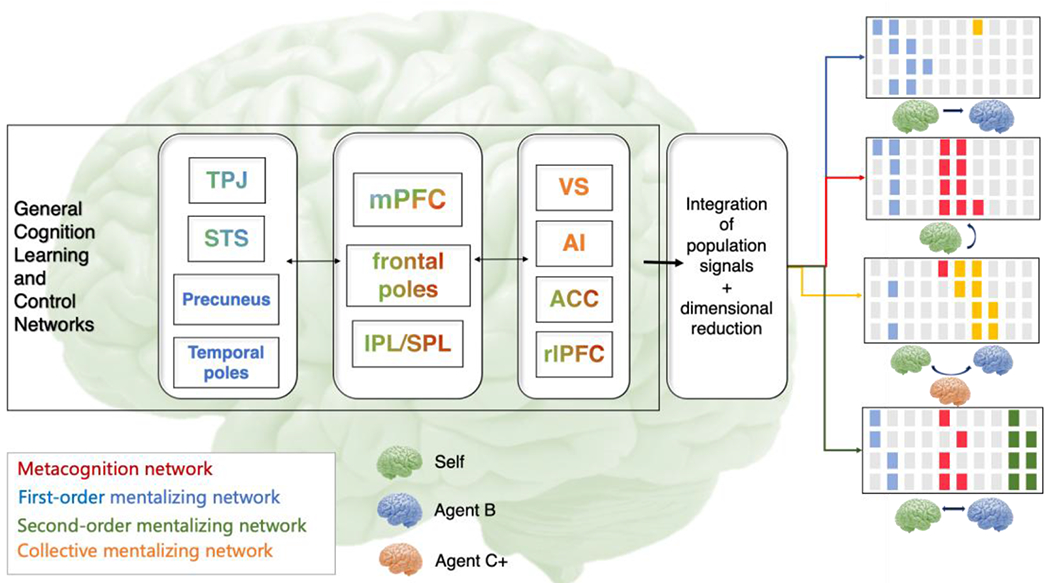
Figure 3.. Simplified model of the different neural networks involved in mentalizing during social interaction.
1) The core metacognitive neural system receives inputs from both first-order and higher-order mentalizing system inputs; 2) anterior cingulate cortex (ACC) and lateral PFC (lPFC) is a junction for both self and other experience/inference, and also encodes prediction errors signal in social learning; 3) metacognitive neural system (mPFC, SPL and reward learning brain area like VS and AI) involved in collective mentalizing; 4) when people share own mentalizing with others and seek other’s mentalizing, the processes can activate all of the four brain systems. The population of cells in these regions create a dynamic social wide brain network in different cases of mentalizing (see the right panel, active neurons are colored, while inactive ones are gray).

References

    1. Apperly IA, Samson D, Chiavarino C, & Humphreys GW (2004). Frontal and temporo-parietal lobe contributions to theory of mind: Neuropsychological evidence from a false-belief task with reduced language and executive demands. Journal of Cognitive Neuroscience, 16(10), 1773–1784. doi:Doi 10.1162/0898929042947928 - DOI - PubMed
    1. Apps MAJ, Lesage E & Ramnani N Vicarious reinforcement learning signals when instructing others. J. Neurosci 35, 2904–2913 (2015). - PMC - PubMed
    1. Andreasen NC, Calage CA, & O’Leary DS (2008). Theory of mind and schizophrenia: a positron emission tomography study of medication-free patients. Schizophrenia bulletin, 34(4), 708–719. - PMC - PubMed
    1. Atique B, Erb M, Gharabaghi A, Grodd W, & Anders S (2011). Task-specific activity and connectivity within the mentalizing network during emotion and intention mentalizing. Neuroimage, 55(4), 1899–1911 - PubMed
    1. Bahrami B, Olsen K, Bang D, Roepstorff A, Rees G, & Frith C (2012). What failure in collective decision-making tells us about metacognition. Philos Trans R Soc Lond B Biol Sci, 367(1594), 1350–1365. doi:10.1098/rstb.2011.0420 - DOI - PMC - PubMed

Publication types

LinkOut - more resources