Review
. 2020 Feb 19;10(2):326.
doi: 10.3390/ani10020326.

Glutamine Metabolism and Its Role in Immunity, a Comprehensive Review

Affiliations
Review

Glutamine Metabolism and Its Role in Immunity, a Comprehensive Review

Ali Mujtaba Shah et al. Animals (Basel). .

Retraction in

Abstract

In the body of an animal, glutamine is a plentiful and very useful amino acid. Glutamine consumption in the body of animals in normal or disease conditions is the same or higher than the glucose. Many in vivo as well as in vitro experiments have been conducted to evaluate the importance of glutamine. Glutamine is a valuable nutrient for the proliferation of the lymphocytes. It also plays a crucial role in the production of cytokines, macrophages, phagocytic, and neutrophil to kill the bacteria. Most of the metabolic organs like the liver, gut, and skeletal muscles control the circulation and availability secretion of glutamine. In catabolic and hypercatabolic conditions, glutamine can turn out to be essential and plays a vital role in metabolism; however, availability may be compromised due to the impairment of homeostasis in the inter-tissue metabolism of amino acids. This is why the supplementation of glutamine is commonly used in clinical nutrition and is especially recommended to immune-suppressed persons. Despite this, in catabolic and hyper-catabolic conditions, it is challenging due to the amino acid concentration in plasma/bloodstream and glutamine should be provided via either the oral, enteral or parenteral route. However, the effect of glutamine as an immune-based supplement has been previously recognized as many research studies conducted in vivo and in-vitro evaluated the beneficial effects of glutamine. Hence, the present study delivers a combined review of glutamine metabolism in essential organs of the cell immune system. In this review, we have also reviewed the metabolism and action of glutamine and crucial problems due to glutamine supplementation in catabolic conditions.

Keywords: animal; glutamine; immunity; metabolism; nutrition.


Conflict of interest statement

The authors declare no conflict of interest.

Figures
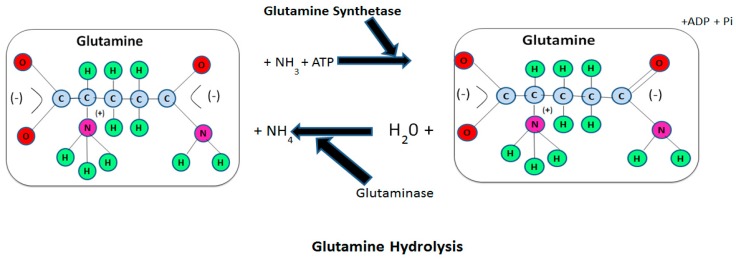
Figure 1
Figure 1
Synthesis and hydrolysis of Glutamine. Glutamine is mostly synthesized and hydrolyzed through the enzymes glutamine synthetase (GS) and glutaminase (GLS), respectively. GS catalyzes glutamine biosynthesis through ammonia and the glutamate source. In response, one adenosine triphosphate (ATP) is utilized. Many amino acids (exogenously or endogenously) provide the glutamate through catabolism. Moreover, GLS is responsible for the hydrolysis of the glutamine and the formation of glutamate and ammonia ion (NH4). Nearly all body cells express GLS and GS and their primary expression and function is carried out if the tissue is more likely to synthesize or utilize the glutamine in normal or disease conditions.
Figure 2
Figure 2
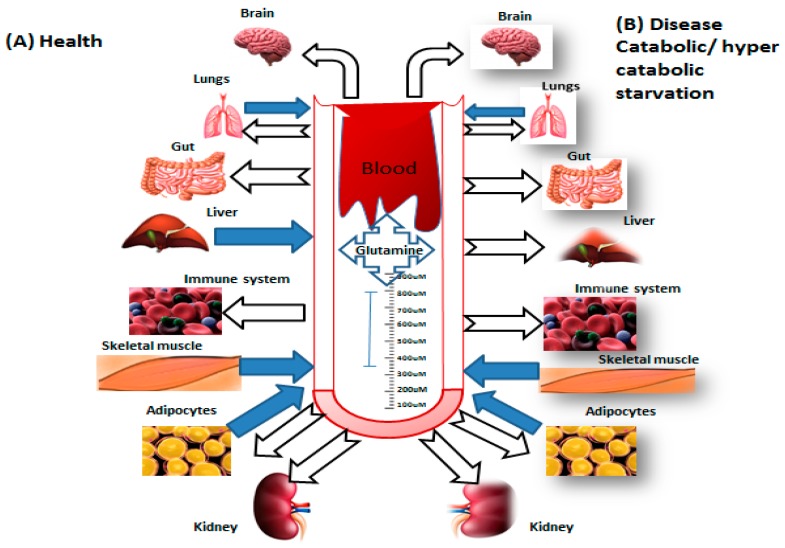
Glutamine production and utilization inside the tissue in health and disease conditions. The blue arrows designate tissue that shows the activity of GS and thus, the synthesis of glutamine; The white arrows designate tissue that shows the activity of GS and thus, the utilization of glutamine. In healthy or in fed conditions, glutamine stocks are equal in plasma and tissues and are sustained mostly by the liver and skeletal muscles. There are two major sites for the storage of glutamine in the body. Alternatively, immune cells enormously depend on glucose and glutamine in condition (A), and more in condition (B). While the GIT is a principal place for the utilization of the glutamine in condition (B), glutamine utilization from both the basolateral and luminal membranes is increased when compared to condition (A). Furthermore, the liver changes its role from chief glutamine producer to chief glutamine consumer to sustain gluconeogenesis and the entire body depends on the skeletal muscle’s ability to sustain the glutamine concentrations. The current reaction is typically accompanied by a dramatic upsurge proteolysis of muscle, cachexia, and atrophy. The adipose tissue and lungs exhibit enzymes GS and GLS, and hence, can synthesize and utilize glutamine in conditions (A,B). The kidneys and brain do not exhibit GS, only GLS, and hence, are mostly reliant on the availability of plasma glutamine in conditions (A,B).

References

    1. Ehrensvärd G., Fischer A., Stjernholm R. Protein Metabolisiu of Tissue Cells in Vitro. 7. The Chemical Nature of Some Obligate Factors of Tissue Cell Nutrition. Act. Phys. Scandi. 1949;18:218–230. doi: 10.1111/j.1748-1716.1949.tb00614.x. - DOI - PubMed
    1. Grohmann U., Mondanelli G., Belladonna M.L., Orabona C., Pallotta M.T., Iacono A., Puccetti P., Volpi C. Amino-acid sensing and degrading pathways in immune regulation. Cytokine Growth Factor Rev. 2017;35:37–45. doi: 10.1016/j.cytogfr.2017.05.004. - DOI - PubMed
    1. Cruzat V.F., Pantaleão L.C., Donato J., Jr., de Bittencourt P.I.H., Jr., Tirapegui J. Oral supplementations with free and dipeptide forms of L-glutamine in endotoxemic mice: Effects on muscle glutamine-glutathione axis and heat shock proteins. J. Nutr. Biochem. 2014;25:345–352. doi: 10.1016/j.jnutbio.2013.11.009. - DOI - PubMed
    1. Newsholme P. Why is L-glutamine metabolism important to cells of the immune system in health, postinjury, surgery or infection. J. Nutr. 2001;131:2515S–2522S. doi: 10.1093/jn/131.9.2515S. - DOI - PubMed
    1. Cruzat V.F., Krause M., Newsholme P. Amino acid supplementation and impact on immune function in the context of exercise. J. Int. Soc. Sports Nutr. 2014;11:61. doi: 10.1186/s12970-014-0061-8. - DOI - PMC - PubMed

LinkOut - more resources