


Comparison of Lateral Abdominal Musculature Activation during Expiration with an Expiratory Flow Control Device Versus the Abdominal Drawing-in Maneuver in Healthy Women: A Cross-Sectional Observational Pilot Study
- PMID: 32092978
- PMCID: PMC7074045
- DOI: 10.3390/medicina56020084
Comparison of Lateral Abdominal Musculature Activation during Expiration with an Expiratory Flow Control Device Versus the Abdominal Drawing-in Maneuver in Healthy Women: A Cross-Sectional Observational Pilot Study
Abstract
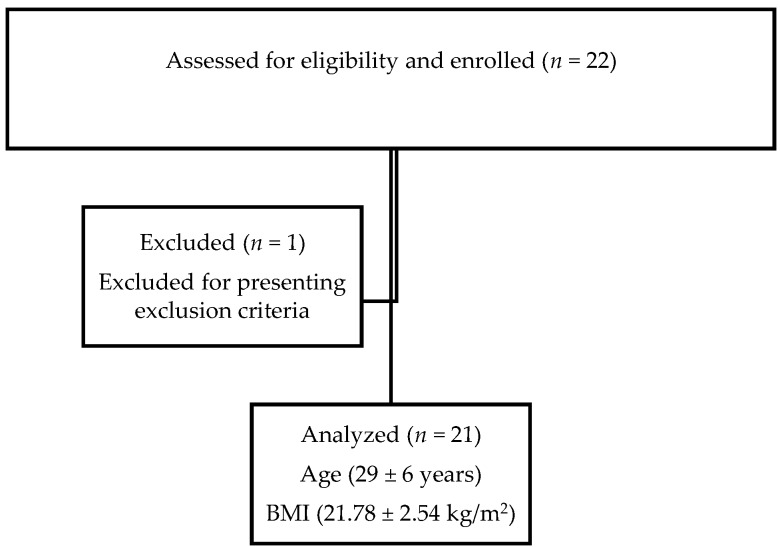
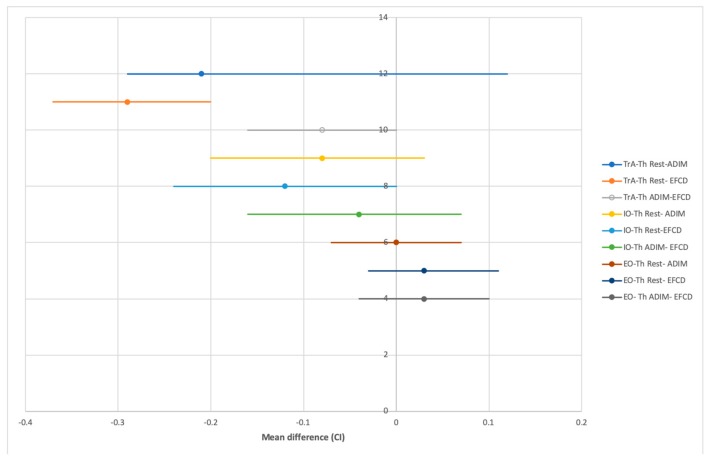
Background and Objectives: The purpose of the present study was to quantify and compare lateral abdominal musculature thickness, including the transverse abdominis (TrA), internal oblique (IO), and external oblique (EO) muscles, via rehabilitative ultrasound imaging (RUSI) during the use of the expiratory flow control device (EFCD) versus the classic abdominal drawing-in maneuver (ADIM). Materials and Methods: A cross-sectional observational pilot study. Twenty-one women were recruited and assessed the thickness of each muscle (TrA, IO, and EO) by ultrasound imaging at rest, during the ADIM, and during expiration with the EFCD. Waist circumference was also measured under the same circumstances. Results: Statistically significant differences were observed between ADIM, EFCD, and at rest condition for the thickness of the TrA (p = 0.001) and IO (p = 0.039). Moreover, statistically significant differences for TrAb at rest compared with the ADIM (p = 0.001, Cohen's d = 2.183) and at rest and with the EFCD (p = 0.001, Cohen's d = 2.843). In addition, between ADIM and EFCD were not statistically significant, although a moderate effect size was found (p = 0.055, Cohen's d = 0.694). For the IO muscle thickness, significant differences were reported between the EFCD and at rest (p = 0.038), Cohen's d = 0.081). Conclusions: Significant differences in the increase of the thickness of the TrA and IO muscles during the use of the EFCD and the ADIM with respect to rest. In addition, for the TrA, statistically significant differences were found during expiration with the EFCD with respect to the ADIM. Expiration with EFCD can be a useful method for the activation of the TrA.
Keywords: abdominal drawing-in maneuver; abdominal muscles; muscle activity; ultrasonography.
Conflict of interest statement
The authors of this publication declare that they have no financial interests that relate to the research described in this paper.
Figures

References
-
- Paulsen F., Waschke J. Sobotta Atlas of Human Anatomy. 15th ed. Volume 1. Elsevier Health Sciences; Berlin, Germany: 2013. English: General Anatomy and Musculoskeletal System; p. 412.
-
- Hides J., Wilson S., Stanton W., McMahon S., Keto H., McMahon K., Bryant M., Richardson C. An MRI investigation into the function of the transversus abdominis muscle during “drawing-in” of the abdominal wall. Spine (Phila Pa 1976) 2006;31:E175–E178. doi: 10.1097/01.brs.0000202740.86338.df. - DOI - PubMed
Publication types
MeSH terms
LinkOut - more resources
Full Text Sources
